Moonshot AI Explained: Kimi K3, Valuation & IPO (2026)
Moonshot AI is one of the most talked-about names in artificial intelligence right now. The Beijing startup builds the Kimi assistant, and in July 2026 it released Kimi K3 — the largest open-weight AI model in the world. The launch pushed the company’s reported valuation to $35 billion and put a Hong Kong IPO on the table. This guide explains what Moonshot AI is, what Kimi K3 can do, where the money is coming from, and whether the model is safe to use.
By the aiera.blog Editorial Team • Updated August 2026
What Is Moonshot AI?
Moonshot AI is a Chinese AI company founded in March 2023 in Beijing. It is best known for Kimi, a family of large language models and a chatbot used by millions of people. Investors count it among China’s “Six AI Tigers” — the group of well-funded startups racing to build frontier models.
The company was co-founded by Yang Zhilin, Zhou Xinyu, and Wu Yuxin. Yang Zhilin, the CEO, studied at Tsinghua University and earned his PhD at Carnegie Mellon, where he co-authored well-known research papers such as Transformer-XL and XLNet. He also worked at Google before starting the company. That background gives Moonshot AI strong technical credibility.
The company made its name early with long context. When Kimi first launched in October 2023, it could handle about 200,000 Chinese characters in a single conversation — one of the longest context windows any commercial model offered at the time. That focus on reading long documents became Moonshot’s signature strength, and it still shapes the products today. Consumer interest cooled through 2025 as Chinese AI competition grew, so Moonshot changed course and began open-sourcing strong models to win back developers. That pivot led directly to Kimi K2 and, later, Kimi K3.
One point often confuses new readers, so it helps to separate three things. Moonshot AI is the company. Kimi is the chatbot you open in a browser or app. Kimi K3 is the underlying model — the engine that powers the chatbot, which Moonshot also publishes so developers can run it themselves. The company’s Chinese name, 月之暗面 (Yue Zhi Anmian), means “Dark Side of the Moon,” a nod to the Pink Floyd album.
Kimi K3: Moonshot AI’s Flagship Model
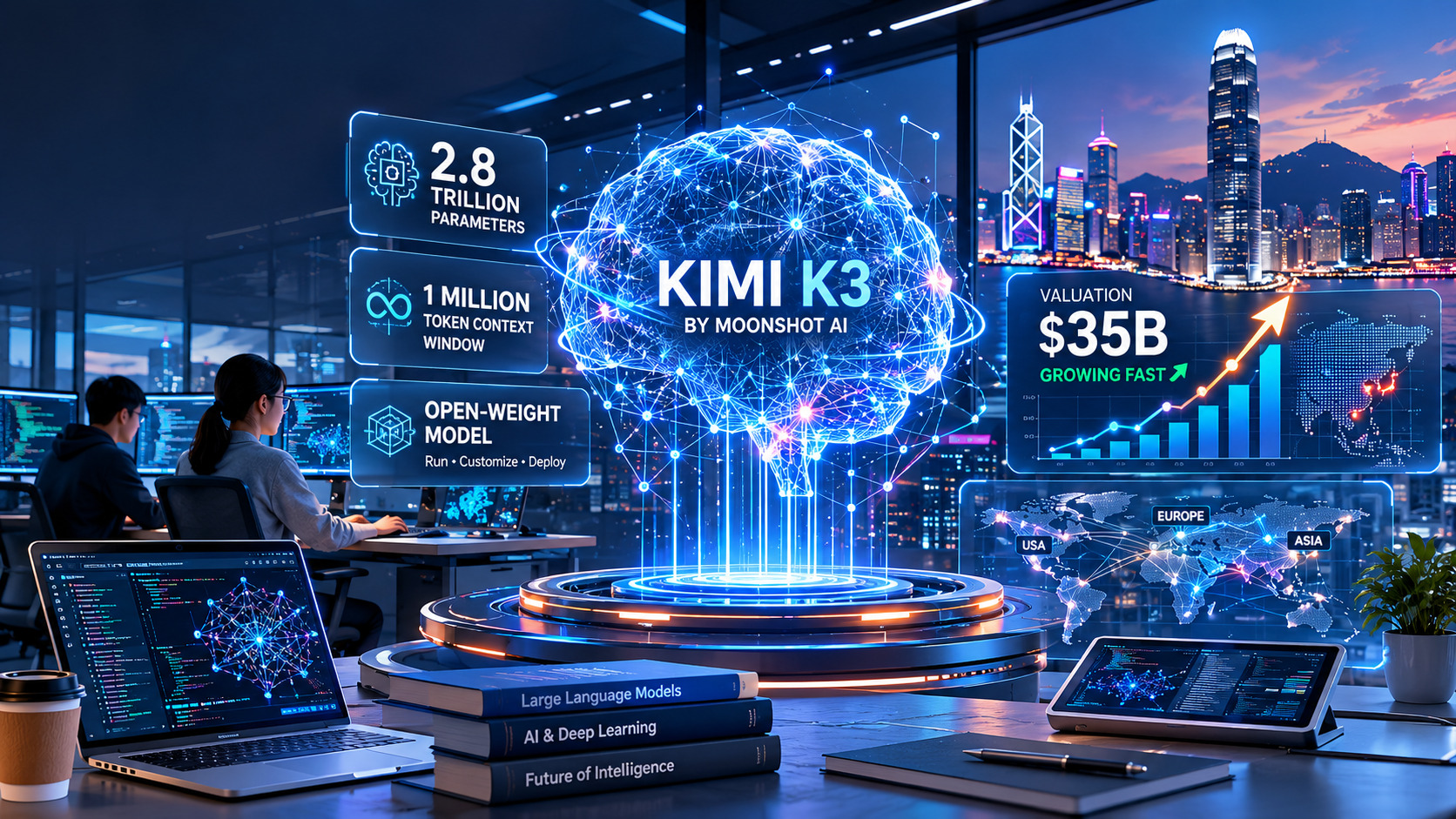
Moonshot AI released Kimi K3 in mid-July 2026, and it quickly drew global attention. The model is trained on roughly 2.8 trillion parameters, which makes it the largest open-weight large language model available today. It also has a 1-million-token context window, so it can read very long documents or entire codebases in a single pass.
The company later released the model’s weights for public download, which lets developers run and fine-tune Kimi K3 on their own hardware. According to reporting by Fortune, Moonshot said K3 performed “competitively” with Anthropic’s Fable 5, currently one of the strongest models on the market.
Independent benchmarks backed up some of that claim. On Vals AI’s overall testing, Kimi K3 ranked second — below Fable 5 but above OpenAI’s GPT-5.6 Sol. On Arena.ai, it placed first for building web interfaces. Like other agentic AI systems we have covered, K3 is built for long-horizon coding, deep reasoning, and multi-step tasks, not just simple chat.
Why does an open-weight model matter so much? When a company publishes its weights, any developer can download the model, run it privately, and adjust it for their own product without paying for every request. Kimi K2 did this in 2025 and topped Hugging Face downloads on launch day, which some people called “another DeepSeek moment.” Kimi K3 pushes that idea further by offering near-frontier quality in a model anyone can host. For startups watching their budgets, that combination is hard to ignore.
Every Kimi Model, From K1.5 to K3
Kimi has moved fast since its first release. The table below shows the main versions and what each one added.
| Model | Released | Key highlight |
|---|---|---|
| Kimi (first version) | October 2023 | 128,000-token context; one of the first with such long memory |
| Kimi k1.5 | Early 2025 | Strong math, coding, and multimodal reasoning |
| Kimi K2 | July 2025 | Open-weight model (~1T parameters); topped Hugging Face downloads |
| Kimi K2 Thinking | Late 2025 | Focus on agentic tasks and step-by-step reasoning |
| Kimi K2.5 | January 2026 | Native multimodal support via the MoonViT vision encoder |
| Kimi K2.6 | April 2026 | Open-weight update with Agent Swarm capabilities |
| Kimi K3 | July 2026 | ~2.8T parameters; largest open-weight model; 1M-token context |
Moonshot AI Valuation, Funding, and the IPO Plan
The Kimi K3 launch did more than win benchmarks. It also triggered a wave of investor interest. In late July 2026, Moonshot AI closed a funding round of about $3.5 billion at a reported valuation of $35 billion, according to Bloomberg. That was far above the $1 billion to $2 billion the company first targeted.
The speed of that rise is striking. Moonshot was valued at roughly $4.3 billion in early 2026. By June it had climbed toward $30 billion, and after the K3 round it reached $35 billion — a jump of several times in about a year. Few technology companies anywhere have re-priced that quickly.
Moonshot AI is backed by major names. Alibaba is an early investor and holds a large stake, and other backers include Tencent, Meituan, IDG Capital, HongShan, China Mobile, and China’s National AI Industry Investment Fund. The same fund also supports rival DeepSeek.
The company is not finished raising money. Reports say it is approaching investors for another round at a pre-money valuation of up to $50 billion, ahead of a possible Hong Kong IPO that could happen as soon as the end of 2026. Its annual recurring revenue reportedly reached $300 million in June, up from $100 million in March. Demand for Kimi K3 was so high that Moonshot briefly paused paid subscriptions for new consumer users soon after launch.
The K3 news also rattled technology stocks, in a moment some compared to DeepSeek’s earlier shock. We covered that market reaction in our piece on the AI-driven sector rotation on Wall Street.
Note: Moonshot AI is a private company and does not publish audited financials, so the figures above come from press reports. This article is for information only and is not investment advice.
Kimi K3 vs Its Rivals
Kimi K3’s main appeal is simple: near-frontier performance at a much lower cost, with weights you can download. Here is how it sits against the models it is most often compared to.
| Model | Company | Open weights? | Positioning |
|---|---|---|---|
| Kimi K3 | Moonshot AI (China) | Yes — downloadable | Largest open-weight model; cheaper to run |
| Fable 5 | Anthropic (US) | No | Current frontier benchmark leader |
| GPT-5.6 | OpenAI (US) | No | Widely used general-purpose model |
| DeepSeek | DeepSeek (China) | Yes | Earlier Chinese open-weight disruptor |
The closed US models still lead the very top benchmarks. But for many developers, an open-weight model that is cheaper to run and free to fine-tune is more useful than a slightly stronger one they can only rent through an API. That trade-off is the heart of the current China–US AI race.
Moonshot AI is not alone in China, either. Rivals such as DeepSeek, MiniMax, and Zhipu (Z.ai) are releasing capable models of their own, often at low prices. This crowded field is one reason Chinese labs keep shipping new versions so quickly — each one is trying to stay ahead of the others as much as it is trying to catch the US leaders.
Is Kimi Safe to Use? The Open-Weight Question
“Open weight” is not the same as fully open source. Moonshot AI releases the model’s trained parameters, so you can run and adapt Kimi K3 yourself. It does not release everything about how the model was built, such as the full training data. For most users this difference does not matter, but it is worth knowing.
Because Moonshot AI is a Chinese company, some governments and large firms in the US are cautious about Chinese AI models, especially for sensitive or regulated work. At the same time, the technology is drawing serious enterprise attention: Microsoft has reportedly been evaluating Kimi K3 for use in Copilot. This is the balance many teams now weigh — strong, low-cost capability on one side, and data and governance questions on the other.
Our general advice at aiera.blog is practical. For casual tasks, brainstorming, and coding help, Kimi is a capable free tool. For confidential company data, legal work, or anything regulated, review your own data-handling rules first, just as you would before adopting any AI model. If you want a US-based alternative for that kind of work, see our guide to Anthropic’s Claude.
How to Use Kimi
Getting started with Kimi is straightforward. You can use it in several ways:
- Web: Open kimi.com in any browser.
- Mobile apps: Kimi is available on iOS and Android.
- API: Developers can build on Kimi through Moonshot AI’s platform at moonshot.ai.
- Self-hosted: The open weights can be downloaded and run on your own hardware.
Kimi offers a free tier, so most people can try it at no cost. Keep in mind that after the Kimi K3 launch, Moonshot briefly paused new paid subscriptions for consumer users because demand was higher than expected, so paid access may vary over time.
Frequently Asked Questions
Who owns Moonshot AI?
Moonshot AI is a private company. Alibaba is an early investor with a large stake, and other backers include Tencent, Meituan, IDG Capital, and China Mobile. No single outside investor controls the company.
Is Kimi free to use?
Yes, Kimi has a free tier on the web and in its apps. After the Kimi K3 launch, Moonshot briefly paused new paid subscriptions for consumer users due to very high demand, so paid options may change.
Is Kimi K3 open source?
Kimi K3 is open weight, not fully open source. You can download and run the trained model, but Moonshot does not release everything about how it was built, such as the full training data.
Is Kimi better than ChatGPT?
It depends on the task. On some benchmarks Kimi K3 ranks above OpenAI’s GPT-5.6, and it is cheaper to run. US models still lead certain top benchmarks, so there is no single winner for every use case.
Who is the CEO of Moonshot AI?
Yang Zhilin is the co-founder and CEO of Moonshot AI. He holds a PhD from Carnegie Mellon and co-authored well-known AI research papers before starting the company.
How big is Kimi K3’s context window?
Kimi K3 has a context window of up to 1 million tokens. That means it can read very long documents, long chat histories, or large codebases in a single request without losing track of earlier details.
The Bottom Line
Moonshot AI has moved from a young Beijing startup to a $35 billion company in about a year, driven by Kimi K3 and a smart bet on open-weight models. Whether it reaches a $50 billion valuation and a Hong Kong IPO will depend on how the model competes over the next year. For now, Kimi K3 is a clear sign that the gap between Chinese and US AI is closing fast. We will keep tracking Moonshot AI and the wider model race here at aiera.blog.