WeBuyBricks AI LEGO Sorting Machine: How the Brick-o-Matic Works
The WeBuyBricks AI LEGO sorting machine is an industrial-scale system designed to solve a surprisingly difficult problem: identifying thousands of different LEGO pieces from large mixed collections and sorting them into useful groups.
The UK company calls the machine Brick-o-Matic.
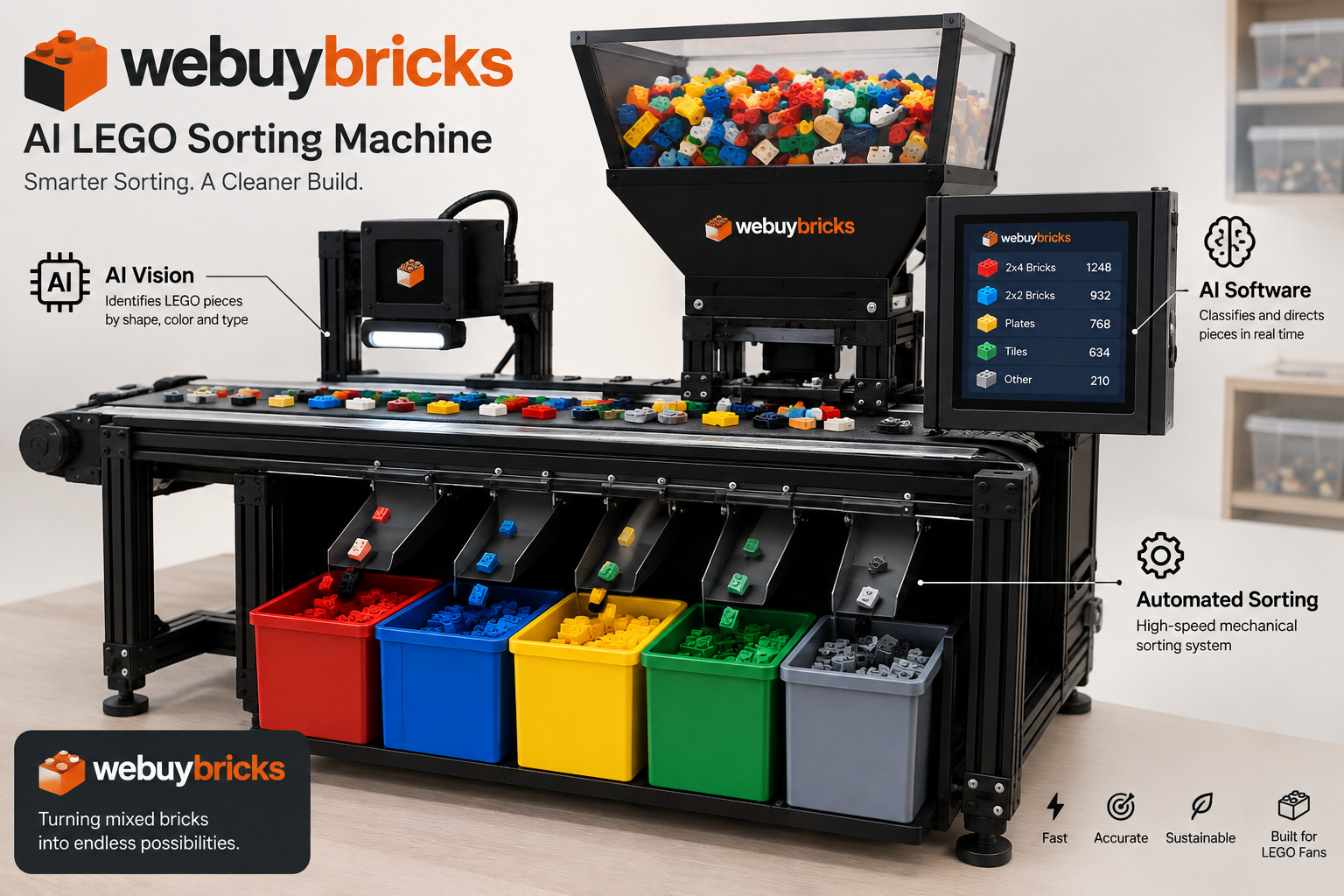
Instead of asking employees to inspect every loose brick manually, the system combines cameras, conveyor belts, artificial intelligence software and air jets. It detects individual pieces, identifies what they are and directs them into the appropriate container.
WeBuyBricks says the machine was developed because manually sorting large quantities of LEGO pieces was becoming impractical as its second-hand brick operation grew.
The interesting part is not simply that AI can recognize a LEGO brick. The system has to distinguish between thousands of extremely similar parts, colours, shapes and sizes while the pieces are moving through a physical production line.
That turns what sounds like a simple image-recognition task into a real industrial automation challenge.
What Is the WeBuyBricks AI LEGO Sorting Machine?
Brick-o-Matic is a custom sorting system developed by WeBuyBricks, a company based in Rawtenstall, Lancashire.
WeBuyBricks buys unwanted LEGO collections, including loose bricks and incomplete sets, then cleans and processes the pieces for resale.
The Brick-o-Matic was created to automate one of the most time-consuming parts of that process: identifying individual pieces.
According to WeBuyBricks, the machine is more than 10 metres long.
It combines several technologies:
- Conveyor systems
- Cameras
- AI-based image recognition
- Object detection
- Part classification
- Sorting containers
- Air jets that redirect pieces
The company worked with specialist partners including Monk Conveyors and PECAP Technology during development.
How Does the WeBuyBricks AI LEGO Sorting Machine Work?
Brick-o-Matic does not simply look at a pile and immediately know what every piece is.
The process happens in stages.
Step 1: LEGO pieces enter the conveyor
Mixed bricks are fed onto the sorting system.
The machine needs the pieces to move through the inspection area individually enough for the cameras and software to examine them.
This is important because overlapping pieces would make visual identification much more difficult.
Step 2: Cameras capture each piece
As a piece travels along the conveyor, cameras capture images of it.
The visual information is then passed to the AI system.
The system needs to recognize more than basic characteristics such as whether an object is red, blue or yellow.
It may need to distinguish between parts that have very similar shapes or colours.
Step 3: An object detector finds the piece
WeBuyBricks describes the first software stage as an object detector.
Object detection is a computer-vision technique that identifies where an object appears inside an image.
In this case, the software first needs to determine that a LEGO piece is present and locate it within the camera image.
Step 4: A classifier identifies the exact part
Once the object has been detected, another part of the system attempts to determine exactly which piece it is.
This stage is known as classification.
That difference matters.
Object detection answers something like:
“Where is the brick?”
Classification attempts to answer:
“Which brick is it?”
The second question is much harder.
How Was the AI Trained to Recognize LEGO Pieces?
Machine-learning systems need examples before they can reliably classify objects.
WeBuyBricks trained Brick-o-Matic by sending known LEGO pieces through the system and photographing them from multiple angles.
Those images were added to a database used to train the recognition system.
The process gives the model examples of what particular pieces look like under different orientations.
A brick may look dramatically different depending on whether the camera sees it from the top, side, underside or at an angle.
A good training dataset therefore cannot rely on one clean photograph of each piece.
The model needs enough visual variation to recognize the same item in real production conditions.
Why Is AI LEGO Sorting So Difficult?
At first glance, LEGO bricks seem like ideal objects for computer vision.
They have defined shapes and relatively consistent manufacturing.
The difficulty appears when the number of possible parts becomes very large.
WeBuyBricks says the sorting problem involves tens of thousands of different combinations of shapes, sizes and colours.
The company’s technical explanation refers to more than 80,000 different shapes, sizes and colour combinations being relevant to the task.
Colour recognition creates another challenge.
There are more than 100 LEGO colours represented across different products and eras, according to WeBuyBricks, and several shades can appear extremely similar to a camera.
Lighting, shadows, surface wear and the orientation of a brick can further affect how the colour appears.
A system that only recognized broad categories such as “red brick” or “grey plate” would therefore not be enough for rebuilding specific sets.
How Fast Can Brick-o-Matic Sort LEGO Pieces?
This is one area where published figures need some context.
WeBuyBricks says the conveyor processes roughly two pieces per second.
In its own detailed explanation of the machine, the company says that this can amount to approximately 40,000 pieces during an eight-hour working day.
Separate recent reporting has described the machine as having capacity for up to 100,000 pieces per day.
These numbers are not necessarily contradictory because daily capacity can depend on operating hours, throughput and how the system is configured.
The safest conclusion is that Brick-o-Matic can process tens of thousands of pieces in a normal operating period, with reported maximum daily capacity reaching about 100,000.
That is dramatically more scalable than manually inspecting every brick.
What Happens After a Brick Is Identified?
Recognition is only useful if the physical system can act on the result.
Once Brick-o-Matic identifies a piece, it needs to direct that component toward the correct sorting location.
Recent reporting describes the machine using jets of air to push pieces into different metal containers.
This allows the software decision to become a physical sorting action.
The resulting groups can then be used in several ways.
WeBuyBricks says the system can organize pieces:
- By type
- By colour
- Into groups associated with particular sets
- According to other sorting requirements
That flexibility is important because not every batch of used LEGO needs to be processed for the same purpose.
Can Brick-o-Matic Rebuild Complete LEGO Sets?
The machine’s broader goal is to help WeBuyBricks turn mixed second-hand bricks back into usable collections and sets.
However, saying that the AI simply “rebuilds sets automatically” would be an oversimplification.
The machine identifies and sorts individual components.
Once the pieces have been accurately categorized, the company can determine which parts are available for particular sets.
This dramatically reduces the manual work involved in starting from an unsorted box.
The distinction matters because recognition, inventory management and physically assembling a completed set are separate tasks.
Why WeBuyBricks Built the Machine
The business case is straightforward.
Used LEGO collections often arrive as large mixtures of unrelated parts.
Sorting these manually is slow.
WeBuyBricks project staff told the BBC that handling high volumes manually was extremely difficult, making automation important to growing the operation.
The company also argues that keeping bricks in circulation can reduce the number of unwanted pieces being discarded.
Recent reports say the business has processed millions of bricks that might otherwise have gone unused or been thrown away.
Those environmental figures come from the company and should be understood as company-reported totals rather than independently audited recycling statistics.
Is Brick-o-Matic the First AI LEGO Sorting Machine?
No.
AI-assisted LEGO sorting has existed in hobbyist and experimental projects for years.
Creators have previously built systems combining cameras, conveyor belts and machine learning to identify LEGO parts.
For example, developer Daniel West demonstrated a universal AI LEGO sorting project years before the current WeBuyBricks machine.
That does not make Brick-o-Matic unimportant.
The notable difference is scale.
WeBuyBricks is applying similar computer-vision principles inside a commercial operation designed to process large quantities of second-hand pieces.
The innovation is therefore less about inventing the idea of an AI LEGO sorter and more about turning the concept into an industrial workflow.
What Brick-o-Matic Shows About Practical AI
Much public discussion about artificial intelligence focuses on chatbots and generative AI.
Brick-o-Matic shows another side of the technology.
Machine learning can also be valuable when connected to:
- Cameras
- Physical machinery
- Conveyor systems
- Inventory databases
- Robotic or pneumatic sorting mechanisms
The AI does not need to write an essay or create an image.
It performs a narrow but valuable task: recognizing physical objects quickly enough for an automated system to make decisions.
That kind of applied AI may become increasingly common in recycling, manufacturing, logistics and resale businesses.
Limitations of AI-Based LEGO Sorting
The technology should not be treated as perfect.
Computer-vision systems can struggle when objects are:
- Damaged
- Dirty
- Partially hidden
- Poorly lit
- Positioned unusually
- Extremely similar to another item
Training data also needs to expand when new or previously unseen pieces appear.
A commercial sorting operation therefore still needs quality control and human oversight.
AI reduces the amount of manual classification required, but it does not necessarily remove people from the process.
Conclusion
The WeBuyBricks AI LEGO sorting machine is a good example of artificial intelligence solving a very physical problem.
Brick-o-Matic combines cameras, object detection, classification software, conveyors and air jets to identify and sort large quantities of used LEGO pieces.
WeBuyBricks developed the machine because manual sorting was difficult to scale, particularly when dealing with tens of thousands of possible part variations.
The system reportedly processes around two pieces per second, with daily capacity reaching tens of thousands of pieces and potentially up to 100,000 depending on operating conditions.
Most importantly, Brick-o-Matic demonstrates that practical AI is not limited to chatbots.
Sometimes AI’s job is considerably less glamorous but extremely useful: looking at one tiny plastic brick after another and figuring out exactly where each one belongs.
Sources Consulted
- WeBuyBricks, September 2026: “How We Taught the Brick-o-matic Machine to Recognise LEGO Pieces.” Primary source describing the machine’s AI training, object detection, classification, conveyor system and sorting process.
- BBC reporting, September 17, 2026: Coverage of WeBuyBricks, its Rawtenstall operation and the reported capacity of the Brick-o-Matic system.
- The Times, September 2026: Reporting on Brick-o-Matic’s industrial sorting process and WeBuyBricks’ second-hand LEGO business.
- Daniel West project documentation: Historical example of an earlier AI-powered universal LEGO sorting project.
Editorial Transparency Note
Claims requiring final verification: Production-volume figures and environmental totals are primarily company-reported and should be rechecked if this article is substantially updated later.
Expert review: Not required for a general AI technology explainer, although an engineer or computer-vision specialist could review deeper technical claims if added.