Abacus AI Smaug: Three Open Models, Real Benchmarks, and the Personal-AI Shift
The model release cycle has gotten noisy. There is a new leaderboard claim most weeks, and a good number of them quietly stop being true a month later.
So when Abacus.AI released the Smaug line, three open-weight models built for agentic work, the announcement was not the interesting part. The interesting part is that you can download the weights and check the numbers yourself.
Here is what shipped, what the benchmarks actually show, and where this fits if you are running agents for yourself rather than for a company.
What the Smaug Line Actually Is
Three open-weight models, each tuned from a different base for a different slice of agent work. These are not chat models with tool use bolted on afterwards.
| MODEL 1 Smaug Flash Base: DeepSeek V4 Flash 0731 For enterprise self-improving agents, where speed and cost per call matter as much as capability. The workhorse of the line. |
| MODEL 2 Smaug Mini Base: Qwen3.8-27B For multimodal use cases and smaller reasoning tasks. Compact enough to run without reaching for a frontier model. |
| MODEL 3 Smaug Agentic Fine-tuned on Kimi K3 The largest of the three, and their clearest demonstration that the fine-tuning technique keeps paying off at frontier scale. |
All three are on Hugging Face or available through the RouteLLM API.
How They Were Trained
Most fine-tuning runs on synthetic data alone, or on narrow task-specific sets. That is fine for narrow tasks. Agents are a different problem, because an agent plans, calls tools, handles errors and revises itself across dozens of steps before it produces anything useful.
Abacus.AI frames it as a training problem rather than a prompting one. Their recipe mixes human-curated traces from real agent runs with synthetic data built around hard examples. The stated reason for the mix is that heavy synthetic fine-tuning tends to trade a model’s reasoning for surface-level task compliance, so you gain a format and lose some actual capability.
The claim they are testing is that the method scales, producing useful lifts on progressively larger bases. The three models are effectively three points on that curve.
Smaug Flash: Fixing a Specific Failure
Flash is the high-volume option, aimed at the always-on workloads behind Abacus.AI Enterprise deployments.
Its base, DeepSeek V4 Flash, is cheap and fast but has a habit of spinning and losing the plot during long tool-use sessions. That specific behaviour is what the fine-tune goes after.
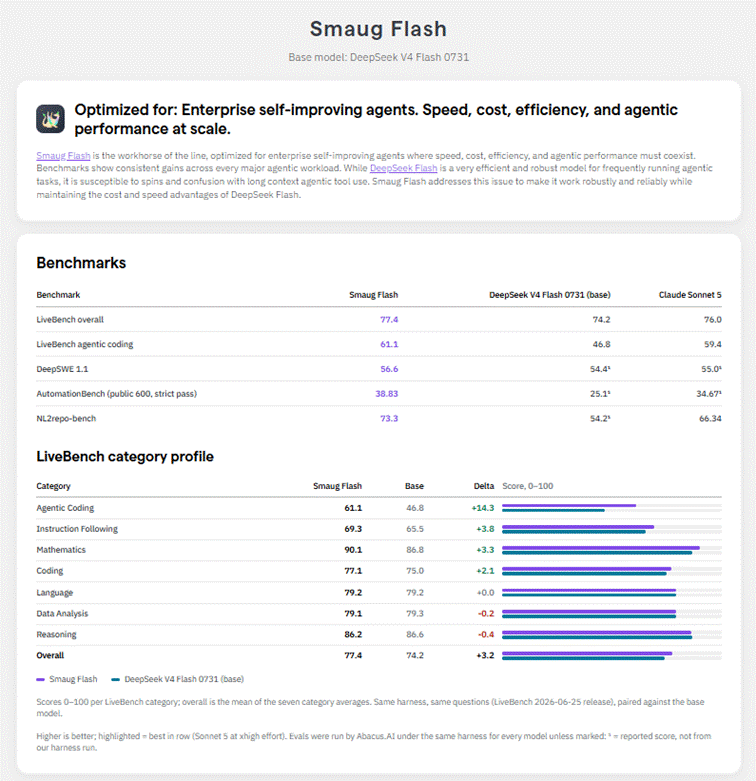
Smaug Flash against its DeepSeek V4 Flash base and Claude Sonnet 5.
It works. Flash posts 77.4 on LiveBench overall against 74.2 for the base and 76.0 for Claude Sonnet 5. On NL2repo-bench it climbs from 54.2 to 73.3.
The number that matters most is agentic coding: 61.1 against 46.8, a gain of 14.3 points. That is the largest single category lift anywhere in the family.
Worth saying plainly: reasoning and data analysis both slip a little. Flash is not better at everything. It is substantially better at the thing it was built to do.
Smaug Mini: Small, and Better Than Expected
Mini runs on Qwen3.8-27B and targets multimodal jobs and lighter reasoning.
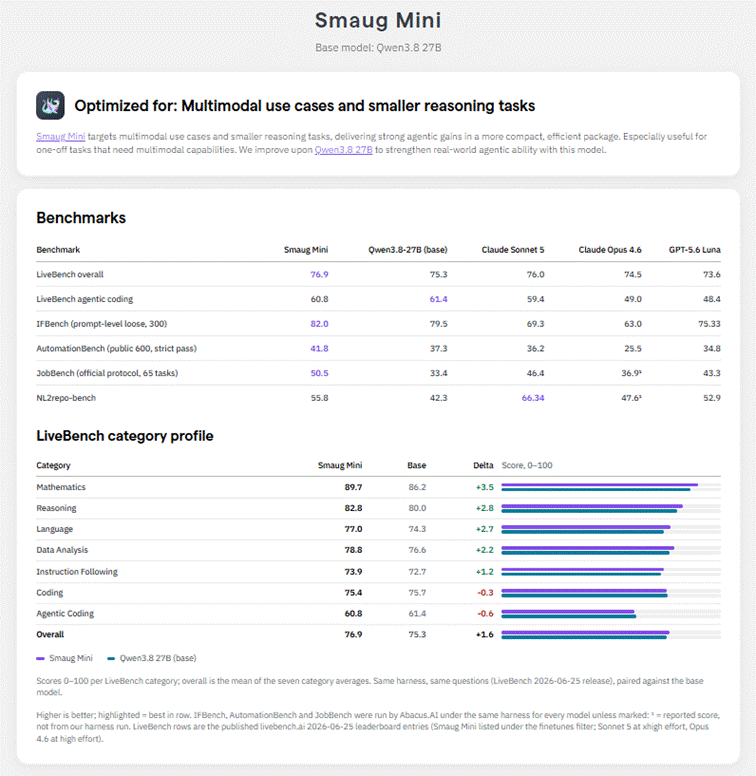
Smaug Mini against its Qwen3.8-27B base, Claude Sonnet 5, Claude Opus 4.6 and GPT-5.6 Luna.
At 76.9 on LiveBench overall it lands ahead of Claude Sonnet 5 at 76.0, Claude Opus 4.6 at 74.5 and GPT-5.6 Luna at 73.6. For a 27B model that is a strong result against much larger systems. JobBench goes from 33.4 to 50.3, and IFBench reaches 82.0.
The category profile is the mirror image of Flash. Mathematics up 3.5, reasoning up 2.8, language up 2.7, with small dips in coding and agentic coding. Mini gains general reasoning. Flash gains tool use. Useful to know when picking between them.
Smaug Agentic: Thin Margins, Real Gains
The flagship, fine-tuned on Kimi K3.
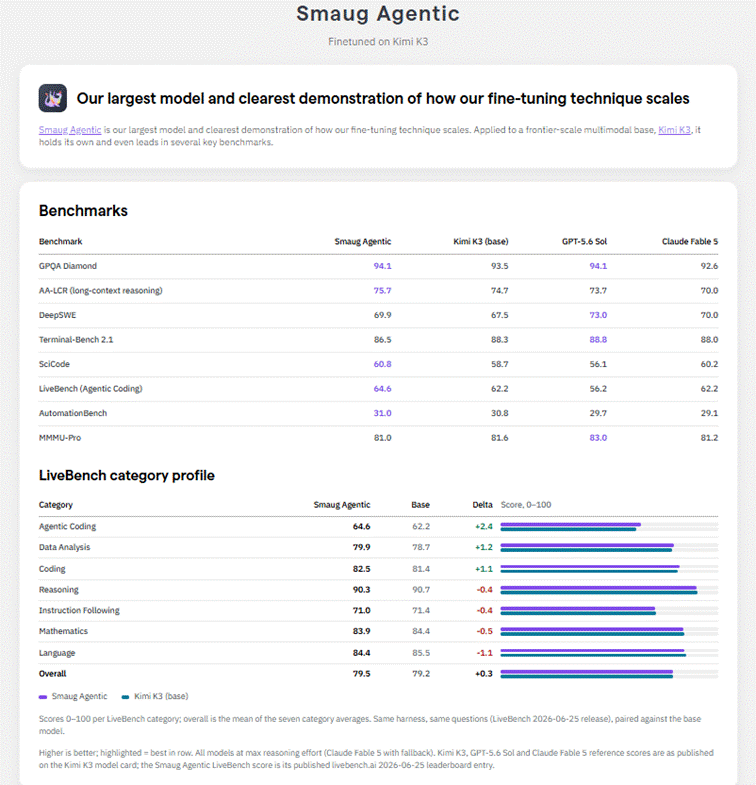
Smaug Agentic across GPQA Diamond, AA-LCR, DeepSWE, SciCode and the LiveBench category profile.
GPQA Diamond reaches 94.1, level with GPT-5.6 Sol and just past the Kimi K3 base at 93.5. AA-LCR, which tests long-context reasoning, comes in at 75.7, the highest in the set. Agentic coding leads at 64.6. It loses on Terminal-Bench 2.1 and DeepSWE.
Overall LiveBench lift is 0.3 points, well below Flash’s 3.2. That is expected, since there is far less headroom above a frontier-scale base. Agentic coding still moves 2.4 points, so the targeted gains hold.
Why LiveBench, and Why That Needs a Caveat
Abacus.AI benchmarks heavily on LiveBench, which is their own benchmark, published as an ICLR Spotlight. A company scoring its own models on its own benchmark is not a neutral arrangement, and that is worth flagging up front.
What holds it up is the design. LiveBench ships new questions every month, drawn from recent AMC12, AIME and IMO problems, LeetCode and AtCoder, Zebra Puzzles, Connections, fresh arXiv abstracts and new Kaggle datasets. Answers are scored against objective ground truth across 17 tasks in six categories.
The contamination worry is not hypothetical for this team. Their paper Data Contamination Through the Lens of Time found statistically significant contamination signals in GPT models by comparing pass rates against problem release dates on Codeforces and Project Euler. LiveBench reads as the response to their own finding.
The Research Trail Behind the Models
The research page and the full publications list are more revealing than the model page, and they go back further than most people expect.
The original Smaug paper is the clearest example. It identified a genuine flaw in Direct Preference Optimisation: when two candidate completions are very similar, standard DPO can actually reduce the model’s likelihood of the preferred one. Their fix, DPO-Positive, produced Smaug-72B, the first open model to pass 80 on the HuggingFace leaderboard.
Giraffe took on context length, surveying extrapolation methods and releasing 13B models at 4k, 16k and 32k. Linear scaling came out ahead.
The rest of the catalogue is wider than LLM work. TabZilla compared 19 algorithms across 176 datasets and concluded the neural-nets-versus-boosted-trees argument is overblown, since light tuning on a gradient-boosted tree usually matters more than the choice itself. ForecastPFN does zero-shot time-series forecasting trained purely on synthetic data, built for cases with 40 observations or fewer. RecZilla predicts which recommender algorithm will suit a dataset nobody has tested yet.
Further back there is neural architecture search work (BANANAS and a study of 31 performance predictors), debiasing during fine-tuning, and Nero, an optimiser that needs almost no hyperparameter tuning. Most of it is catalogued under their open-source work.
The through-line is measurement. These papers are mostly about working out what genuinely helps, then releasing the benchmark so other people can check the answer.
Where Personal Agents Come In
Most of the Smaug framing is enterprise. The more interesting question is what it means for one person running agents for themselves.
A personal agent is not a chatbot you talk to. It is something that reads a long document and files the takeaways, watches a dataset on a schedule, drafts work and revises it against your feedback, or checks a repository and opens a fix when something breaks.
Three things decide whether that is usable day to day.
- Cost per call. A personal agent runs constantly rather than occasionally. If every call is priced like a frontier model, you switch it off after a week. Flash exists for exactly this shape of workload.
- Something you can self-host. Personal context is personal. Mini handles multimodal input at 27B, small enough to self-host. If you would rather your documents, screenshots and receipts never left your machine, that is worth more than a couple of benchmark points.
- Holding up over a long session. The common failure is losing the thread twenty tool calls in. Flash was tuned against precisely that behaviour, and Agentic’s 75.7 on AA-LCR is a long-context reasoning result, not a coding one.
This is the same ground ChatLLM covers on the product side: agents wired into your apps, handling real tasks for individuals and small teams rather than enterprise rollouts. Smaug is the model layer that makes that cheap enough to leave running.
| One honest caveat. None of these benchmarks test a personal workload. Agentic coding, instruction following and long-context recall are reasonable proxies, but they are still proxies. Whether an agent survives a week of your actual inbox is something you have to find out yourself. |
What to Test First
- Smaug Flash. If you run agents at volume. The 14.3 point agentic coding gain is the claim to verify against your own pipeline.
- Smaug Mini. If size or privacy matters. Beating Sonnet 5 on LiveBench overall at 27B is worth checking on your own tasks, especially running locally.
- Smaug Agentic. If long-context reasoning is the bottleneck. Margins over its base are thin, but the AA-LCR result is the strongest in its set.
The Bottom Line
No AGI language, no vague gestures at emergent capability. Strong open bases, tuned for agent work, benchmarked per category with the losses left visible, and weights released so anyone can check. If you are trying to work out where open-weight models actually sit right now, the Smaug line is worth an afternoon of testing.