Opentrons Raises $40 Million to Put AI in Charge of the Lab Bench
Key Takeaways
- Opentrons Series E raised $40 million on 29 October 2026, led by healthcare investor Avego, with participation from BroadOak Capital Partners and existing investors including SoftBank Vision Fund and Khosla Ventures.
- The money will fund robotics, software and data infrastructure for what Opentrons calls autonomous science: AI systems and lab robots that design, execute and learn from experiments in a continuous loop.
- Opentrons says it has deployed more than 11,000 robots to laboratories in more than 80 countries, including at 90% of the top 20 global pharmaceutical companies, every top-20 US research university, and 14 of the top 15 global biopharma companies.
- The company’s Flex platform combines programmable robots with software and AI tools, and its open, API-driven design is meant to make experiments reproducible and their data structured enough for AI to learn from.
- What is not yet proven is the hardest claim: that AI-generated experimental protocols can reliably be converted into repeatable physical results at scale. That is a validation question, not a funding announcement, and the $40 million does not answer it by itself.
Introduction
AI has rewritten the timeline for biological discovery in one half of the process and left the other half almost untouched. Designing a molecule, predicting a protein structure or searching a literature database can now happen in hours. Running the physical experiment — pipetting, mixing, incubating, measuring, repeating — still happens at human speed, on benches, by hand, with all the variability that hands introduce.
Opentrons Labworks, a New York-based lab automation company founded in 2014, has spent a decade trying to close that gap. On 29 October 2026, it announced a $40 million Series E financing, led by healthcare investor Avego, to scale the next phase of that effort: robots, software and data infrastructure that together let AI systems design experiments, run them on physical robots, and learn from the results in a loop. The company calls that vision autonomous science. The funding round is real and well documented. Whether autonomous science, as a working system rather than a slogan, is ready is a harder question — and the most useful way to read this announcement is to separate the installed base Opentrons can prove from the loop it still has to demonstrate.
What Opentrons announced
The announcement, issued from Long Island City, New York, on 29 October 2026, describes Opentrons as “the leader in open, AI-native laboratory automation”. The Series E was led by Avego Management, a healthcare-focused investment firm, with additional investment from BroadOak Capital Partners. Existing investors include SoftBank Vision Fund, Khosla Ventures, Sands Capital, Lerer Hippeau and Y Combinator, according to the company’s announcement and coverage.
The stated uses of the capital are broad but consistent across sources: scaling robotics, software and data infrastructure tools; investing in AI-driven experiment execution; expanding automation capabilities; entering new markets and geographies; accelerating protocol development through software and AI; and deepening integration with the broader lab automation ecosystem. In the company’s own framing, every experiment run on its robots generates structured, reproducible data, “laying the foundation for autonomous science”. The Series E, it says, will fund the phase in which its AI and robotics systems “work together to design, execute and learn from experiments required to achieve its customers’ scientific goals”.
That framing is important because it marks a shift in what Opentrons is selling. Its early pitch was accessibility: programmable, comparatively affordable robots that brought automation to individual academic benches, not just to large centralised facilities. Its current pitch is standardisation: a common execution layer on which AI models and physical labs can meet, with open APIs and shared protocols doing for biology what a common software stack did for computing. The $40 million is, in that telling, not just growth capital for more robots, but infrastructure capital for a standard.
The installed base, and why it matters
Opentrons’ strongest asset in this story is not the funding round; it is the installed base it cites. The company says it has deployed more than 11,000 robots to laboratories in more than 80 countries, including at 90% of the top 20 global pharmaceutical companies, according to its announcement. Other coverage of the same announcement puts the figure at 14 of the top 15 global biopharma companies and every top-20 US research university. Those figures are company figures, not independently audited counts, but they are consistent across the announcement and multiple reports, and they are the reason the autonomous-science claim deserves to be taken seriously.
An installed base of that size does two things that a startup with a prototype cannot do. First, it creates a library of protocols — the step-by-step instructions for experiments — that have actually been run on real hardware, in real labs, with real samples. Opentrons’ open-source approach has, in coverage’s words, “crowdsourced a massive library of open-source protocols”, creating a network effect that legacy competitors, with closed systems, struggle to replicate. Second, it generates structured data at scale. An experiment run on a programmable robot produces a machine-readable record of what was done, in what order, with what volumes and timings. An experiment run by hand produces a notebook entry. For AI training, the difference is decisive: structured, reproducible data is learnable; handwritten notes mostly are not.
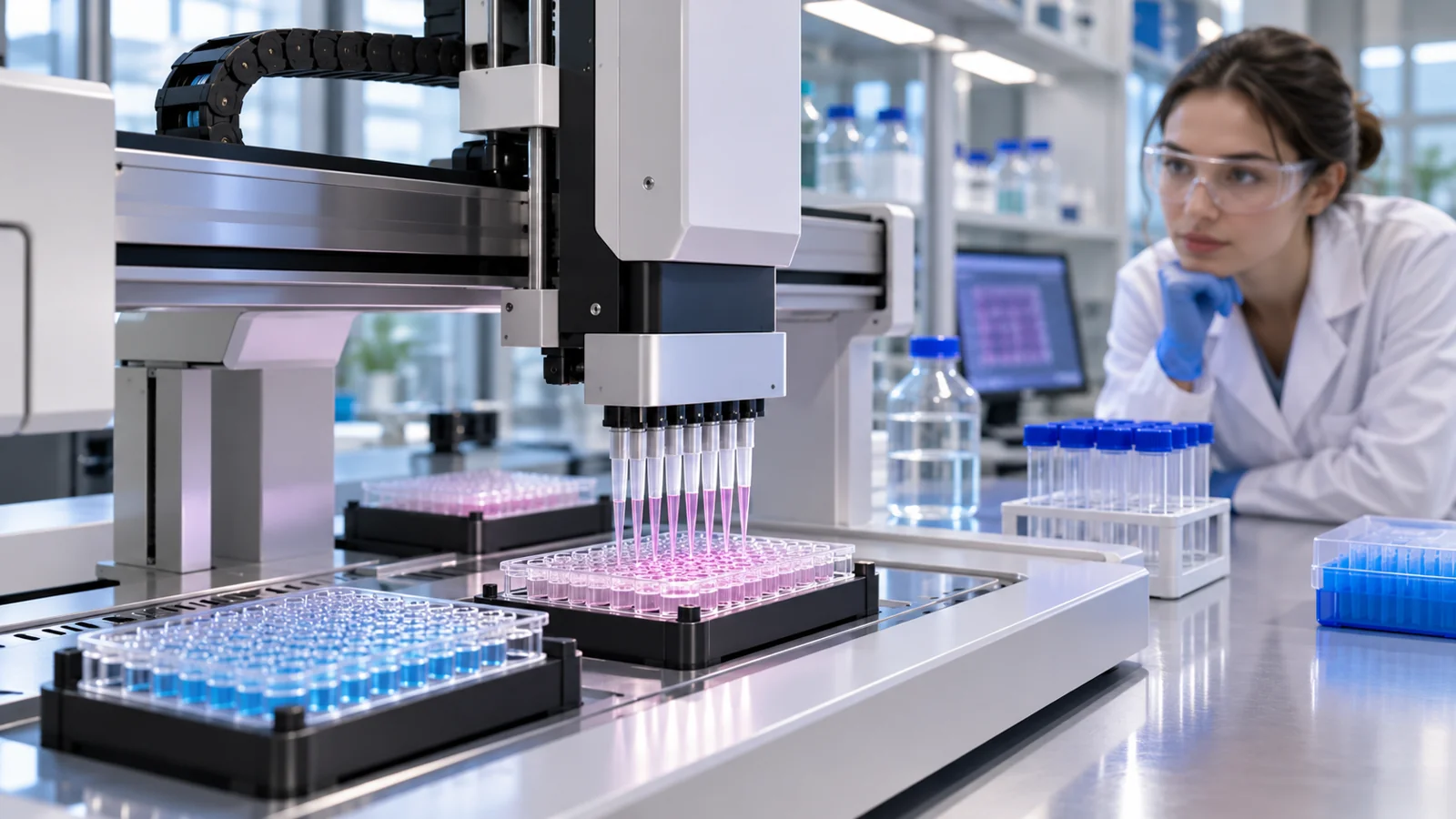
The flagship hardware in this story is the Opentrons Flex platform, which combines robots with software and AI systems that enable experiments to be designed, run and improved in a continuous loop. The Flex is not a single robot arm doing a single task; it is a platform for liquid handling, sample preparation and experimental workflows, programmable through APIs. That programmability is the point. A closed robot that does one protocol well is a labour-saving device. An open, API-driven robot that can be instructed by software — and, in principle, by an AI agent — is an execution layer for a model that lives in the cloud.
What “autonomous science” actually means, and what it does not
The phrase “autonomous science” is doing a lot of work in this announcement, and it needs unpacking. In Opentrons’ version, it means a loop with three stages: an AI system designs an experiment or a protocol; a robot executes it physically; the structured results feed back into the model, which refines the next experiment. Design, execute, learn, repeat — with less manual intervention at each turn.
That loop, if it works reliably, would address a genuine bottleneck. Computational biology has become fast; physical biology has not. A drug candidate designed in silico still has to be synthesised, tested and iterated in a wet lab, and each iteration takes days or weeks of bench work. A reliable design-execute-learn loop would compress that cycle, and would do so in a way that is reproducible in a way human bench work often is not: the same protocol, run on the same robot, should give the same result in Boston and in Basel.
What the loop does not mean, at least not yet, is a lab with no humans. Scientists still set the goals, interpret the results, handle edge cases and take responsibility for safety and for the science itself. The announcement does not claim otherwise, and readers should be wary of coverage that implies a fully self-driving lab is already here. The honest reading is narrower: Opentrons is building the execution layer that autonomous science would need, and it has the installed base to test that layer at scale. Whether AI-generated protocols can actually be converted reliably into repeatable physical operations — the question posed by the most careful coverage of the round — is still, as that coverage puts it, “a question that has yet to be validated”.
There are good reasons for caution. Physical experiments fail in ways simulations do not: reagents vary, samples degrade, instruments drift, and a protocol that works in one lab’s conditions may fail in another’s. Structured data helps, but it does not eliminate that variability; it makes it visible. And the AI side of the loop has its own failure modes, including protocols that look plausible on paper but are unsafe, unrepeatable or simply wrong in a way that only a physical run reveals. The loop’s value depends on catching those failures quickly and learning from them, not on pretending they do not happen.
Who is betting, and on what
Avego, the lead investor, is a healthcare-focused firm, which matters because it suggests the round is being underwritten on healthcare and life-sciences grounds, not on general AI enthusiasm. BroadOak Capital Partners, the other named new investor, is also a life-sciences investor. The existing investors — SoftBank Vision Fund, Khosla Ventures, Sands Capital, Lerer Hippeau and Y Combinator — span technology and healthcare, which fits a company that sits at the intersection of both.
That investor mix is a useful signal, but it is not validation of the technology. Investors fund a thesis; customers validate a product. The customers to watch are the pharmaceutical companies and research universities already using Opentrons robots: whether they expand from automation of routine tasks to AI-driven protocol design, whether they publish results from the loop, and whether they renew and expand. A funding announcement tells you what a company plans to build. Customer expansion tells you whether anyone wants it built that way.
The competitive context also matters. Opentrons is not the only company chasing the lab-automation bottleneck, and larger instrument makers have their own automation and AI strategies. Opentrons’ bet is that openness — open APIs, shared protocols, affordable hardware — will beat closed, expensive systems, in the same way open software stacks beat proprietary ones in other industries. That bet has worked in its first decade, judging by the installed base. Whether it works for AI-driven science depends on whether openness produces better data and faster learning than a closed system with tighter integration — a question the next two years of deployments will answer better than any press release.
What to watch next
Watch for three things. First, evidence of the loop working: published or customer-reported cases where an AI-designed protocol was executed on Opentrons hardware, produced a result, and informed the next iteration, with reproducibility data rather than anecdotes. Second, the software and data business: whether Opentrons’ revenue mix shifts from hardware sales towards software, data infrastructure and recurring protocol services, which would indicate that the execution-layer thesis is monetising. Third, partnerships: coverage of the round notes partnerships with companies such as NVIDIA to develop physical-AI tools, which, if they deepen, would suggest the loop is being built on serious compute, not just on marketing.
For readers who want the broader context, our guide to what AI agents are and how they work explains the agent loop — perceive, decide, act, learn — that Opentrons is trying to extend from software into the physical lab. And our flagship guide to the best AI tools of 2026 is a reminder that the tools that matter most are often the ones that do unglamorous work reliably, not the ones with the most dramatic demos. Lab robots belong in that category: they will not make headlines for a chatbot, but if they work, they will change how fast science itself moves.
For now, the fair summary is this: Opentrons has raised $40 million, from credible healthcare investors, to scale a real installed base into a standard for AI-driven science. The base is proven. The loop is the bet. And the $40 million is best read not as proof that autonomous science has arrived, but as funding to find out, at scale, whether it can.