AI Basics Class: A Powerful Guide for Future-Ready Students
Artificial Intelligence is no longer futuristic, it’s becoming a basic skill. An AI Basics Class teaches how machines think and make decisions, but it also gives students a fresh way to see the world. By mixing logic with creativity, AI helps them spot patterns, solve problems, and imagine new possibilities. Early exposure removes fear and builds confidence, making technology feel simple instead of overwhelming.
Today, AI literacy is becoming just as essential as reading, writing, and math. From smart assistants to search engines, AI guides how we work, learn, and communicate. By teaching the foundations early, an AI Basics Class empowers students with knowledge that will support them throughout their education and future careers. They learn that technology isn’t here to replace them, it’s a tool they can control, shape, and use to create meaningful things. When kids understand how AI works from the beginning, they grow up more prepared for the future.
AI for Early Grades (AI Basics Class 1, 2, 3)
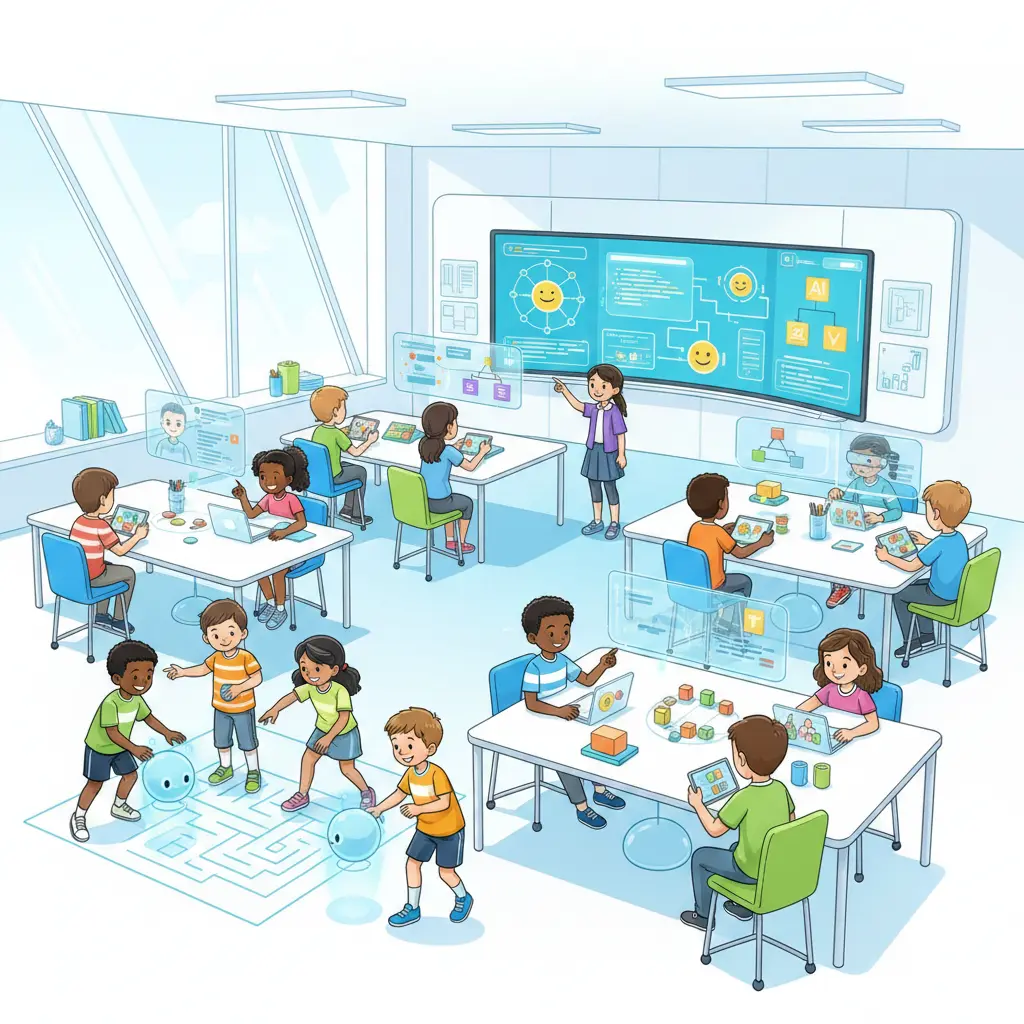
Artificial Intelligence to young students in Grades 1-3 is less about technology and more about shaping how they think and explore. At this age, children are naturally curious, and AI lessons turn that curiosity into meaningful learning through simple discoveries, pattern recognition, and creative play. They begin to understand how decisions are made by noticing similarities, differences, and sequences, strengthening logical thinking and helping them organize information better.
Starting early helps them grow into confident thinkers with creativity, curiosity, and AI literacy, skills that now matter as much as reading and math. As students grow older, reinforcing these ideas through simple assessments becomes important, and this AI fundamentals quiz guide offers a beginner-friendly way to test and strengthen foundational understanding.
AI Class 1 – Teaching Kids How Smart Devices “Think”
In AI Class 1, children aged 5 – 6 learn how smart devices “think” using simple rules like “if this, then that.” By exploring cause and effect in games and activities, they begin to understand how decisions are made, both by machines and in everyday life.
This early exposure strengthens logical thinking, helping young minds recognize patterns, predict outcomes, and solve problems step by step. Learning AI concepts at this age makes technology less intimidating and encourages curiosity, creativity, and confidence in exploring the digital world.
AI Class 2 – Building Early Analytical Skills
In AI Class 2, children learn to recognize patterns, a skill that lays the foundation for coding in later grades. Through fun activities, they explore how computers organize information and make decisions, like how Google Photos automatically sorts images or how smart apps suggest the next video.
By identifying sequences, similarities, and differences, students strengthen analytical thinking and problem-solving abilities. Early exposure to these concepts boosts confidence with technology, helping children understand the digital world around them and preparing them for more advanced AI and coding challenges in the future.
AI Class 3 – Using Games to Expand Thinking
In AI Class 3, children use games and interactive activities to explore how machines “think.” They learn not only to predict outcomes but also to explain why a device behaves a certain way, developing both curiosity and reasoning skills. By experimenting with simple AI rules in fun scenarios, students strengthen critical thinking and problem-solving abilities.
These experiences help children understand cause and effect, recognize patterns, and gain confidence in technology. Early exposure through games encourages creativity while laying a foundation for more advanced AI and coding skills in the future.
AI Learning for Middle Grades (AI Basics Class 5)
AI Class 5 helps students connect basic theory to real-world technology. They learn how AI powers tools they already use, like YouTube recommendations, voice assistants, and smart devices. Through simple hands-on projects, students see how data influences decisions and how machines learn from patterns. This strengthens analytical thinking and builds confidence in understanding everyday tech.
Students also create small AI models or games based on real-life situations, turning abstract ideas into clear, practical experiences. This approach boosts creativity, curiosity, and problem-solving skills. By linking lessons to familiar tools, children understand AI’s purpose and potential. This early foundation prepares them for advanced learning in coding, robotics, and data science, while encouraging them to think critically and experiment confidently in an AI-driven world.
What AI Class 5 Students Typically Learn
In AI Class 5, students explore how machines analyze data, recognize patterns, and make decisions. They learn to build simple AI models, play logic-based games, and understand how real-world applications such as recommendation systems and smart assistants work.
A key focus is fairness in AI, helping students become aware of bias and how decisions can be influenced by the data used. By combining hands-on activities with discussions on ethics, students strengthen critical thinking and problem-solving skills and develop an early sense of responsible technology use.
Fun AI Projects for Class 5 Students
AI Class 5 includes engaging projects that go beyond coding, encouraging teamwork and creativity. Students might design simple AI-powered games, create story-based chatbots, or build mini smart assistants in groups. Activities like predicting outcomes from data sets or sorting images help them understand AI concepts while collaborating with peers.
These projects teach problem-solving, communication, and creative thinking alongside technical skills. By learning together, students gain confidence in using AI, exploring ideas, and understanding how technology can solve real-world challenges in fun, hands-on ways.
How AI Basics Class Shapes Problem-Solving at This Age
AI activities help children break problems into clear steps and approach challenges methodically. By experimenting with patterns, algorithms, and cause-and-effect games, kids learn to think logically, predict outcomes, and test solutions. This early exposure strengthens structured thinking, making problem-solving in school, technology, and everyday life more confident and effective.
AI Basics for Higher Grades (AI Basics Class 9 & 10)
AI Basics Classes for Grades 9 and 10 go beyond foundational concepts, preparing students for future careers and responsible technology use. At this stage, learners connect AI theory with real-world applications, understanding how intelligent systems influence industries like healthcare, finance, education, and entertainment. Hands-on projects help students see AI as a tool that can shape their future career paths. A major focus is on ethical AI use.
By the end of Class 9 and 10, students gain both technical knowledge and ethical insight. They develop confidence in using AI responsibly, a clear understanding of career opportunities in coding, data science, robotics, and other technology-driven fields, and the ability to critically evaluate AI’s impact on society. These classes expand students’ vision, helping them imagine a future where they can innovate, lead, and contribute responsibly in an AI-driven world.
AI Basics Class 9 – Making Complex Topics Simple
AI Basics Class 9 simplifies complex concepts while encouraging students to question how algorithms work, not just use them. Through hands-on projects and interactive simulations, learners explore why a recommendation appears or how a model predicts outcomes. This approach strengthens analytical thinking, problem-solving, and logical reasoning.
By experimenting with data and spotting patterns, students gain confidence in technology and develop curiosity about AI. Class 9 prepares them for advanced learning, helping them think critically, understand AI’s real-world impact, and use it responsibly in future projects and careers.
AI Basics Class 10 – Skills That Make Students Stand Out
AI Basics Class 10 gives students skills that make them shine in competitions, science fairs, and future tech opportunities. They learn to explore real-world AI applications, experiment with algorithms, and understand how machines make decisions. Hands-on projects help them analyze data, predict outcomes, and create innovative solutions.
These activities boost critical thinking, problem-solving, and creativity, while collaborative exercises build confidence. By the end of Class 10, students not only use AI effectively but also think ethically, solve complex problems, and present their ideas impressively, giving them a clear edge in academic and practical challenges.
Real-World AI and Future Tech Awareness for Teens
Teens encounter AI daily in ways they relate to, gaming apps that adjust difficulty, YouTube recommending videos, and school apps that personalize learning. Connecting lessons to these examples helps students see AI in action, understand patterns, and recognize how decisions are made in familiar technology.
At the same time, they develop “AI awareness”, learning to distinguish between helpful and harmful AI. Early exposure teaches them to evaluate technology critically, recognize bias, and use AI responsibly, shaping a thoughtful, future-ready perspective on digital tools.
Advanced AI Topics for Senior Classes (Class 19 – 27)
Senior AI classes (Class 19-27) focus on advanced concepts that prepare students for careers and real-world applications. Building on foundational knowledge, learners explore machine learning, natural language processing, and predictive analytics, while developing practical skills through hands-on projects. A major emphasis is on portfolio building. Students create AI-driven apps, chatbots, recommendation engines, or smart games, projects they can showcase in competitions, internships, or college applications.
Building on foundational knowledge, learners explore advanced topics like machine learning, natural language processing, and predictive analytics. For those who want to refresh or strengthen their AI fundamentals before tackling these senior-level concepts, this AI fundamentals quiz guide provides a solid, beginner-friendly review.
AI Class 19 – Building a Thinking Mindset for Tech Careers
Class 19 students begin developing a research-like mindset, learning to approach problems with curiosity, analysis, and structured thinking. They explore how to break complex challenges into smaller steps, test hypotheses, and interpret results, skills that mirror real-world technology and research processes.
By fostering this thinking early, students strengthen problem-solving, analytical reasoning, and creativity, preparing them for future tech careers and advanced AI projects while building confidence in tackling unfamiliar challenges.
AI Class 20 – Logical Decision-Making & Algorithms
AI Class 20 shows how algorithms and logical decision-making work in real life. Students explore AI in finance (fraud detection), healthcare (risk prediction), and industries (supply chain optimization). Hands-on projects teach step-by-step problem-solving and cause-and-effect thinking. This early exposure builds analytical reasoning, practical decision-making, and confidence, preparing students to apply AI effectively in careers and real-world challenges.
AI Class 23 & 27 – From Ideas to Professional Prep
In Class 23, students transform ideas into mini-projects, learning to test, evaluate, and improve AI models. This hands-on approach strengthens critical thinking, problem-solving, and iterative learning, giving them confidence to refine solutions like real developers.
By Class 27, students start preparing like professionals, building polished projects that enhance portfolios, boost college applications, and impress potential internship opportunities. They gain practical experience, showcase innovation, and develop the skills needed to stand out in academic and early career pathways.
Core AI Fundamentals Every Student Should Know
Mastering core AI fundamentals gives students tech fluency, the ability to understand, use, and innovate with technology confidently. Key concepts include algorithms, data analysis, machine learning basics, pattern recognition, and ethical AI use. Early mastery equips students to navigate the digital world effectively and prepares them for advanced AI learning.
Learning these fundamentals makes students engage in projects, experiments, and simulations that reinforce logical thinking and problem-solving. They explore how machines make decisions, how data drives outcomes, and how to test and improve models. This approach ensures students not only understand AI concepts but can also apply them practically.
A critical aspect is ethical awareness. Students learn to recognize bias, evaluate AI outputs, and make informed decisions when using technology. They gain confidence in distinguishing helpful AI from harmful AI, developing responsible tech use alongside technical skills.
Project Ideas for AI Students (Beginner to Advanced)
Beginner Projects help students understand AI through simple, engaging tasks like pattern games, basic chatbots, or data sorting. These activities teach step-by-step problem-solving, logical thinking, and confidence in using AI tools. Intermediate Projects introduce more challenge, such as building recommendation systems, predictive models, or AI quizzes. Students learn analytical thinking, iterative testing, and teamwork as they refine and improve their solutions.
Advanced Projects mirror real-world applications. Students create AI-based games, image recognition tools, or smart assistants, learning practical skills in coding, model evaluation, data handling, and ethical thinking. They also practice presenting their work, developing a professional mindset. Across all levels, the focus remains on building both skill and mindset together.
AI Basics Classes 1 – 5: Projects for Creative Learning
For Classes 1 – 5, projects focus on creative learning and exploration. A unique example is having students design a “smart garden” simulation, where AI decides when virtual plants need water or sunlight based on simple rules.
They also create story-based chatbots or sort objects using pattern recognition. These tasks teach logical thinking, problem-solving, and curiosity while keeping learning fun. Students gain confidence with technology and build foundational AI skills for higher classes.
AI Basics Classes 9 – 10: Projects for Skill Building
For Classes 9 – 10, projects focus on building practical AI skills while encouraging critical thinking and creativity. A genuine example is designing a movie recommendation system that suggests films based on user preferences. Students also work on predictive models, data analysis exercises, and basic chatbots.
These projects teach algorithmic thinking, problem-solving, and iterative testing, helping learners understand how AI works in real-world applications. By completing these hands-on tasks, students develop confidence, technical competence, and a portfolio of meaningful projects that prepares them for advanced studies and competitive opportunities.
Advanced Mini-Projects for Classes 19 – 27 ( Portfolio-Worthy )
For Classes 19 – 27, projects focus on advanced AI applications and portfolio building. A standout example is developing a smart health assistant that analyzes user symptoms to suggest preventive measures or lifestyle tips using AI algorithms. Students also create AI-powered predictive models, recommendation engines, or image recognition tools.
These projects teach critical thinking, model evaluation, and ethical AI use, while producing tangible results. By completing such portfolio-worthy projects, learners can showcase their skills in competitions, internships, and college applications, demonstrating both technical competence and innovative problem-solving abilities.
Benefits of taking AI Basics Classes at a Young Age
Learning AI Basics classes at a young age does more than teach technology, it strengthens personality and thinking skills. Children develop critical thinking as they explore cause-and-effect relationships in AI projects, and problem-solving as they test ideas, refine models, and evaluate outcomes. AI activities also enhance creativity, encouraging students to imagine innovative solutions while learning to work collaboratively and communicate ideas clearly.
Early exposure builds confidence with technology, turning curiosity into capability and reducing fear of complex concepts. Students learn to make logical decisions, recognize patterns, and approach challenges methodically. By combining technical skills with analytical thinking, ethical awareness, and teamwork, young learners develop a well-rounded mindset. These cognitive and personal benefits give them a strong foundation for academics, future careers, and life, shaping thoughtful, innovative, and resilient individuals ready to navigate an AI-driven world.
Builds Creative Problem-Solving Skills
Learning AI encourages students to think outside the box while tackling challenges. By experimenting with patterns, testing models, and giving solutions, they develop creative problem-solving skills that combine logic, innovation, and critical thinking, abilities that benefit academics, personal projects, and future careers in technology and beyond.
Gives Students an Early Career Edge
Learning AI from a young age gives students a head start in future careers. By building practical skills, completing projects, and developing a portfolio early, they gain confidence, technical expertise, and problem-solving abilities that set them apart in academics, internships, and competitive opportunities.
Conclusion: Preparing Students for an AI-Driven Future
From early grades to advanced classes, learners develop critical skills like problem-solving, analytical reasoning, and ethical awareness, while engaging in building AI models, testing algorithms, and exploring real-world applications. Students gain confidence, logical thinking, and creativity, laying a foundation for both academics and future careers. Students who start young also gain an early career edge, with portfolios, practical projects, and AI experience that set them apart in competitions, internships, and college applications.
To continue growing, students can explore advanced AI topics, participate in competitions, and undertake personal projects. By staying curious, experimenting with new tools, and learning from real-world applications, learners can deepen their AI expertise, expand their career opportunities, and become confident innovators in an increasingly AI-driven world.
-
Is AI too advanced for young kids in Class 1-3?
No, AI Basics Class 1-3 is designed to be simple and playful, using games and patterns to teach basic concepts. It builds curiosity and logical thinking without overwhelming young learners.
-
What skills do students gain after an AI basics Class?
Students gain critical thinking, problem-solving, logical reasoning, creativity, and tech confidence. They also learn data analysis, pattern recognition, ethical awareness, and the ability to approach challenges methodically.
-
Are AI projects difficult for beginners?
No, AI projects for beginners are designed to be simple and hands-on, using games, patterns, and fun experiments. They teach concepts step by step, helping students build skills and confidence gradually.
-
How long does it take to learn basic AI concepts?
Students can grasp basic AI concepts in a few weeks to a couple of months, depending on class frequency and engagement. Early exposure to hands-on activities and projects helps them understand and apply concepts quickly.
-
What’s the difference between AI basics and coding classes?
AI basics focus on understanding how intelligent systems think, make decisions, and solve problems, often through patterns, logic, and real-world applications. Coding classes focus on writing programs, syntax, and software development skills to create functional applications or algorithms.