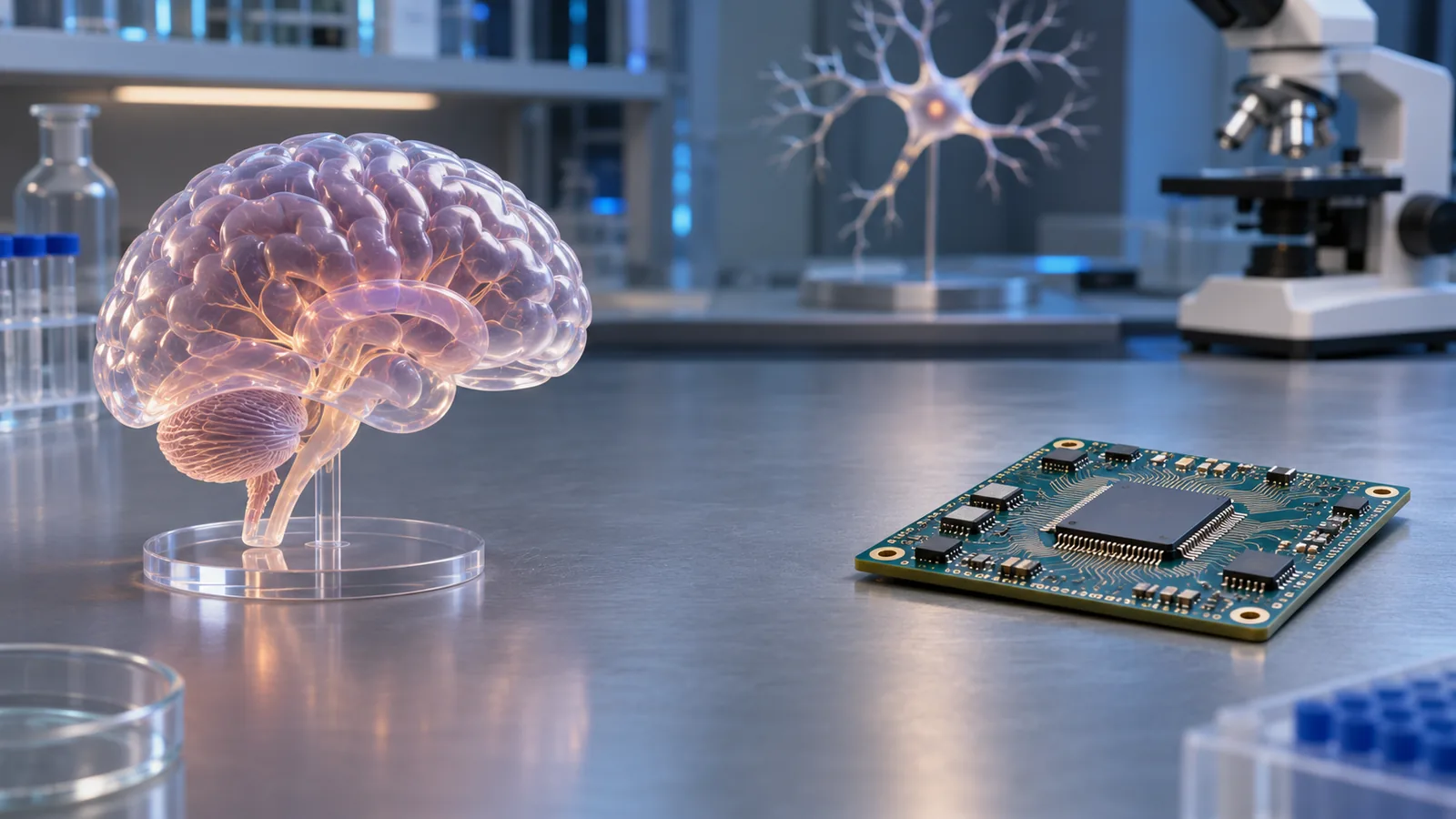
Ternary Bonsai 2.5: A 27B Coding Model That Fits in 5.9 GB
Key Takeaways
- PrismML announced Ternary Bonsai 2.5 27B on 24 November 2026, a 27-billion-parameter agentic coding model compressed to ternary weights.
- The model fits in 5.9 GB, about nine times smaller than the 53.8 GB FP16 Qwen3.8-27B base model it is derived from.
- It is free under the Apache 2.0 licence and runs on llama.cpp, on GPU or CPU, and on Apple MLX.
- Vendor-reported scores include 75.6 on SWE-bench Verified, up from 60.8 in Bonsai 2, against 80.6 for the full-precision base model.
- AppWorld rose to 90.5 from 51.2 in Bonsai 2, against 93.2 for the base, and DeepSWE rose to 27.0 from zero.
- Terminal-Bench 2.1 scored 60.1, and the tool-calling average was 77.2 against 77.7 for the FP16 base across five benchmarks.
- LiveCodeBench v6 actually dipped, to 83.0 from 83.8, a reminder that compression is not free.
- All scores are vendor-reported, with no independent reproduction yet, and they depend on the harness, prompting and number of attempts used.
What Ternary Means
PrismML announced Ternary Bonsai 2.5 27B on 24 November 2026, in a PR Newswire release. It is a 27-billion-parameter agentic coding model, and its defining feature is compression. The model's weights have been reduced to ternary values, meaning each weight takes one of three values rather than the many values used in a full-precision model. The result is a model that fits in 5.9 GB, about nine times smaller than the 53.8 GB FP16 version of the Qwen3.8-27B base model it is derived from.
To understand why that matters, it helps to understand what model weights are. A large language model is, at its core, a vast collection of numbers, the weights, that determine how it responds to input. In a full-precision model, each weight is stored as a 16-bit floating-point number, which can take a huge range of values. That precision is expensive in memory. A 27-billion-parameter model at 16-bit precision needs about 54 GB of memory, which is more than most consumer computers have available for a single application.
Ternary quantisation reduces each weight to one of three values: negative one, zero, or positive one. That is a radical reduction in precision, and it means each weight can be stored in a fraction of the space. The result is a model that fits in 5.9 GB, small enough to run on a laptop, a workstation, or a single consumer GPU. The trade-off is obvious: throwing away that much precision should, in theory, damage the model's abilities. The question Bonsai 2.5 answers is how much damage, and whether the remaining capability is good enough for real work.
The answer, according to PrismML's own reported scores, is that the damage is small on most benchmarks and real on at least one. That is a more interesting result than a clean success would be, because it shows both the promise and the limits of extreme compression.
The Size That Changes Who Can Run It
The practical significance of 5.9 GB is that it changes who can run a 27-billion-parameter coding model. At 53.8 GB, the full-precision base model needs a data-centre GPU or a high-end workstation with substantial memory. At 5.9 GB, the model can run on a laptop, on a desktop with a consumer GPU, or on a CPU alone, albeit more slowly. That is the difference between a model that belongs to organisations with infrastructure and a model that belongs to anyone with a computer.
The model runs on llama.cpp, the widely used open-source inference engine, on both GPU and CPU, and on Apple MLX, Apple's framework for running machine learning models on its silicon. Support for llama.cpp and MLX matters because it means the model can be run with standard, well-maintained tooling, rather than requiring a proprietary runtime. A developer who already runs local models will be able to try Bonsai 2.5 without learning a new stack.
It is free under the Apache 2.0 licence, which permits commercial use. That is an important detail for a coding model, because the most valuable use of a coding model is inside a company's own development workflow, and a licence that forbids commercial use would rule that out. The Apache 2.0 licence removes that obstacle.
The combination of small size, free licence and standard tooling makes Bonsai 2.5 a model that can be adopted quickly and widely. It can be run locally, which means code and data do not need to leave the developer's machine. For companies that handle sensitive code, or that work under data-protection rules that restrict sending code to a cloud service, local running is not a convenience but a requirement. A 27-billion-parameter model that fits on a laptop is a model that can be used where cloud models cannot.
The Benchmark Scores, As Reported
PrismML reports a set of benchmark scores for Bonsai 2.5, and they are, on the whole, strong. On SWE-bench Verified, a benchmark that tests a model's ability to fix real software issues from GitHub repositories, Bonsai 2.5 scores 75.6. That is up from 60.8 in Bonsai 2, the previous version, a substantial improvement. The full-precision base model scores 80.6, so the ternary model is about five points behind the model it was compressed from. That is a meaningful gap, but it is also a gap that many users would accept in exchange for a nine-fold reduction in size.
On AppWorld, a benchmark that tests an agent's ability to carry out tasks across applications, Bonsai 2.5 scores 90.5, up from 51.2 in Bonsai 2. That is a dramatic improvement, and it brings the ternary model close to the base model's 93.2. The jump from 51.2 to 90.5 suggests that the improvement from Bonsai 2 to Bonsai 2.5 is not only about compression, but about the underlying model and the training. A model that improves by nearly 40 points on a benchmark between versions has changed in more than its weights.
On DeepSWE, a benchmark for software engineering tasks, Bonsai 2.5 scores 27.0, up from zero in Bonsai 2. A score of zero in the previous version means the model could not complete any of the tasks; a score of 27.0 means it can now complete more than a quarter of them. That is a real improvement, even if the absolute figure is modest, and it suggests that the new version is capable of work the old one could not do at all.
On Terminal-Bench 2.1, a benchmark that tests a model's ability to work in a terminal environment, Bonsai 2.5 scores 60.1. Terminal work is a core part of agentic coding, because much of what a coding agent does involves running commands, manipulating files and using tools from the command line. A score of 60.1 is a solid result, and it supports the claim that Bonsai 2.5 is an agentic model, not only a code-completion model.
On tool calling, the average across five benchmarks is 77.2, against 77.7 for the FP16 base model. Tool calling is the ability to use external tools correctly, calling the right function with the right arguments, and it is central to agentic work. The gap of half a point between the ternary model and the full-precision base is negligible, and it suggests that ternary compression has almost no effect on this particular capability.
PrismML also reports a speed of 291 tokens per second on a single H100 GPU. The H100 is a data-centre GPU, so that figure reflects a high-end setup, but the speed is relevant because it shows that the compressed model can be run fast when the hardware is available. On a consumer GPU or a CPU, the speed will be lower, but the model's small size means it can be run at all, which is the more important point.
The LiveCodeBench Dip
Not every number went up. On LiveCodeBench v6, a benchmark that tests code generation on problems drawn from competitive programming and real-world coding tasks, Bonsai 2.5 scores 83.0, down from 83.8. That is a small dip, less than a point, but it is a dip, and it matters for two reasons.
First, it is a reminder that compression is not free. Ternary quantisation throws away information, and on some tasks that information matters. LiveCodeBench tests a model's ability to write correct code for problems that require careful reasoning, and it is plausible that the precision lost in compression affects exactly the kind of detailed reasoning those problems require. The dip is small, but it is real, and it shows that the trade-off between size and capability is not one-directional.
Second, it is a credit to PrismML that the dip is reported at all. A vendor that only reported improvements would be presenting a selective picture. By including a benchmark where the score fell, PrismML gives a more honest account of what the model can and cannot do. That honesty is worth noting, because it is not universal in model announcements.
The dip should also be kept in proportion. A fall of 0.8 points on one benchmark, against improvements of 15 points on SWE-bench Verified and 39 points on AppWorld, is a small blemish on an otherwise strong set of results. It does not undermine the model. It qualifies the claim that compression is costless, and that qualification is useful.
Ternary Weights in Plain Terms
It is worth explaining what ternary weights actually mean, because the term is unfamiliar to most readers and the idea behind it is simple once stated. A neural network model is made of weights, numbers that determine how the model transforms its input into its output. In a standard model, each weight is stored as a 16-bit floating-point number, which can take a very large number of possible values. That precision allows the model to make fine distinctions, but it costs memory: 16 bits per weight, multiplied by 27 billion weights, is about 54 gigabytes.
Ternary quantisation replaces each of those precise numbers with one of three values: minus one, zero, or plus one. That is all. A weight can be negative, zero, or positive, and nothing in between. The information that is lost is the fine detail: the difference between a weight of 0.73 and a weight of 0.74, for example, disappears entirely, because both become the same ternary value. What remains is the sign and the rough magnitude, the direction in which the weight pushes the model's output.
The surprising thing, and the reason ternary models are interesting, is how much capability survives that loss. Bonsai 2.5 scores 75.6 on SWE-bench Verified against 80.6 for the full-precision base, and its tool-calling average of 77.2 is nearly identical to the base model's 77.7. Those figures suggest that much of what a coding model knows is encoded in the pattern of which weights are positive, negative or zero, rather than in their precise values. The fine detail matters less than the broad structure, and a model that preserves the structure can preserve most of the capability.
There are limits, and the LiveCodeBench dip is the clearest evidence of them. Some tasks depend on fine distinctions, and on those tasks the loss of precision shows. The dip is small, but it is a reminder that ternary quantisation is a trade-off, not a free lunch. The model is nine times smaller, but it is not identical, and the differences will matter more for some tasks than for others.
The technique is not new in principle. Quantisation, the reduction of precision to save memory, has been used in machine learning for years, and ternary networks have been studied in research papers for nearly a decade. What is new is that the technique now works well enough, at this scale, for a 27-billion-parameter coding model to be compressed to 5.9 GB while retaining most of its benchmark performance. That is a practical achievement, and it is the reason Bonsai 2.5 is worth attention beyond the benchmark numbers.
Why All Scores Are Vendor-Reported
Every score in this article is vendor-reported. That means the numbers come from PrismML, and they have not yet been independently reproduced. That does not mean they are wrong. It means they should be read with the appropriate caution, and that the caution should be stated plainly.
Benchmark scores depend on the harness, the prompting, the number of attempts and the exact version of the model tested. PrismML notes that its scores depend on "thinking mode at xhigh effort", which is a setting that gives the model more time to reason before answering. A model run at high effort will score better than the same model run at low effort, and a comparison between models run at different effort levels is not a fair comparison. The scores are also affected by the harness, the software that connects the model to the benchmark, and by the prompting, the exact instructions given to the model.
Independent reproduction is the process by which these dependencies are checked. An independent evaluator runs the model under standardised conditions, with a published harness and prompting, and reports the result. If the independent result matches the vendor's, the vendor's claim is strengthened. If it does not, the difference reveals something about the conditions under which the vendor's score was obtained. That process takes time, and it has not yet happened for Bonsai 2.5. Until it does, the scores should be treated as PrismML's account of its model's performance, not as settled fact.
That caution applies to the comparison with the base model as well. The base model's scores of 80.6 on SWE-bench Verified and 93.2 on AppWorld are also reported by PrismML, and the same caveats apply. The gap between the ternary model and the base model is probably real, but its exact size will only be known once both models have been tested independently under identical conditions.
What Local Coding Models Mean
Bonsai 2.5 is part of a wider shift toward local AI, and that shift is worth understanding. For the first few years of the large language model era, the most capable models were available only through cloud APIs. A developer who wanted to use a frontier model sent their code to a company's server, waited for a response, and paid per token. That model works well, but it has drawbacks. Code sent to a cloud service leaves the developer's machine, which raises privacy and security concerns. Cloud APIs cost money on every request, which adds up for heavy users. And cloud APIs depend on an internet connection, which is not always available.
Local models solve those problems, but until recently they were much less capable than cloud models. A model small enough to run on a laptop was, by necessity, a small model, and small models were significantly worse at coding than the large models available through APIs. The gap is narrowing. Ternary compression is one of the techniques closing it, because it allows a large model to be shrunk to a size that fits on consumer hardware without losing most of its capability.
The result is that a developer can now run a 27-billion-parameter coding model on their own machine, for free, with no data leaving the device. That is a meaningful change in who controls the tools of software development. It is also a change that matters for companies in regulated industries, for developers in countries with limited internet access, and for anyone who values privacy.
There are limits. A local model, even a good one, is not yet as capable as the largest cloud models, and it will not be for some time. The largest models have hundreds of billions or trillions of parameters, and they cannot be compressed to fit on a laptop without losing far more capability than Bonsai 2.5 loses. Local models are a complement to cloud models, not a replacement for them, and the sensible approach for most developers is to use both: local models for routine work and sensitive code, cloud models for the hardest problems.
What Developers Should Do
For a developer considering Bonsai 2.5, the practical advice is to try it. It is free, it runs on standard tooling, and it fits on hardware you probably already own. Run it on your own code, on your own tasks, and compare it with the models you already use. The benchmarks are a guide, but your own experience is the test that matters.
Pay attention to the tasks where it struggles. If the LiveCodeBench dip reflects a real weakness in careful reasoning, that weakness will show up in your work too, and you will want to know where it is. A model that is excellent at fixing GitHub issues but weaker at writing new code from scratch is still useful, but it is useful in a different way from a model that is strong at both.
Be aware that the model is a compressed version of a larger model, and that compression has trade-offs. The scores suggest those trade-offs are small, but they are not zero, and the LiveCodeBench dip is the evidence. If your work depends on the kind of reasoning that LiveCodeBench measures, you may want to use the full-precision base model, or a cloud model, for those tasks.
Finally, remember that the scores are vendor-reported. They are a reason to try the model, not a guarantee of its performance. Your own testing is the only verification that counts.
For context on how other new models are being priced and measured, see our coverage of Gemini 4 Hydrogen's pricing and benchmarks, and of Claude Fable 5.2.
What We Could Not Verify
- Any of the benchmark scores independently. All figures, including SWE-bench Verified 75.6, AppWorld 90.5, DeepSWE 27.0, Terminal-Bench 2.1 60.1 and the tool-calling average of 77.2, are vendor-reported, with no independent reproduction yet.
- The speed of 291 tokens per second on a single H100, which is PrismML's figure and has not been independently measured.
- How the model performs on consumer hardware or CPU-only setups, as distinct from the H100 figure. No independent measurements of local running speed were available in the material reviewed for this article.
- Whether the LiveCodeBench dip reflects a real capability gap or a difference in harness, prompting or effort settings. The dip is reported, but its cause has not been established.
- The exact conditions under which the scores were obtained, including the harness, prompting and number of attempts, beyond PrismML's note that scores depend on "thinking mode at xhigh effort".