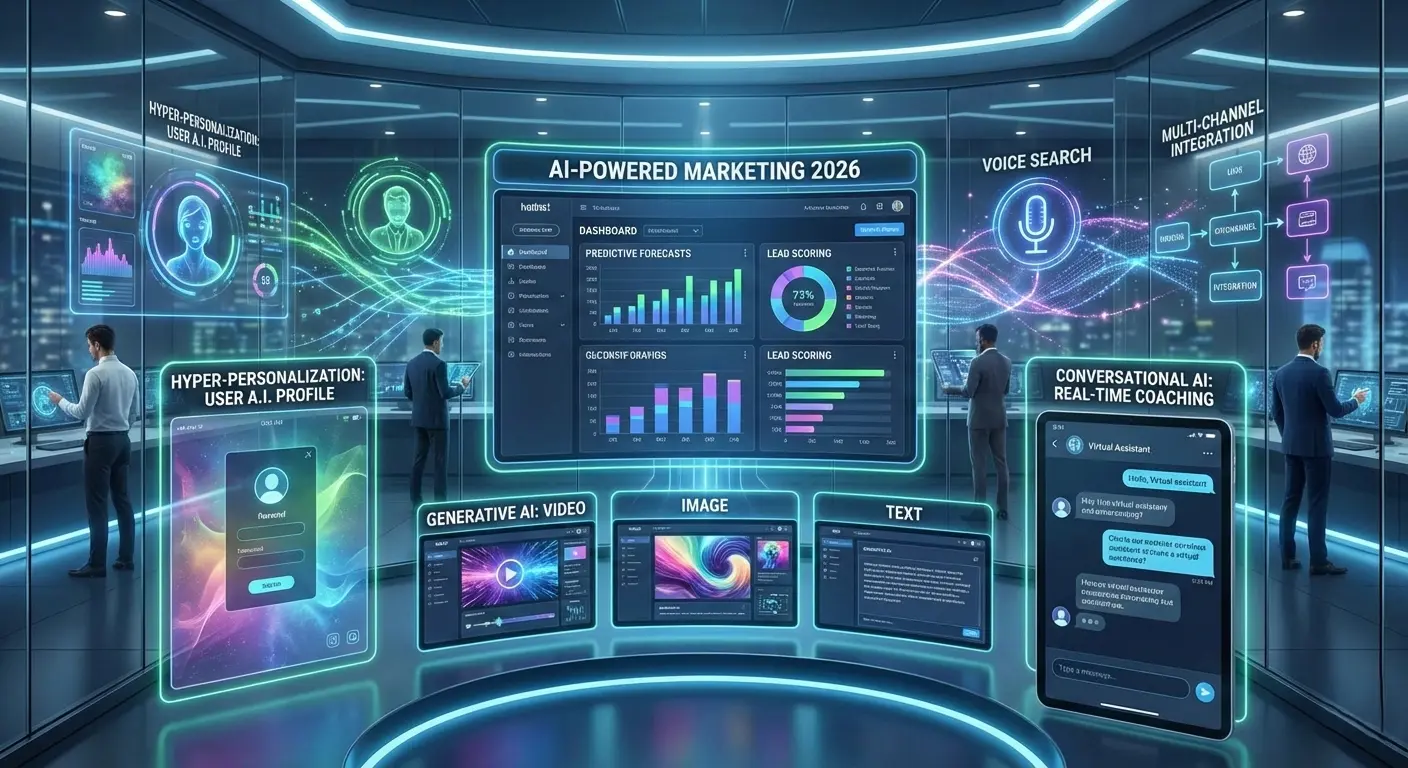
Latest AI Trends in Marketing for Success in 2026
The marketing landscape is rapidly changing, with AI at the center of this shift. If you’re wondering what the key trends in AI marketing for 2026 are, you’re asking the right question at the right time. As businesses look ahead to 2026, AI is no longer optional, most marketers already use AI tools daily, and adoption continues to grow. AI is reshaping how brands automate campaigns, personalize experiences, and make data-driven decisions faster and more accurately.
This guide covers the latest AI trends in marketing and AI-driven sales, focusing on what actually works in real campaigns. Whether you’re a marketer or a business owner, understanding and applying these trends is essential to staying competitive. Based on hands-on experience with AI tools, the focus here is on practical priorities, not hype.
The Current State of AI in Marketing and Sales
Before diving into future predictions, we need to understand where we stand today. The AI marketing ecosystem has matured significantly over the past two years, moving beyond simple automation into sophisticated decision-making territory a foundation that shapes the Latest AI Trends in Marketing. According to recent AI implementation research from McKinsey, generative AI alone could contribute between $2.6 and $4.4 trillion annually to the global economy.
Marketing and sales departments represent the highest potential impact areas for this technology. Organizations actively using AI report revenue increases between 10% and 20%, demonstrating tangible business value. However, marketing technology surveys indicate a concerning gap, despite heavy investment in martech stacks, utilization rates hover around only 33%. This means businesses own powerful AI tools but fail to leverage their full capabilities.
From my experience working with various marketing teams, the opportunity for 2026 lies not just in adopting new technologies but in maximizing existing investments. This utilization gap often stems from inadequate training and unclear implementation strategies. The companies seeing real results are those treating AI as a strategic partner rather than a plug-and-play solution.
What Are Latest AI Trends in Marketing for Success in 2026?
The coming year brings several transformative trends that will reshape how marketers connect with audiences. These aren’t speculative predictions, they’re extensions of technologies already proving their value in early-adopter organizations.
Hyper-Personalization Powered by Machine Learning
By 2026, hyper-personalization will reach a new level of sophistication, with AI analyzing customer data in real time to deliver individualized experiences across every touchpoint one of the Latest AI Trends in Marketing. AI-powered personalization already drives around a 20% increase in conversions, going far beyond simple tactics like using a first name by analyzing browsing behavior, purchase history, engagement patterns, and contextual signals such as location, weather, or timing to craft highly relevant messaging.
Websites now adapt content instantly based on visitor profiles, email campaigns dynamically adjust timing and offers, and product recommendations accurately anticipate customer needs. I’ve tested several personalization platforms over the past year, and the difference between basic segmentation and true AI-driven personalization is dramatic. The technology finally delivers on promises marketers have been making for decades.
Generative AI Content Creation Reaches Maturity
In 2026, these tools will produce high-quality text, images, video, and audio that genuinely support marketing goals. While productivity gains are significant, the real shift is in quality, well-guided AI output is now often indistinguishable from human-created content. The strongest results come from combining human creativity with AI efficiency. Marketers define strategy, brand voice, and creative direction, while AI executes at scale.
As consumer awareness of AI-generated content grows, successful brands remain transparent and maintain human oversight to preserve authenticity and emotional impact an important principle within the Latest AI Trends in Marketing. My experience with generative AI tools shows that output quality directly correlates with input quality: vague prompts produce generic content, while detailed, strategic prompts unlock remarkable results, making the learning curve well worth climbing.
Predictive Analytics Transforming Campaign Strategy
Predictive analytics is among the most powerful AI trends in marketing, allowing marketers to anticipate outcomes instead of reacting to past performance. Sophisticated algorithms now forecast customer behavior, campaign results, and market trends with remarkable accuracy.
Key applications include customer behavior prediction to target likely buyers or prevent churn, campaign outcome forecasting to test messaging and channels before spending, budget allocation optimization for maximum ROI, and early warning systems for churn prevention. These advanced predictive capabilities are increasingly accessible to mid-market companies, not just large enterprises with dedicated data science teams.
Conversational AI Beyond Basic Chatbots
Remember those frustrating chatbots that couldn’t understand simple questions? They’re becoming obsolete as conversational AI adopts advanced natural language processing to handle complex, nuanced interactions one of the Latest AI Trends in Marketing. With the market projected to reach $32 billion, these tools are making conversations more natural and context-aware while significantly improving resolution rates and customer satisfaction.
Modern conversational AI integrates with CRM systems, retaining history across channels. Website chats can continue via SMS without losing context. Beyond support, AI qualifies leads, schedules meetings, answers product questions, and handles initial objections, freeing human sales reps for high-value tasks. Upgrading from rule-based systems consistently boosts satisfaction, reduces support costs, and improves conversion rates.
Voice Search and Audio Marketing Expansion
Voice commerce is rapidly growing, and AI marketing in 2026 must adapt to how people search and shop using voice commands. Voice queries are longer, conversational, and often phrased as questions, requiring content strategies tailored for spoken language.
AI also enhances voice advertising and podcast campaigns by optimizing audio ads and enabling dynamic, personalized ad insertion an important aspect of the Latest AI Trends in Marketing. Local search is particularly impacted, as voice queries often carry strong local intent, making AI-powered local SEO essential for capturing nearby customers.
Programmatic Advertising Intelligence
Programmatic advertising continues evolving, with 2026 bringing smarter AI that improves results while reducing costs. Advanced real-time bidding evaluates countless signals to optimize each impression, minimizing wasted spend and enhancing targeting precision, showcasing the latest AI trends in marketing.
AI also enables cross-platform optimization, recognizing users across devices and channels, and ensures privacy-compliant targeting using contextual signals and first-party data. Creative optimization automatically tests and promotes high-performing ads, continuously refining campaigns faster than human teams could manage.
What Are the Latest Trends in AI-Driven Sales?
Marketing and sales increasingly converge through AI integration. Understanding the latest trends in AI-driven sales helps marketers align their efforts with revenue-generating activities.
AI Sales Assistants Revolutionizing Workflows
AI sales assistants save time by automating routine tasks while improving execution quality. Studies show 83% of sales teams using AI report revenue growth, reflecting both efficiency gains and better performance.
AI adapts email sequences based on prospect behavior, handles meeting scheduling, and enriches CRM data automatically. The latest trends focus on augmentation, making salespeople more effective rather than replacing them. You can check out our AI agents for marketing blog to understand how this work.
Predictive Lead Scoring and Prioritization
AI-powered lead scoring helps sales teams focus on the most promising leads, improving win rates by around 30%. Modern models analyze behavioral signals like website visits, content downloads, email engagement, and social activity, detecting buying intent that humans might miss.
By integrating external intent data from web behavior, AI identifies companies actively researching solutions. This prioritization lets sales reps engage the right prospects at the right time with the right message, speeding up the sales cycle and boosting revenue.
Conversation Intelligence and Sales Coaching
Conversation intelligence platforms use AI to record, transcribe, and analyze sales calls, helping teams improve performance. By 2026, 60% of B2B sellers are expected to use AI-guided selling tools, with conversation intelligence as a key component.
AI identifies patterns from top performers what questions work, how objections are handled, and which phrases drive deals. Real-time coaching offers suggestions during calls, highlights competitor mentions, and signals when conversations stall, while sentiment analysis tracks emotional dynamics, enabling managers to assess both content and relationship quality, reflecting the latest AI trends in marketing.
AI-Powered Sales Forecasting Accuracy
AI-driven sales forecasting replaces intuition with data-driven accuracy, reducing errors that affect the entire organization. Pipeline analysis evaluates each deal’s stage, engagement, stakeholders, and historical patterns to predict closure probability objectively.
Revenue prediction models aggregate these probabilities into reliable forecasts, helping leadership make informed decisions on hiring, inventory, and investments. AI also identifies at-risk deals early, enabling timely intervention, resource allocation, or strategic adjustments before opportunities are lost.
What Are the Latest Trends in AI for Marketing Analytics?
Data drives modern marketing, and AI transforms how we collect, process, and act on marketing analytics.
Real-Time Data Processing and Insights
AI-driven sales forecasting eliminates reliance on intuition, bringing data-driven accuracy to predictions across the organization. Pipeline analysis evaluates each deal’s characteristics, stage, age, engagement, and stakeholders, predicting closure probability based on historical patterns. With AI, overly optimistic forecasts are corrected, exemplifying the latest AI trends in marketing.
Revenue prediction models aggregate individual deal probabilities into reliable organizational forecasts, allowing leadership to make informed decisions about hiring, inventory, and investments. Additionally, AI identifies at-risk deals before they are officially lost, enabling early intervention, allocation of resources, executive involvement, or strategic adjustments while opportunities still exist.
Advanced Attribution Modeling
Understanding which touchpoints drive conversions has always challenged marketers, and AI adds a new level of sophistication to attribution modeling. Machine-learning-powered multi-touch attribution evaluates each interaction’s contribution across millions of customer journeys, replacing arbitrary rules-based models with data-driven insights, highlighting the latest AI trends in marketing.
AI also enhances customer journey mapping, visualizing the paths from first awareness to purchase and highlighting influential touchpoints that warrant increased investment. Accurate attribution improves ROI measurement, enabling marketers to defend budgets and optimize spending based on real performance data.
Sentiment Analysis and Brand Monitoring
AI in marketing goes beyond campaign execution to include brand intelligence and reputation management. Social listening AI monitors conversations across platforms, analyzes sentiment, and tracks share of voice against competitors at a scale impossible for human teams.
Crisis detection systems identify emerging issues early, such as spikes in negative sentiment or unusual complaint volumes, triggering immediate alerts for rapid response. Competitor analysis also benefits, with AI tracking mentions, campaign launches, and market positioning to provide actionable insights for strategic planning.
How to Implement AI Marketing in Your 2026 Strategy
Understanding trends is less important than implementing them effectively. Here’s a practical framework for integrating AI into marketing operations:
The key to AI marketing success in 2026 lies in thoughtful, strategic implementation rather than rushing in.
Challenges and Considerations for AI Marketing Adoption
Enthusiasm for AI shouldn’t blind marketers to key challenges. Data privacy regulations like GDPR and CCPA strictly limit how customer data can be used, making compliance and privacy-by-design essential from the start.
AI bias and lack of human oversight can create serious risks, from unfair targeting to brand damage. At the same time, AI reshapes marketing roles by automating routine work while increasing the need for strategic and creative skills, requiring teams to reskill, highlighting the latest AI trends in marketing.
Integration and costs must be planned carefully, as AI tools often demand more time and resources than expected. The best approach is to start small, prove value, and scale responsibly.
Top AI Marketing and Sales Tools for 2026
Selecting the right tools is critical for AI marketing success and should follow a clear strategy. Content creation platforms should support multiple formats, brand voice customization, and collaborative workflows, while analytics tools offer real-time processing, predictive capabilities, and integration with existing data sources, reflecting the latest AI trends in marketing and.
Marketing automation platforms should be evaluated for AI features, personalization depth, optimization options, and predictive sending, while sales enablement tools, covering lead scoring, conversation intelligence, or forecasting, must integrate smoothly with CRM systems. Customer data platforms unify fragmented data, enabling AI-driven insights and activation. Based on hands-on testing, starting with tools offering free trials or pilot programs provides the most practical insights, we can give you overview of this on top ai trends for 2026 to know what other trends can be helpful to you.
ROI of AI Marketing: What to Expect
Setting realistic expectations is essential for making sound AI investments and maintaining patience during implementation. Studies show organizations using AI effectively can see revenue increases of 10-20%, and 83% of sales teams report revenue growth with AI, but these results require context.
Meaningful ROI usually emerges within 6–12 months as teams navigate learning curves, integration challenges, and optimization cycles. Success requires disciplined measurement, establishing baseline metrics, and tracking changes rigorously. Over time, AI systems improve as they gather data and learn patterns, exemplifying the latest AI trends in marketing.
Conclusion
Understanding the key trends in AI marketing for 2025 gives organizations a competitive edge in an increasingly AI-driven landscape. Technologies like hyper-personalization, generative content, predictive analytics, and conversational interfaces are reshaping marketing fundamentals, while AI-driven sales tools, assistants, scoring models, and forecasting enable teams to work smarter, reflecting the latest AI trends in marketing.
Awareness alone isn’t enough; implementation is what drives results. Start with areas of highest impact, build capabilities incrementally, and maintain human oversight while leveraging AI efficiency. These trends are no longer predictions, they are the current reality, and success depends on how quickly and effectively organizations adapt. You can check what`s actually changing in 2026 and how it effects you.
How is AI changing digital marketing in 2026?
AI is changing digital marketing in 2026 by automating tasks, personalizing content for individuals, and using predictive data to make smarter campaign decisions.
What is the best AI tool for small business marketing?
Small businesses should focus on affordable all-in-one platforms that combine email marketing, content creation, and basic analytics with built-in AI, offering simple setup and ready-to-use templates.
Will AI replace human marketers?
AI supports rather than replaces marketers by automating routine tasks and freeing time for strategy, creativity, and relationship building, with human judgment and direction remaining essential.
How much does AI marketing cost to implement?
AI marketing costs range from low monthly subscriptions for basic tools to higher investments for custom enterprise solutions, with most businesses seeing ROI within 6-12 months when implemented properly.
What skills do marketers need for AI in 2026?
Key AI marketing skills include data literacy, prompt engineering, strategic thinking, and the ability to interpret AI insights, along with the comfort learning new tools.