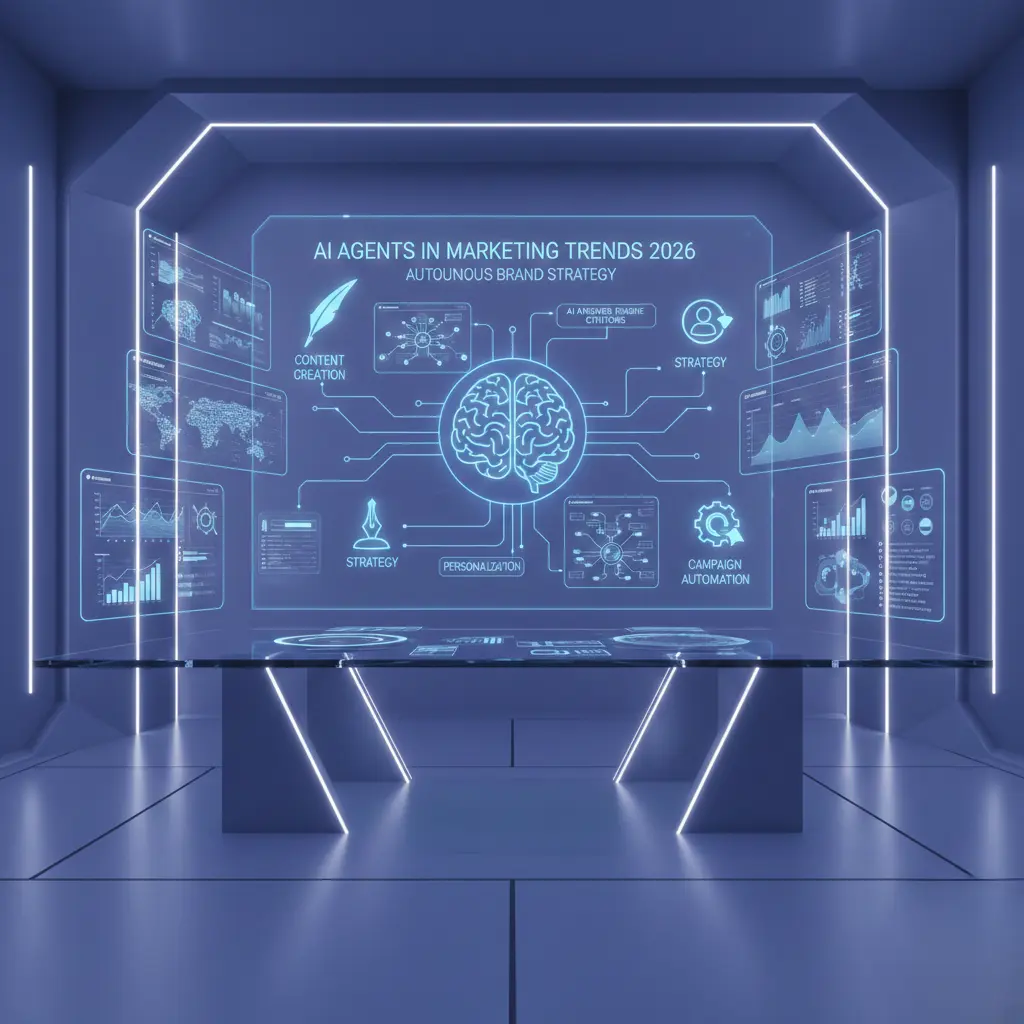
Enrich Your Brand with AI Agents in Marketing Trends 2026
AI agents in marketing trends are no longer futuristic concepts. They’re here, reshaping how brands connect with audiences, optimize campaigns, and drive unprecedented ROI. Simultaneously, the rise of AI answer engines like ChatGPT, Perplexity, and Google’s AI Overviews is fundamentally changing how consumers discover brands. The marketing landscape is undergoing its most significant transformation in decades.
While businesses spent years mastering social media and SEO, a new revolution has quietly emerged, one powered by autonomous AI systems that think, learn, and execute marketing strategies independently. This article explores the most impactful AI agents in marketing trends for 2026 and reveals exactly how your brand can leverage these technologies to stay ahead of the competition. You can also check other top ai trends in 2026 that will redefine our work method.
What Are AI Agents in Marketing?
Before diving into trends, let’s establish a clear understanding of what AI agents actually are and why they matter for modern marketing. AI agents in marketing are autonomous software systems powered by large language models (LLMs) that can perceive their environment, make decisions, and take actions to achieve specific marketing objectives. Unlike traditional marketing automation tools that follow rigid rules, these agents can adapt, learn, and operate with minimal human intervention. For a broader view, explore our latest ai trends in marketing, where we analyze how artificial intelligence is evolving across industries.
Key Characteristics of Marketing AI Agents:
| Characteristic | Description | Marketing Application |
|---|---|---|
| Autonomy | Operates independently after initial setup | Self-optimizing ad campaigns |
| Reasoning | Analyze data to make logical decisions | Customer segmentation |
| Learning | Improves performance over time | Predictive content recommendations |
| Action-Taking | Executes tasks without constant approval | Automated email sequences |
| Multi-Step Planning | Breaks complex goals into subtasks | Full campaign management |
The distinction between AI agents and simple AI tools is crucial. While a basic AI tool might generate a single piece of content, an AI agent can research your audience, develop a content strategy, create multiple assets, schedule publications, analyze performance, and optimize future content, all autonomously.
The Current State of AI Agents in Marketing: 2025 Snapshot
Understanding where we stand helps contextualize the AI agents in marketing trends shaping our immediate future.
AI Marketing Adoption Statistics
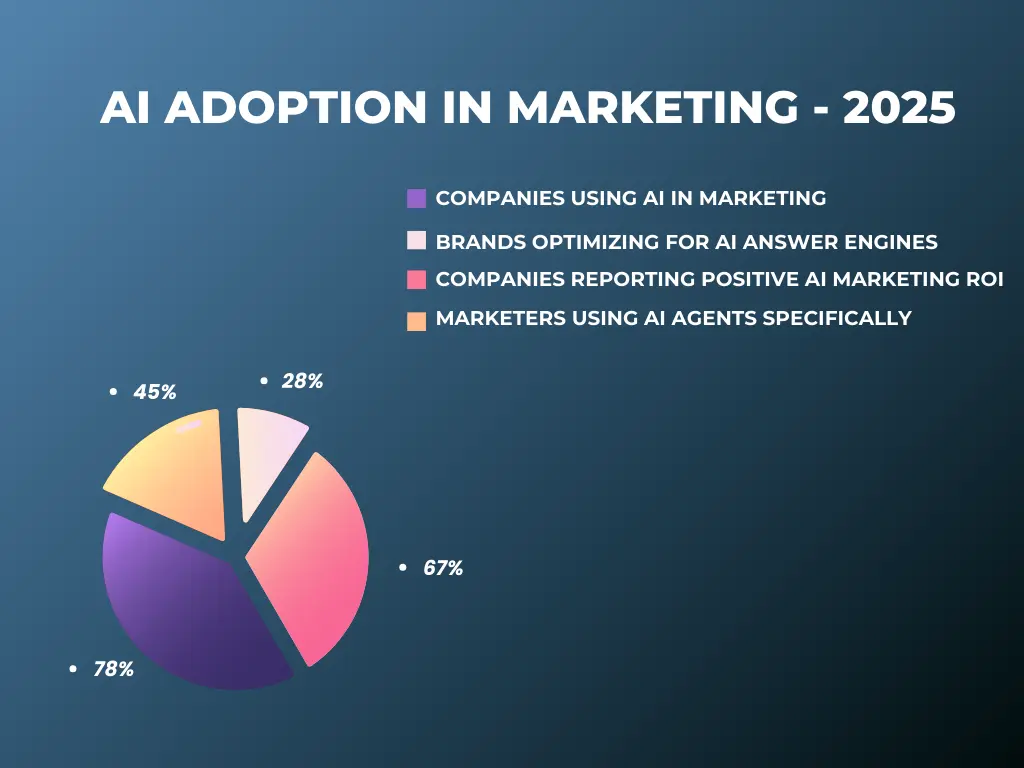
The data reveals a significant opportunity gap. While most companies use some form of AI, less than half have adopted true AI agents in marketing strategies, and even fewer optimize for answer engines. This gap represents your competitive advantage.
Top 7 AI Agents in Marketing Trends for 2026
Let’s explore the most significant AI agents in marketing trends that forward-thinking brands are leveraging right now.
Trend 1: Multi-Agent Collaboration Systems
The most sophisticated development in AI agents in marketing is the emergence of multi-agent systems, where specialized agents work together like a virtual marketing team.
Imagine this workflow:
These collaborative agent systems can manage entire marketing operations with a single human overseeing strategy-level decisions. Implementation Tip: Start by identifying your most time-consuming marketing workflow and implement a single agent before scaling to multi-agent systems.
Trend 2: Hyper-Personalization at Scale
Traditional personalization added a customer’s name to emails. AI agents take personalization to an entirely different level. Modern AI agents in marketing can analyze individual customer behaviors, preferences, purchase history, and real-time context to deliver uniquely tailored experiences for each user. This includes:
| Personalization Level | Technology | Engagement Lift |
|---|---|---|
| Basic (Name only) | Simple automation | 5 – 10% |
| Segment-Based | Marketing automation | 15 – 25% |
| Behavioral | AI-powered tools | 30 – 45% |
| Hyper-Personal | AI agents | 50 – 80%+ |
Trend 3: Autonomous Campaign Management
One of the most impactful AI agents in marketing trends is fully autonomous campaign management. These agents handle:
The autonomous approach means campaigns continuously improve without manual intervention. Brands using autonomous AI agents report up to 40% improvement in ROAS (Return on Ad Spend) compared to manually managed campaigns.
Trend 4: Predictive Customer Journey Orchestration
Rather than reacting to customer behavior, predictive AI agents anticipate customer needs before they are expressed.
| Customer Behavior | AI Agent Action | Outcome |
|---|---|---|
| Browses Category → | Predicts Interest → | +23% CTR |
| Cart Abandonment → | Optimal Timing → | +34% Recovery |
| Engagement Drop → | Re-engagement → | +45% Retention |
| Purchase Pattern → | Upsell Trigger → | +28% AOV |
Trend 5: AI-Powered Creative Generation
Generative AI agents now produce marketing assets that rival those created by humans. This includes:
The key development in 2026 is that these agents maintain brand voice consistency while generating creative at scale. They learn from your existing content to replicate your unique style.
Trend 6: Conversational Commerce Agents
Chatbots have evolved into sophisticated conversational commerce agents capable of:
These agents operate 24/7, handling customer interactions that previously required human sales representatives, while maintaining conversion rates comparable to those of human agents.
Trend 7: Real-Time Market Intelligence Agents
The final major trend in AI agents in marketing involves intelligence-gathering agents that monitor:
These agents provide marketers with actionable intelligence in real-time, enabling them to respond rapidly to market changes.
How AI Answer Engines Are Changing Brand Discovery
While AI agents in marketing handle execution, another AI revolution is transforming how customers find brands in the first place.
Understanding AI Answer Engines
AI answer engines are platforms like ChatGPT, Perplexity AI, Google AI Overviews, Microsoft Copilot, and Claude that provide direct answers to user queries instead of traditional search result links.
The Shift from SEO to AEO
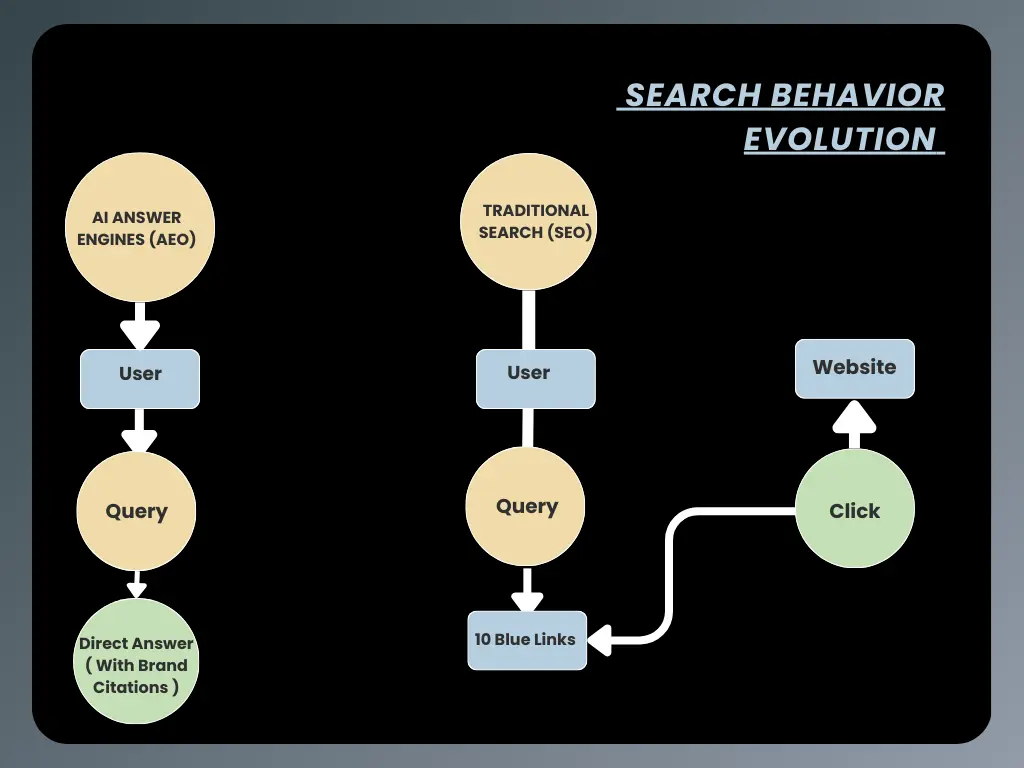
This shift has massive implications for brand visibility. When a user asks ChatGPT, “What’s the best project management software?” your brand either appears in that answer or it doesn’t. There’s no page two to optimize for, there’s only being mentioned or being invisible.
5 Strategies to Leverage AI Answer Engine Trends
Brands that understand both AI agents and marketing trends, as well as search engine optimization, will dominate their categories. Here’s how to ensure your brand appears in AI-generated answers.
Strategy 1: Create Citation-Worthy Content
AI answer engines pull information from sources they deem authoritative. Your content must be comprehensive, accurate, and structured for AI readability.
Key Elements:
Strategy 2: Build Topical Authority
Rather than targeting individual keywords, establish deep expertise in your category. AI systems evaluate topical authority when selecting sources.
| Authority Building Tactic | Impact Level | Implementation Difficulty |
|---|---|---|
| Comprehensive pillar content | High | Medium |
| Regular publishing schedule | Medium | Low |
| Expert author bylines | High | Medium |
| Industry partnerships | High | High |
| Original research/studies | Very High | High |
Strategy 3: Optimize for Conversational Queries
AI answer engines respond to natural language questions. Your content should directly address the questions your audience asks. Transform your content approach:
❌ Project Management Software Features. ✅ What features should I look for in project management software?
Strategy 4: Strengthen Brand Entity Signals
AI systems understand brands as entities. Strengthening your entity presence helps AI engines recognize and recommend your brand.
Entity optimization includes:
Strategy 5: Monitor AI Visibility
You can’t improve what you don’t measure. Regularly query AI answer engines about your category and track:
The Convergence: Using AI Agents for Answer Engine Optimization
Here’s where the two major trends intersect. Forward-thinking marketers are using AI agents in marketing to optimize their presence in AI answer engines.
Practical Applications:
| AI Agent Function | Answer Engine Benefit |
|---|---|
| Content research agents | Identify gaps in topical coverage |
| Writing agents | Create comprehensive, structured content |
| Monitoring agents | Track brand mentions in AI responses |
| Optimization agents | Update content based on AI preferences |
| Distribution agents | Build authority through strategic publishing |
This integration creates a powerful feedback loop where AI agents help you appear more prominently in other AI systems.
Implementation Roadmap: Your 90-Day Plan
Turning AI agents in marketing trends into practical results requires a structured approach.
Phase 1: Foundation (Days 1-30)
Phase 2: Implementation (Days 31-60)
Phase 3: Scale (Days 61-90)
Measuring Success: KPIs for AI Marketing
Track these metrics to evaluate your AI agents in marketing initiatives:
Performance Dashboard
EFFICIENCY METRICS
VISIBILITY METRICS
PERFORMANCE METRICS
ROI METRICS
Common Pitfalls to Avoid
As you implement AI agents in marketing trends, steer clear of these mistakes:
The Future: What’s Next for AI Agents in Marketing
The evolution of AI agents in marketing trends shows no signs of slowing. Emerging developments include:
- Truly autonomous marketing departments, Agent teams managing entire marketing functions
- Predictive market creation, AI identifying unmet needs before competitors
- Real-time personalization everywhere, Every touchpoint uniquely tailored
- Voice and multimodal optimization, AI agents optimizing for all content formats
- Emotional intelligence integration, Agents understanding and responding to customer emotions
Conclusion: Your Competitive Advantage Awaits
The convergence of AI agents in marketing and search engine optimization represents the most significant shift in marketing since the advent of social media. Brands that embrace latest AI technologies today will build insurmountable advantages over competitors who wait. The key is starting now, you don’t need to implement every trend simultaneously. Begin with one AI agent use case that addresses your biggest pain point.
Simultaneously, start creating content optimized for AI answer engines. As you’ve seen throughout this guide, AI agents in marketing trends aren’t about replacing human marketers; they’re about amplifying human strategic thinking with machine efficiency and scale. The future of marketing is already here, the only question is whether your brand will lead or follow.
Ready to transform your marketing with AI? Start by auditing your current marketing workflows and identifying one process where an AI agent could make an immediate impact. Your journey into the AI-powered marketing future begins with that single step.
What are AI agents in marketing?
AI agents in marketing are autonomous software systems that use artificial intelligence to perform marketing tasks independently, including campaign management, content creation, customer engagement, and analytics.
How do AI answer engines affect brand visibility?
AI answer engines provide direct answers to user queries, meaning brands must be cited in AI responses to gain visibility. This requires Answer Engine Optimization (AEO) strategies focused on creating authoritative, well-structured content.
What is the difference between marketing automation and AI agents?
Traditional marketing automation follows pre-set rules, while AI agents can learn, adapt, and make independent decisions based on data analysis and changing conditions.
How can small businesses leverage AI agents in marketing trends?
Small businesses can start with accessible AI agent tools for specific tasks like content creation, email optimization, or customer service chatbots, then scale as they see results.
What skills do marketers need to work with AI agents?
Marketers should develop skills in AI prompt engineering, data analysis, strategic oversight, and understanding AI capabilities and limitations.