Amazon AI Division Changes: What Just Happened in 2026
The Amazon AI division changes of 2026 mark one of the biggest strategy resets in the company’s history. In a matter of months, Amazon cut jobs in its artificial general intelligence (AGI) unit, closed its AGI Lab, wound down most of its in-house Nova models, and lost two of its top AI leaders. These Amazon AI division changes touch teams, products, and leadership all at once. At aiera.blog, we pulled the whole story into one place so you can see exactly what happened and why it matters.
Here’s the short version:
- Amazon laid off staff in its AGI unit and shut its AGI Lab, including an 80-person research site in San Francisco.
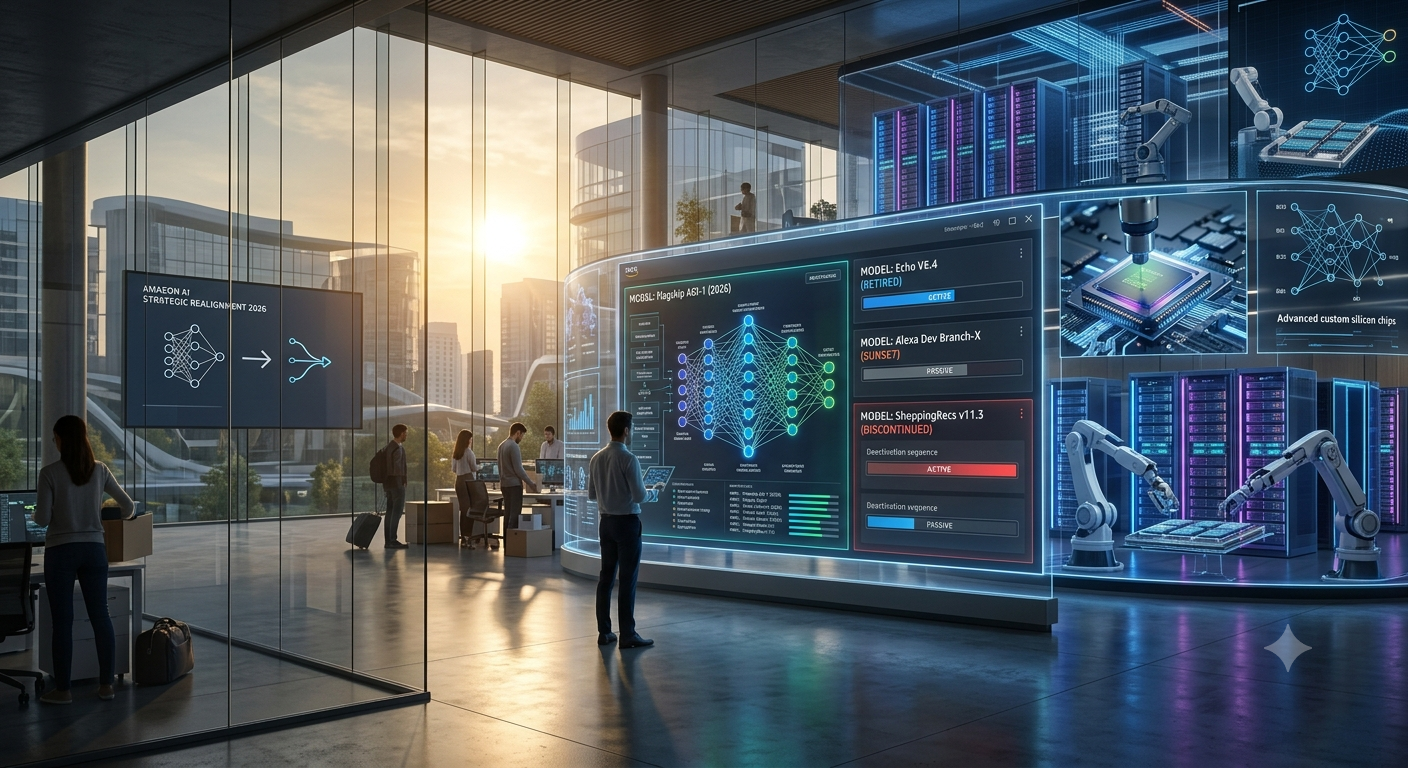
- Most flagship Nova models — Premier, Omni, Reel, and Canvas — are being wound down to “keep the lights on” mode.
- Amazon is pouring what’s left into a single new frontier model, due at AWS re:Invent in late 2026.
Below is the full timeline of these Amazon AI division changes, plus what they mean for AWS customers, developers, investors, and everyday Alexa users.
What Changed: The Quick Timeline
The reset didn’t happen overnight. It built up over roughly eight months:
- December 17, 2025 — CEO Andy Jassy folds the AGI group into a unified organization covering AI models, custom silicon, and quantum computing, led by senior vice president Peter DeSantis. AI chief Rohit Prasad is set to depart.
- February 2026 — David Luan, who founded Amazon’s AGI Lab, leaves the company.
- April 2026 — Jassy’s shareholder letter reveals an annualized AI-services run rate above $15 billion and confirms up to $5 billion more in funding for Anthropic.
- May 13, 2026 — Amazon retires its standalone Rufus shopping chatbot and replaces it with Alexa for Shopping.
- July 22, 2026 — Amazon confirms layoffs in its AGI unit.
- July 28–30, 2026 — Reports confirm most Nova models are being deprecated and the AGI Lab has closed.
- Late 2026 (AWS re:Invent) — A new frontier model from a fresh research team is expected to debut.
Taken together, the Amazon AI division changes show a company moving from “build everything” to “build one thing well, and rent the rest.”
The AGI Layoffs of 2026
On July 22, 2026, Amazon confirmed it had laid off employees in its AGI organization — the group behind its Nova models. The company did not say how many people were affected or which teams were hit hardest, though reports pointed to units led by vice presidents Adeeb Shanaa and Vishal Sharma.
An Amazon spokesperson framed the cuts as sharpening focus rather than retreating. Building large AI models “remains one of the most important things we’re working on,” the spokesperson said, but the company is concentrating on “the initiatives that matter most for customers.” Affected U.S. employees received 90 days of pay and benefits, outplacement support, transitional health coverage, and severance eligibility.
These AGI cuts weren’t isolated. They followed a broader run of reductions — Amazon eliminated roughly 16,000 roles in January 2026, part of more than 30,000 job cuts since October 2025 (see our 2026 tech layoffs tracker). Seen in that light, the layoffs are one visible piece of the wider Amazon AI division changes.
The AGI Lab Shutdown and San Francisco Closure
The layoffs came alongside a bigger structural move: Amazon shut its AGI Lab. The lab was formed in 2024, largely from the talent Amazon acquired through its deal with AI startup Adept. Its 80-person research site in San Francisco has now closed, even as Amazon insists work on its top models continues elsewhere.
The lab’s closure was, in many ways, the writing on the wall. Its founder, David Luan, had already left in February — one of a string of senior exits that hollowed out Amazon’s frontier-AI ambitions before the formal restructuring landed. Of all the Amazon AI division changes, the lab shutdown is the clearest structural signal that the company no longer wants a standalone frontier-research shop.
Nova Models: What’s Cut and What Survives
The clearest proof of the shift is at the product level. Amazon launched its Nova family at re:Invent in December 2024 as affordable rivals to models from OpenAI, Anthropic, and Google. Less than two years later, most of that lineup is being quietly pulled. This product retreat is the part of the Amazon AI division changes that customers will feel most directly.
Here’s where things stand:
| Model | Status | Notes |
|---|---|---|
| Nova Premier | Wound down (KTLO) | High-end model; maintenance only |
| Nova Omni | Wound down (KTLO) | Multimodal; development halted |
| Nova Reel | Wound down (KTLO) | Video generation; deprioritized |
| Nova Canvas | Wound down (KTLO) | Image generation; deprioritized |
| Nova 2 Lite | Active | Stays in the portfolio |
| Nova 2 Sonic | Active | Real-time voice model |
| Nova Forge | Active | Customization service |
| Nova Act | Active | Agentic tool |
“KTLO” — short for “keep the lights on” — means the models stay available for existing customers but are no longer a development priority. New investment is going elsewhere.
The Leadership Shake-Up
Few AI teams have seen this much turnover this fast. The people who built Amazon’s model strategy are largely gone, and a new group is in charge:
- Rohit Prasad, who led Amazon’s AGI work, left at the end of 2025.
- David Luan, AGI Lab founder, departed in February 2026.
- Peter DeSantis, a longtime infrastructure executive, now runs the unified organization spanning AI models, silicon, and quantum.
- Pieter Abbeel, a UC Berkeley professor and Covariant founder who joined through Amazon’s 2024 acquisition, leads the new Frontier Model Research (FMR) team.
- Matt Wood, an AWS veteran, returned as Chief AI and Technology Officer.
The message behind this leg of the Amazon AI division changes is clear: infrastructure and research leaders are in, and the previous model-first regime is out.
Why Amazon Is Doing This
So why gut a division the company spent years building? The Amazon AI division changes look drastic, but a few clear reasons stand out.
First, Nova never broke through. Amazon never made it a household name the way OpenAI, Anthropic, and Google did with their models. The models also proved expensive to run for the value they delivered, while cheaper rivals kept undercutting on price.
Second, Amazon would rather be the landlord than another tenant. AWS already hosts much of the AI industry’s compute — including commitments worth $138 billion from OpenAI and more than $100 billion from Anthropic — and its custom Trainium chips are now a multibillion-dollar business that Jeff Bezos calls a fourth company pillar.
Third, the partnership path is working. More than 100,000 customers run Anthropic’s Claude on Amazon Bedrock, and Amazon has invested billions in Anthropic. Why pour scarce compute into losing models when you can sell the infrastructure underneath the winners?
Finally, the money backs the pivot. Amazon plans roughly $200 billion in capital expenditure in 2026, most of it on data centers, chips, and networking — the picks-and-shovels layer of AI. In that sense, the Amazon AI division changes are less about giving up on AI and more about choosing a different place to compete.
The Frontier-Model Bet: What’s Next
Amazon isn’t abandoning AI models altogether. Instead, it’s making one big bet instead of many. Talent and compute freed up by the Nova wind-down are flowing to Pieter Abbeel’s Frontier Model Research team, which is building a single, genuinely competitive foundation model.
That flagship model is expected to debut around AWS re:Invent in late 2026. Amazon hasn’t confirmed its name — it may still carry the Nova branding. The real test of the Amazon AI division changes is whether the company can build a frontier model that developers actively choose over Claude, Gemini, or GPT. Hosting everyone else’s models is a strong business; building one people prefer is a much harder game.
What the Amazon AI Division Changes Mean for You
The Amazon AI division changes land differently depending on who you are:
- AWS and Bedrock customers: Your options aren’t shrinking so much as consolidating. Claude, plus surviving Nova tools like Nova Act and Nova Forge, remain first-class on Bedrock. If you built on Nova Premier, Omni, Reel, or Canvas, plan a migration path, since these are now maintenance-only.
- Developers: Expect Amazon to push agentic and enterprise tooling harder than raw model bragging rights. Betting on Bedrock’s multi-model approach — rather than any single Amazon model — is the safer long-term play.
- Investors: This is a margin story. Amazon is trading uncertain model glory for a more defensible infrastructure business, while $200 billion in capex tests patience. Watch re:Invent for proof the frontier bet is real.
- Alexa and shopping users: The consumer side already changed. Rufus is gone, folded into Alexa for Shopping — a single assistant that lives across the app, the website, and Echo Show.
How Big Are These Amazon AI Division Changes?
To put the reset in context, this is not a routine team reshuffle. Within about eight months, Amazon lost its two most senior AI leaders, closed a dedicated research lab, deprecated four flagship models, and reorganized the remaining talent under an infrastructure boss. For a company that launched Nova with fanfare in 2024, that is a fast and public reversal. The Amazon AI division changes also fit a wider 2026 pattern across Big Tech, as firms stop chasing every model and instead back the products and partnerships that actually pay off. In short, Amazon is trading breadth for focus.
Frequently Asked Questions
What do the Amazon AI division changes mean for AWS customers? Short term, very little breaks. Surviving Nova tools and Anthropic’s Claude stay available on Bedrock. If you rely on Nova Premier, Omni, Reel, or Canvas, start planning a migration, since those models are now maintenance-only.
Why is Amazon making changes to its AI division? Amazon is refocusing on enterprise AI and infrastructure. Its Nova models underperformed rivals and were costly to run, so it cut AGI roles and shifted talent and compute toward one frontier model and partners like Anthropic.
Is Amazon shutting down Nova? Not entirely. Amazon is winding down Nova Premier, Omni, Reel, and Canvas into maintenance mode, but keeps Nova 2 Lite, Nova 2 Sonic, Nova Forge, and Nova Act active while it builds a new flagship model.
Who leads Amazon’s AI division now? Peter DeSantis leads the unified organization covering AI models, silicon, and quantum. Pieter Abbeel heads the new Frontier Model Research team. Rohit Prasad and David Luan have both left.
How many people did Amazon lay off in the AGI unit? Amazon confirmed the layoffs in July 2026 but did not disclose a number. Affected U.S. employees received 90 days of pay and benefits, outplacement support, and severance eligibility.
What is Amazon’s new frontier model? It’s a single flagship model from the Frontier Model Research team, led by Pieter Abbeel, expected to debut around AWS re:Invent in late 2026. Amazon hasn’t confirmed its final name.
The Bottom Line
The Amazon AI division changes of 2026 aren’t a company quitting AI — they’re a company choosing where to fight. Amazon is stepping back from the crowded model race and leaning into what it already dominates: cloud infrastructure, custom chips, and partnerships with the labs building the best models. Whether these Amazon AI division changes pay off will become clearer once the frontier-model bet is tested at re:Invent. For more plain-English breakdowns of the biggest moves in AI, keep following aiera.blog