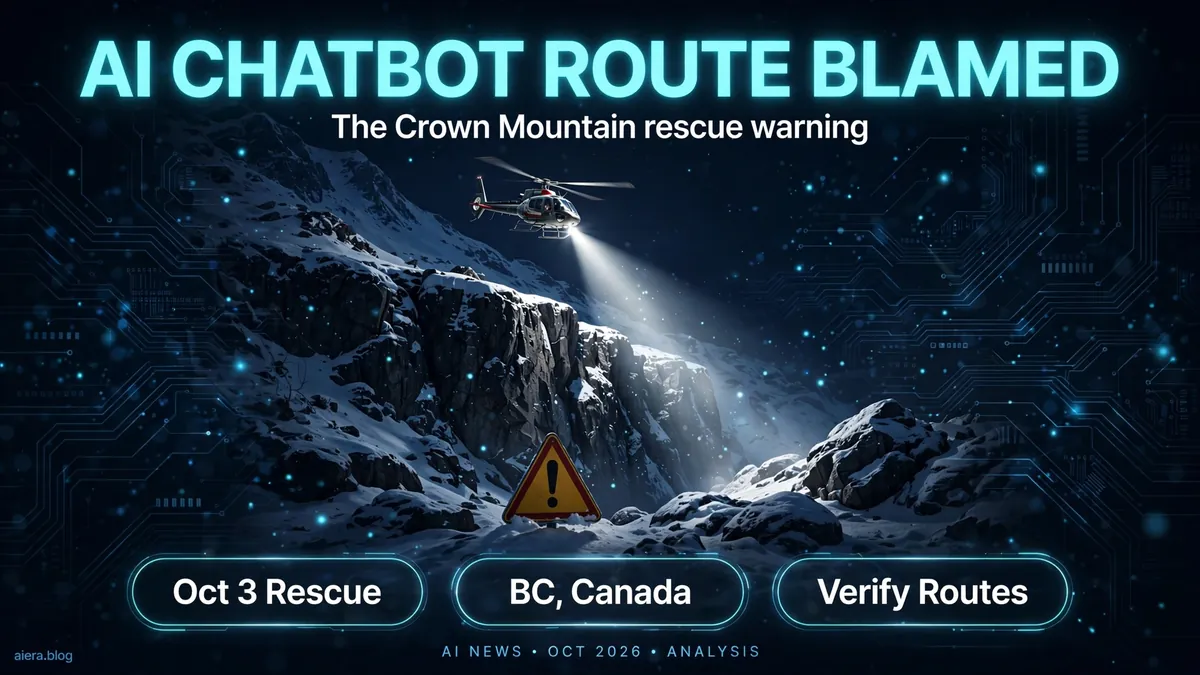
AI Chatbot Route Blamed for Crown Mountain Rescue: What Really Happened
Key Takeaways
- The crown mountain rescue in British Columbia was triggered when a 16-year-old hiker became stranded at the base of a technical climbing cliff after a route plan involving an AI chatbot steered him off the standard hiking trail.
- North Shore Rescue, a volunteer search-and-rescue organisation, extracted the teen by helicopter on Saturday 3 October 2026 after he phoned his mother and called emergency services from the cliff base.
- Rescue search manager Paul Markey warns hikers to "not blindly rely on AI as a route planning tool," noting that "Claude has never been in that specific area, has never been on that route, and has never been in the outdoors."
- The teen disputes the framing: he says he spent three days planning, used AllTrails and Google Maps as his primary sources, and only cross-referenced some information with Claude, entering the climbing terrain by his own mistake at an unmarked turn.
- Chatbots fail at real-world navigation because they generate plausible-sounding directions without grounding in terrain, current conditions, or the difference between hiking and technical climbing routes — a limit already exposed by a similar September 2026 incident on California's Mt. Shasta involving Google's Gemini.
Introduction
The crown mountain rescue on 3 October 2026 is already being called a cautionary tale for the AI age — and unusually, the story is not about an AI system doing something remarkable. It is about what happens when a confident-sounding chatbot offers directions through terrain it has never seen. Sixteen-year-old Bryce Gowryluk, an experienced hiker and keen indoor climber from Vancouver, set out for Crown Mountain, north of Vancouver, with a route plan that rescuers say was shaped by conversations with Anthropic's Claude chatbot. The plan led him off the standard non-technical hiking route and onto Widowmaker Arete, a technical 5.9 multi-pitch climbing route that demands ropes, cams, and a climbing plan — none of which he had. Stranded at the base of its final headwall, he did the one thing rescuers say he got exactly right: he called for help early. Volunteer search-and-rescue crews extracted him by helicopter, unhurt. What makes this case important is not just the happy ending. It is the dispute at its centre: rescuers blame the chatbot's navigation advice, while the teen insists the framing is unfair and that his own mistake at an unmarked turn was the real cause. This article lays out both accounts, the facts everyone agrees on, and what the incident exposes about the honest limits of AI in the outdoors.
What happened on Crown Mountain
Crown Mountain sits north of Vancouver in British Columbia, a popular backcountry objective reachable via Grouse Mountain. On Saturday 3 October 2026, Bryce Gowryluk — also reported as Bryce Vincent Gowryluk — took the gondola to the top of Grouse Mountain and hiked toward Crown Mountain, intending to follow a route plan he had worked up over three days of preparation.
Somewhere along the way, the plan went wrong. Instead of staying on the standard non-technical hiking route, Gowryluk descended Crown Pass and crossed the Crater Slabs and Crown Couloir — also known as Crown Gully — eventually reaching the base of the final headwall of Widowmaker Arete. That last detail matters enormously. Widowmaker Arete is not a hiking route. It is a technical multi-pitch climbing route graded 5.9, requiring ropes, protection hardware like cams, and a climbing plan. Gowryluk was, in the words of North Shore Rescue search manager Paul Markey, "pretty well equipped for hiking and scrambling, but certainly not prepared or equipped for rock climbing."
He carried a headlamp, good clothing, boots, a spare battery, and spare food. His phone stayed charged, and crucially, he called his mother first and then phoned emergency services. Police notified North Shore Rescue, and the volunteer team mobilised. North Shore Rescue posted about the incident on Facebook on Sunday 4 October.
The chatbot's role: what Claude actually did
According to North Shore Rescue, Gowryluk had generated — or at least consulted on — his route plan using Claude, Anthropic's AI chatbot. The suggested path led him off the standard hiking route and onto climbing terrain. Markey's assessment was blunt: "do not blindly rely on AI as a route planning tool." He added the line that has since been quoted across coverage of the story: "Claude has never been in that specific area, has never been on that route, and has never been in the outdoors."
That single sentence captures the technical problem at the heart of the incident. A chatbot can produce a route plan that reads as confident and well-structured while having no grounding in the physical terrain it describes. It cannot distinguish, from a trail description alone, where a hiking route ends and a climbing route begins — a distinction that on Crown Mountain is the difference between a long day out and a helicopter extraction.
It is worth stating clearly what the chatbot did and did not do. The AI chatbot's route advice contributed to the emergency. It did not help with the rescue in any way. The rescue was carried out entirely by human volunteers. Any framing that suggests a chatbot "helped" with the rescue inverts what actually happened, and this article deliberately avoids it.
Anthropic, for its part, has not commented. The company did not respond to requests for comment about the incident, so there is no official Anthropic statement on record.
The Crown Mountain rescue: how North Shore Rescue got him out
The extraction was anything but simple. North Shore Rescue had coincidentally just finished helicopter hover-entry recertification training on Crown Mountain that same day, so crews and aircraft were available. But the cliff where Gowryluk was stranded could not be approached directly by helicopter — the terrain was too tight for the aircraft to get close.
So the volunteers did it the hard way. Two rescuers were inserted above Gowryluk's position. One of them was belayed down the cliff face to reach him, then moved the teen to a safe extraction point from which he could be winched up and flown to the North Shore Rescue base near Cleveland Dam. He was unhurt.
Rescuers had particular praise for one decision: he called early. In search and rescue, a delayed call turns a straightforward extraction into a night operation or worse. Gowryluk's charged phone, his early call, and his willingness to ask for help before the situation deteriorated made the operation possible. North Shore Rescue is an all-volunteer team, and the operation drew on the specialised alpine skills its members train for year-round.
The teen's rebuttal: "AI isn't to blame"
Here is where the story becomes more complicated than the headlines. Gowryluk disputes the rescuers' framing. In an interview with CBC News — covered by 1News — he says he did not plan the trip with Claude at all. According to his account, he spent three days planning the hike, primarily used AllTrails and Google Maps, and only cross-referenced some information with Claude — using the chatbot mostly for his packing list.
He also says the critical mistake was his own. He believes he missed an unmarked turn and thought he was somewhere else when he entered the Widowmaker area. In his view, blaming AI alone is unfair, and he takes responsibility for the navigation error himself.
Both accounts deserve to be taken seriously. The rescuers' version is based on their conversation with the teen during and after the rescue and is the only official account from the responding organisation. The teen's version is his direct testimony about his own preparation. The truth may well contain elements of both: a cross-referenced plan, a missed turn, and a chatbot that failed to catch — or actively reinforced — a dangerous error.
There is a reported coda worth mentioning with the proper caveat. According to a secondhand account via The Outpost, Gowryluk says he intends to keep climbing but will "never again" use AI for route planning. Because this comes through a secondary report rather than a direct interview on record, it should be treated as reported rather than confirmed.
What is not disputed: nobody in the official record has produced an incident report beyond North Shore Rescue's Facebook post, the exact time of the distress call has not been published, and it is unknown whether the teen used a free or paid tier of Claude — a detail that is irrelevant to what happened.
Why chatbots fail at real-world navigation
The Crown Mountain incident is not an isolated quirk. Just weeks earlier, in September 2026, three hikers on California's Mt. Shasta used Google's Gemini to plan a route, according to Backpacker citing search-and-rescue teams. They summited via the Clear Creek Route, their phones died, and they wandered off-route into Mud Creek Canyon, requiring rescue the next morning. Two incidents, two different chatbots, the same failure mode.
The pattern is predictable once you understand what a chatbot is doing. A large language model generates text based on patterns in its training data. It does not "know" the route the way a guide knows it. It has no access to your exact position, the weather on the ridge today, the condition of a snow bridge, or whether the turn you just missed was the critical one. It can describe a route that sounds authoritative while omitting the one detail that keeps you alive — because it never had that detail in the first place.
This is why the advice from rescue professionals is so consistent, and it is worth connecting to the broader conversation about AI safety: an AI system that is perfectly safe for writing emails can be dangerous when its output is treated as expert guidance in a high-stakes physical environment. Some observers have gone further and argued the pace of AI deployment itself is the risk — a debate covered in our piece on why some experts want AI development slowed down.
Chatbots also suffer from sycophancy and overconfidence: they agree with the user's framing and rarely volunteer that they are out of their depth. A human guide who has never been on a route would say so. A chatbot will generate the route anyway, with numbered steps and confident headings. In the backcountry, that confidence is the hazard.
What the rescue crews recommend instead
Paul Markey's recommendation is simple and practical: use established, authoritative navigation tools and cross-check everything. He named Caltopo, AllTrails, and GaiaGPS — tools built on real maps, real trail data, and real trip reports from people who have been there. Even the teen's own rebuttal, notably, cites AllTrails as his primary source, which underlines a shared lesson: whatever you use, the verification has to come from ground truth, not from a chatbot's fluency.
For anyone planning a backcountry trip, the practical checklist that emerges from this incident is straightforward:
- Plan from authoritative map sources first, not from a chatbot.
- Cross-check any route against at least two independent sources, including recent trip reports.
- Understand the difference between the grade of your route and the grade of your skills — hiking, scrambling, and technical climbing are different sports with different equipment.
- Carry the ten essentials, keep your phone charged, and call early if something goes wrong — the rescuers were explicit that calling early is what kept this incident from becoming a tragedy.
- Tell someone your exact plan and your expected return time.
The honest limits of AI in the outdoors
There is a version of this story in which the lesson is "never use AI." That is too simple, and it is not what the evidence supports. Used correctly — for brainstorming packing lists, summarising regulations from official sources you then verify, translating a phrase for a hut booking — AI can be a useful trip-planning assistant. The honest limit is the boundary between information and judgement. A chatbot can inform; it cannot judge. It cannot look at a ridge and tell you the snow is wrong for today. It cannot feel your fatigue, assess your skill against the terrain, or know that the turn you are about to take is the one that leads to a 5.9 headwall.
The Crown Mountain rescue should be filed alongside the Mt. Shasta incident as early evidence of a predictable new category of backcountry accident: the AI-assisted navigation error, a case that WebProNews framed as exposing the navigation limits of AI. The technology will get better at sounding right. That is precisely why the verification has to stay human. The mountains do not care how confident your chatbot was.
For readers thinking about how AI fits into their work and daily routines in lower-stakes settings, our companion piece on AI agents and how they work explains where these systems genuinely excel — and our free AI tools guide is a safe place to start experimenting. But when the consequences are physical, the rule from the people who do the rescuing stands: do not blindly rely on AI as a route planning tool. Verify with authoritative sources, carry the right gear, and call early.