AI Fundamentals Microsoft: What AI-900 Covers & How to Pass It in 2026
AI Fundamentals Microsoft (AI-900) is a beginner-level certification that teaches the core concepts of artificial intelligence, including machine learning, computer vision, natural language processing, and generative AI, all within Microsoft’s Azure ecosystem. It’s designed for anyone who wants a structured, credible foundation in AI, whether you’re a complete beginner, a career switcher, or a manager who needs to speak the language of AI confidently. Here’s everything you need to know to understand it, study for it, and pass it in 2026.
Why AI Fundamentals Microsoft Matter Right Now
Let me be real with you: two years ago, “AI literacy” was a nice-to-have. Today, it’s becoming a baseline expectation across industries. According to McKinsey’s 2024 Global Survey on AI, 72% of organizations now use AI in at least one business function, a sharp increase from roughly 50% the year before. That means whether you work in marketing, finance, healthcare, or operations, AI is already reshaping your field.
At the same time, LinkedIn’s 2025 Most In-Demand Skills report shows that AI literacy and prompt engineering are among the fastest-growing skills employers actively seek, even for non-technical roles. So the question isn’t whether you need to understand AI. It’s how you start. And for millions of learners worldwide, Microsoft’s AI Fundamentals path has become that starting point.
When I first explored AI Fundamentals Microsoft course, I assumed it would be too surface-level to matter. Just another certificate to collect, I was wrong; it gave me a mental framework that made every AI conversation, tool, and decision afterward significantly clearer.
What Are AI Fundamentals Microsoft Version?
AI Fundamentals Microsoft refers to two connected things:
As outlined on Microsoft’s official AI-900 certification page, the certification is designed for candidates with both technical and non-technical backgrounds. You don’t need to be a developer, you don’t need to know Python, you need to understand what AI is, how it works at a high level, and how Azure delivers AI services.
The exam was updated in early 2024 to include generative AI concepts, covering Azure OpenAI Service, large language models, and Microsoft Copilot. That update made AI-900 dramatically more relevant than its previous version.
Who Is This Actually For?
This certification speaks to three distinct audiences:
Let me be honest here: this is NOT for advanced users. If you have already built ML models in TensorFlow or PyTorch, AI-900 will bore you. It’s a fundamentals exam, and that’s exactly its strength for the right audience.
Why Microsoft’s Version Beats Generic AI Courses
There are hundreds of “Intro to AI” courses online. So why choose Microsoft’s?
As HubSpot’s marketing blog noted in its roundup of top AI certifications, Microsoft’s fundamentals-level exams are particularly strong for professionals seeking industry-recognized credentials without a steep technical barrier.
What Does the AI-900 Exam Actually Cover?
The AI-900 exam was restructured in 2024. Here’s the current domain breakdown based on Microsoft’s exam skills outline:
Domain Breakdown Table
| Domain | Weight | What It Covers |
|---|---|---|
| Describe AI workloads & considerations | 15-20% | Common AI use cases, responsible AI principles |
| Fundamental principles of machine learning | 20-25% | Supervised vs unsupervised learning, deep learning basics, regression, classification |
| Features of computer vision | 15-20% | Image classification, object detection, OCR, Azure AI Vision |
| Features of NLP workloads | 15-20% | Text analytics, language understanding, speech services, translation |
| Features of generative AI | 15-20% | LLMs, Azure OpenAI Service, prompt engineering, Copilot concepts |
| Azure AI services & tools | 15-20% | Azure Machine Learning Studio, Cognitive Services, Bot Service |
The Generative AI Update: Why This Changed Everything
Before 2024, AI-900 felt somewhat dated. It covered classical ML concepts well but ignored the generative AI revolution entirely.
Now, the exam includes:
This update alone makes AI-900 one of the most current entry-level AI certifications available. As Simplilearn’s certification guide points out, the inclusion of generative AI fundamentals Microsoft exam puts you ahead of several competing entry-level AI credentials.
Is the AI-900 Certification Worth It in 2026?
Short answer: yes, but with realistic expectations.
Pearson VUE’s certification trend data shows that AI fundamentals Microsoft exams have seen a significant uptick in registrations since 2023, especially among career-switchers and non-developers. Employers aren’t just looking for AI engineers anymore. They want people across the organization who understand AI.
But here’s my honest take: You won’t become an AI engineer by passing this exam that’s not the point. If someone tells you AI-900 will land you a $150K machine learning job, they’re lying.
What AI-900 Gets You (and What It Doesn’t)
| ✅ What It Gets You | ❌ What It Doesn’t |
|---|---|
| Employer-recognized credential | A job by itself |
| LinkedIn certification badge | Deep technical skills |
| Structured mental model of AI | Ability to build production AI systems |
| Foundation for advanced certs (AI-102, DP-100) | Expert-level Azure knowledge |
| Confidence in AI conversations | Coding proficiency |
Career paths it supports: AI-adjacent product management, consulting, data analytics, business intelligence, technical sales, and any role where understanding AI is an advantage, which, in 2026, is most roles.
How Long Does It Take to Study? A Realistic Timeline
I’ve seen blog posts claim you can pass AI-900 in “a weekend.” Technically possible? Sure, if you have a tech background and a very focused weekend. Realistic for most people? No.
Here’s an honest breakdown:
Free and Paid Study Resources Worth Your Time
Study strategy tip: Don’t just read. Use the Azure portal (free tier) and actually click through the AI services. Seeing Azure AI Vision analyze an image teaches you more than reading five paragraphs about it.
Can You Pass AI-900 With No Coding Background?
Absolutely yes, this is one of the most common concerns I hear, and it’s the easiest to address. AI-900 is a conceptual exam. There is no coding on it. You won’t write Python. You won’t debug algorithms. You need to understand what machine learning does, not how to implement it in code.
Here’s how I’d explain one of the trickiest concepts for non-technical learners:
Supervised learning is like studying with an answer key. You show the AI thousands of examples where you already know the correct answer (“this email is spam,” “this email is not spam”), and the AI learns the pattern. Then, when it sees a new email, it can predict: spam or not spam.
That’s the level of understanding AI-900 requires. If you can follow that explanation, you can pass this exam.
Your AI Fundamentals Microsoft Roadmap: What Comes After AI-900?
AI-900 is a starting point, not a destination. Here’s how Microsoft’s AI certification path unfolds:
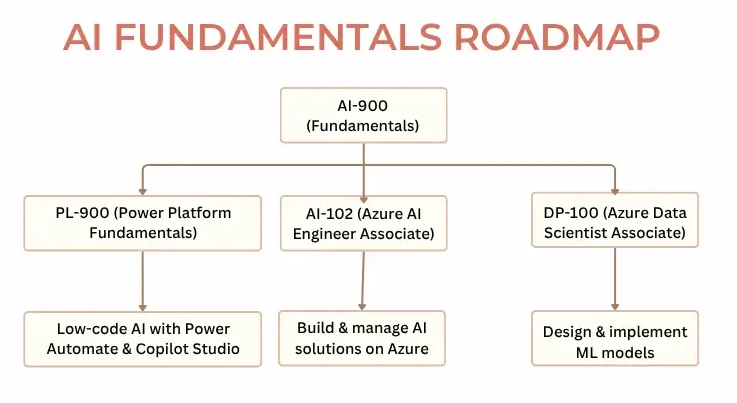
For career switchers, I recommend AI-900 → PL-900 → AI-102. This takes you from “understanding AI” to “building with AI” to “engineering AI solutions” a clear, resume-friendly progression.
If you’re exploring broader Azure certifications, check out Microsoft’s certification poster for the full landscape.
AI Fundamentals Microsoft Cheat Sheet
Bookmark this section, it’s your quick reference for every key concept in the AI-900 exam.
Core Definitions
| Term | Simple Definition |
|---|---|
| Artificial Intelligence (AI) | Software that mimics human-like capabilities (seeing, hearing, understanding, deciding) |
| Machine Learning (ML) | A subset of AI where systems learn patterns from data instead of being explicitly programmed |
| Deep Learning | ML using neural networks with many layers, powers image recognition and language models |
| Natural Language Processing (NLP) | AI that understands, interprets, and generates human language |
| Computer Vision | AI that analyzes and understands images and video |
| Generative AI | AI that creates new content (text, images, code) based on learned patterns |
| Large Language Model (LLM) | A massive neural network trained on text data (e.g., GPT-4) |
| Responsible AI | Microsoft’s framework for building AI that is fair, reliable, safe, private, inclusive, transparent, and accountable |
| Azure OpenAI Service | Microsoft’s managed access to OpenAI models (GPT, DALL-E, Whisper) within Azure |
| Microsoft Copilot | AI assistant embedded across Microsoft 365 apps, powered by LLMs |
Azure AI Services Mapped to Concepts
| AI Concept | Azure Service |
|---|---|
| Image analysis | Azure AI Vision |
| Speech-to-text / Text-to-speech | Azure AI Speech |
| Text analytics & sentiment | Azure AI Language |
| Chatbots | Azure Bot Service + AI Language |
| Generative AI / GPT access | Azure OpenAI Service |
| ML model training | Azure Machine Learning |
| Document processing | Azure AI Document Intelligence |