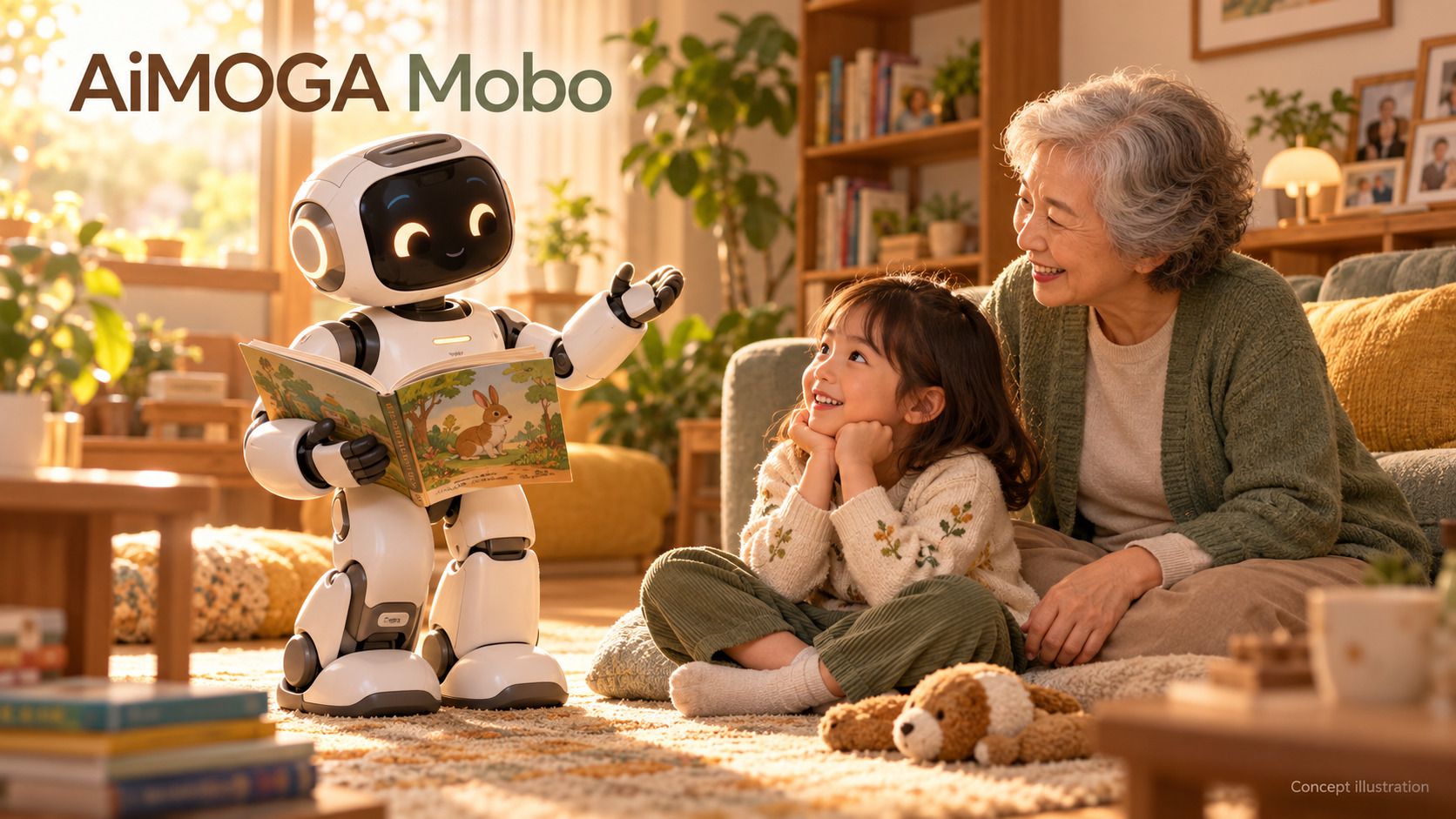
AiMOGA Mobo Robot: A 0.9-Metre Humanoid Companion for Family Life
Key Takeaways
- AiMOGA Robotics launched Mobo on 23 October 2026, its first consumer-grade humanoid family companion robot, unveiled globally from its headquarters in Wuhu, China.
- Mobo stands 0.9 metres tall, has 22 degrees of freedom, and supports more than 20 languages, including Bahasa Malaysia, according to AiMOGA.
- It is powered by MoAgent, AiMOGA’s embodied intelligence system, which the company describes as a dual-brain architecture for real-time responses, multi-tasking, and adaptive learning.
- For families, Mobo is designed for children’s interactive learning and storytelling, object recognition, and elders’ conversational companionship and customisable reminders.
- Beyond the home, AiMOGA says Mobo has potential in customer service and logistics, building on its earlier deployments in sales reception, traffic management, and medical guidance.
- No consumer price, delivery date, or market-by-market availability was confirmed in the launch coverage, so buyers should wait for those details before judging Mobo as a purchase.
AiMOGA Robotics has launched Mobo, a small humanoid robot designed to live in the family home rather than on a factory floor or in a research lab. The launch, announced on 23 October 2026, marks the company’s move from commercial and public-service robots into consumer robotics, and it arrives at a moment when humanoid robots are shifting from exhibition pieces to products that companies hope ordinary households will actually buy. Mobo is not a full-size humanoid. At 0.9 metres tall, roughly waist height for an adult, it is sized to be approachable, especially for children, and to move around a home without dominating a room. That size choice is itself a design statement: this robot is meant to be a companion first, and a machine second.
What Mobo is
Mobo is described by AiMOGA as its first consumer-grade humanoid family companion robot. It was unveiled globally from AiMOGA’s headquarters in Wuhu, China, during a joint international users summit with its sister brands, and the launch was framed as a step toward intelligent living for households and enterprises. AiMOGA is the robotics brand of Chery, the Chinese carmaker, and that parentage matters. The company says it draws on Chery’s global research and development system, including 31 in-house research laboratories focused on motion control and intelligent perception, and on automotive expertise in manufacturing, supply chain management, and quality control.
The specifications that matter
Mobo’s headline specifications are modest on paper and ambitious in combination. It stands 0.9 metres tall and has a full-body, 22-degree-of-freedom motion system. Degrees of freedom describe how many independent ways a robot’s joints can move, and 22 is enough, according to AiMOGA, for expressive gestures, stable movement, and dance routines. That last detail may sound like a novelty, but for a family companion, expressiveness is functional. A robot that can gesture, turn toward a speaker, and move in a way that reads as friendly is easier for children and older adults to interact with than a static screen on wheels.
Language support is another headline feature. Mobo supports more than 20 languages, including Bahasa Malaysia, which reflects the launch’s emphasis on Malaysian households and enterprises. For a family robot, language coverage is not a bonus feature. It determines whether grandparents, children, and visitors can all talk to the same device in the language they are most comfortable in, and whether the robot can be useful in multilingual homes and in customer-facing roles across different markets.
Mobo also offers voice interaction, visual object recognition, schedule reminders, and long-term memory. In practice, AiMOGA says, that means Mobo can discuss nearby objects, remind users of planned activities, and follow up on earlier conversations, creating more continuous interaction over time. It is designed to remember individual family members’ habits and preferences, with privacy protection incorporated from the outset, according to the company. That privacy claim deserves attention, because a robot that remembers habits, recognises faces, and listens in a home collects sensitive information by design. AiMOGA has not, in the launch coverage, published a detailed privacy policy for Mobo’s home use, so families should look for specifics on what data is stored, where it is stored, who can access it, and how it can be deleted before bringing such a device into a home with children.
MoAgent and the dual-brain idea
At the centre of Mobo is MoAgent, AiMOGA’s proprietary embodied intelligence system. Embodied intelligence is the term for AI that operates through a physical body, sensing the world, making decisions, and acting on them, rather than only producing text or images. AiMOGA describes MoAgent as a dual-brain architecture, and the launch announcement says it enables real-time responses, multi-tasking, and adaptive learning through facial recognition and secure MogaCloud integration.
AiMOGA’s executive vice president, Peng Xia, described Mobo’s spatial perception, interaction, execution, decision-making, and cognition layers as forming a perception-decision-execution-feedback loop. In plain language, that means Mobo senses its surroundings, decides what to do, acts, and then uses the result to adjust its next decision. Spatial memory enables object retrieval, while social navigation recognises pedestrian paths and interaction zones, so the robot can move around people without getting in the way. Multimodal technology coordinates language, facial expressions, and movement for more natural interaction.
It is worth being precise about what is confirmed and what is claimed here. The architecture description comes from AiMOGA, and independent benchmarks for Mobo’s real-time performance, navigation reliability, and long-term memory have not been published in the launch coverage. The dual-brain label is a company description of its system design, not an independently verified technical standard. That does not make it untrue, but it does mean buyers and researchers should treat it as a design claim to be tested in real homes, not as a proven capability. The history of consumer robotics is full of systems that worked well in staged demos and struggled with cluttered rooms, noisy households, and unpredictable children, and Mobo will be judged by how it handles those conditions.
What Mobo is designed to do at home
For children, AiMOGA positions Mobo as a learning and play companion. It offers interactive learning, storytelling, and object recognition, which could mean a child pointing at an object and asking what it is, listening to a story, or working through a learning activity with a robot that responds by voice and gesture. For parents, the appeal is obvious, but so are the questions. How is content moderated, how long can a child interact unsupervised, and what safeguards prevent the robot from sharing inappropriate material or collecting data about a child. Those questions are not answered in the launch announcement, and they should be answered before Mobo is treated as a children’s product rather than a family device that children may also use.
For older adults, Mobo is designed to provide conversational companionship and customisable reminders. That combination addresses two real needs: social contact, which can be scarce for people living alone, and practical support, such as reminders for medication, appointments, and daily routines. A robot companion is not a substitute for human contact or care, and AiMOGA does not claim that it is. But as a supplement, a device that can hold a conversation, remind someone of a planned activity, and follow up on an earlier chat could be genuinely useful, provided it is reliable. A missed reminder is worse than no reminder if a person comes to depend on it, so reliability in this role matters more than novelty.
Beyond the home: customer service and logistics
AiMOGA also says Mobo has strong potential in professional settings, from customer service to logistics. That claim builds on the company’s earlier work. AiMOGA has deployed robots in sales reception, smart traffic management, and medical guidance, and Mobo extends that experience into a smaller, more approachable form. In a shop, a hotel lobby, or a clinic waiting area, a 0.9-metre robot that can greet visitors, answer questions, and guide them could be less intimidating than a larger machine, and more engaging than a screen.
Why a carmaker is building a family robot
What is still missing
Several important details were not confirmed in the launch coverage, and readers should not fill them in by assumption. No consumer price was stated. No delivery date or shipping market list was published beyond the announcement of global pre-orders. No battery life, charging method, weight, or safety certification details were given in the coverage reviewed for this article. No independent review or hands-on test of a production unit was available at launch. Those gaps are normal for a launch announcement, but they mean Mobo should be followed as a product in development, not yet as a purchase recommendation.
The bigger picture
For readers thinking about where AI is heading more broadly, our article on AI to superintelligence traces the path from today’s tools to longer-term visions, and helps place a product like Mobo in context. Mobo is not superintelligence, and it does not claim to be. It is a practical, bounded attempt to bring embodied AI into a home, with clear uses and clear limits. That modesty is a strength, if the product delivers on it.
The fair summary is this: AiMOGA has launched a small, expressive, multilingual family companion robot with an ambitious intelligence system and a credible manufacturing background, but without yet publishing the price, delivery details, privacy specifics, or independent test results that would let families judge it as a purchase. Watch for those details, and for hands-on reports from real homes, before deciding whether Mobo belongs in yours. In the meantime, our guide to how AI can help your business offers a practical way to evaluate new AI products, whether they are built for a home or a workplace, by starting with the job to be done rather than the novelty of the technology.
Sources: AiMOGA Launches Global Robot Innovation: Mobo Debuts from Wuhu, Empowering Homes and Businesses and AiMOGA to Unveil Mobo, Its First Family Companion Robot, on October 21