Humanity’s First Exam: Google’s New Test Exposes the Reliability Gap in Frontier AI
Key Takeaways
- Google DeepMind released Humanity's First Exam (HFE) on Monday 24 November 2026, a benchmark that asks whether frontier AI models can answer straightforward, everyday questions correctly every time, not just once.
- The exam contains 544 elementary text and image prompts across 20 foundational capabilities, grouped into 136 families of four logic-preserving variants each.
- The top five models score between 96 and 98 per cent on a single attempt, but average only 85.6 per cent on the strict family pass^4 metric, which gives a family no credit unless every variant is answered correctly.
- OpenAI's GPT-6.2 Astra leads the ranking at 92.4 per cent on family pass^4, ahead of GPT-6.2 Sol at 86.9 per cent and Google's own Gemini 4 Neon at 85.8 per cent.
- Claude Opus 5.5 trails Astra by only 6.6 points on single attempts, but by 29.4 points on the strict consistency metric, showing that the gap between models is far wider on reliability than on capability.
- About 73 to 74 per cent of wrong answers involve visual perception, such as miscounting objects or misjudging positions in an image.
- The ranking is Google DeepMind's own, judged with Gemini, and only 20 per cent of the prompts are public, so the results should be read as one lab's measurement, not an independent rerun.
- A three-week Kaggle competition runs until 15 December 2026, inviting the community to submit everyday questions that today's models still get wrong, with $50,000 in Kaggle merchandise on offer.
What Humanity's First Exam Actually Tests
Most AI benchmarks ask a hard question. Can the model solve a difficult maths problem, write a working program, or reason through a graduate-level science question? Humanity's First Exam asks the opposite kind of question. It asks whether a model can answer a straightforward, everyday question correctly, and then whether it can answer the same question, changed in small ways, correctly again and again.
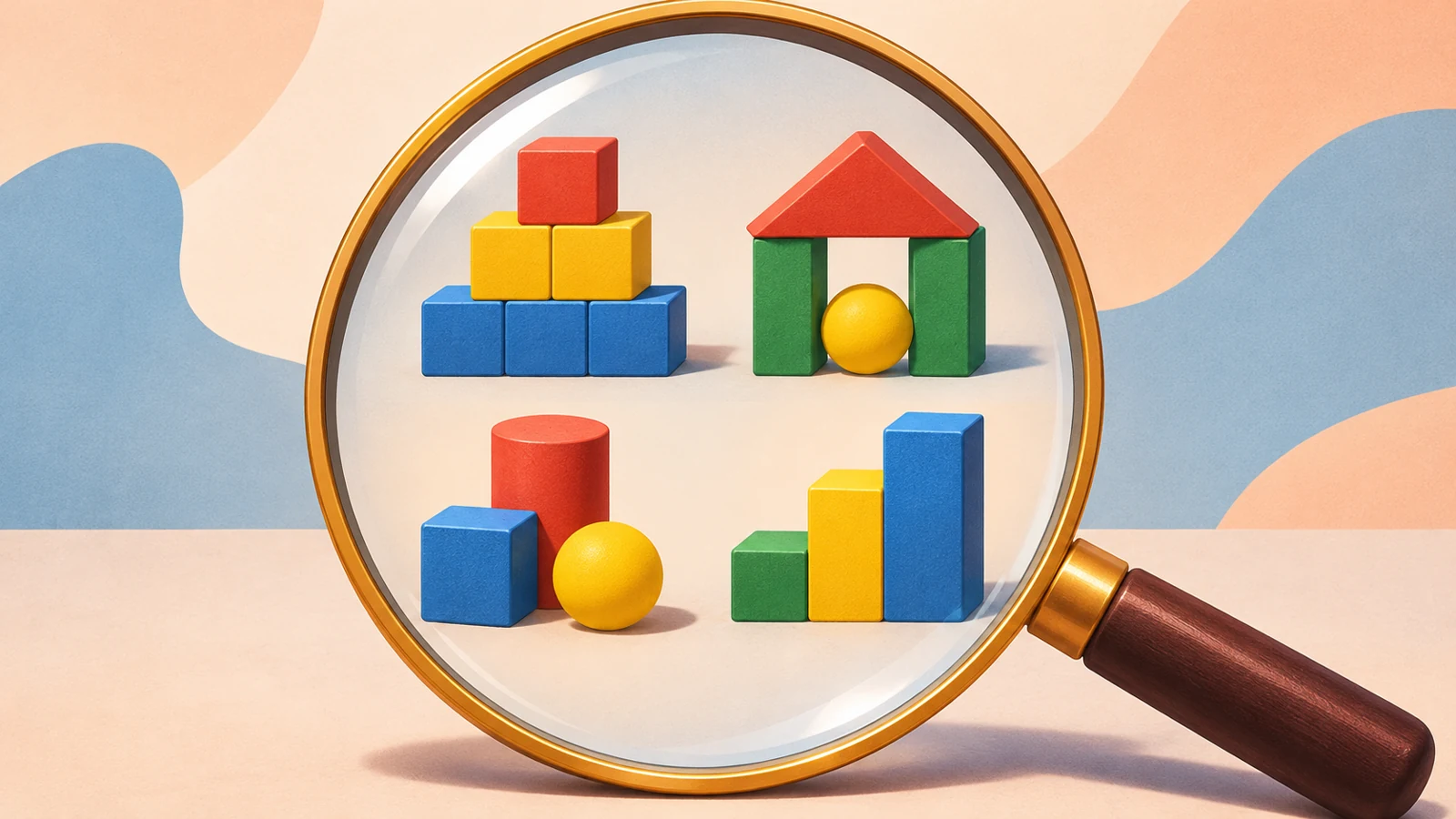
The name is a deliberate contrast with Humanity's Last Exam, the benchmark that probes expert-level reasoning at the upper edge of what models can do. Where that exam tests the ceiling of model capability, Humanity's First Exam tests the floor. The questions are elementary by design: counting objects in a picture, following a formatting instruction, reading the colour of letters in a sign, or working out how many coffee mugs in the foreground have no steam rising from them. A capable adult would answer most of them without thinking twice. The point is that a model which can solve a hard problem once may still fail a simple one the second time it is asked.
Google DeepMind launched the benchmark on Monday 24 November 2026, with a blog post and a technical report, and put it on Kaggle, where a live leaderboard scores the models and a public subset of the prompts is available for anyone to rerun. The dataset consists of 544 elementary text and image prompts across 20 foundational capabilities. Those prompts are organised into 136 families of four. Each family starts with one seed prompt and adds three variants that change names, word order, layout or image details while keeping the underlying logic exactly the same. A model that has genuinely understood the task should answer all four variants correctly. A model that got the first one right by luck, or by leaning on a surface pattern in the wording, is likely to fail one of the variants.
The prompts were built to break models. The DeepMind team kept only the seeds that made at least one model in a five-model panel fail, and then dropped every family that did not have four model-failing variants. That is an important detail, because it means the exam is not a random sample of everyday questions. It is a curated set of questions that are known to trip up at least one frontier model. The scores therefore do not estimate how often models fail in ordinary use. They measure something narrower and more useful: when a model is asked a simple question it has been known to get wrong, how often does it get it right every time?
The exam mixes text and images. Of the 544 prompts, 316 are multimodal, spread across 79 families, and 228 are text only. That split matters, because the failures turn out to be concentrated in the visual half of the exam, as the results below show.
Each model was run zero-shot, in a single turn, with no system prompt, no search and no code, six times on each prompt. That produced 3,264 rollouts per model, and 58,752 rollouts across the set of models evaluated. The evaluation ran in an isolated environment on Kaggle, without public internet access, so the models could not look anything up.
The Reliability Gap in Numbers
The headline result is a gap, and the gap is the whole point of the benchmark. The top five models score between 96 and 98 per cent when each prompt is attempted once, the metric known as pass@1. That is the kind of number that appears on leaderboards and in launch announcements. But when the scoring demands that a model answer all four variants in a family correctly, the average for those same five models falls to 85.6 per cent. The difference between demonstrating a capability once and applying it consistently is, on average, more than ten points, and for some models it is far larger.
Two metrics sit side by side in the results, and they measure different things. Family pass@4 asks whether at least one of the 16 runs across a family is correct. It is the capability ceiling: it shows what the model can do at its best, given repeated attempts. Every model in the top 12 sits between 99.3 and 100 per cent on this metric. Family pass^4 asks whether all 16 runs are correct. It is the floor, and it is where the ranking separates. The distance between the two is what the technical report calls the Family Reliability Gap, and across the 18 models evaluated it ranges from 7.6 to 80.1 percentage points.
The ranking on the strict metric is led by OpenAI's GPT-6.2 Astra, which scores 92.4 per cent on family pass^4 in the technical report, with a pass@1 of 97.8 per cent. GPT-6.2 Sol follows at 86.9 per cent, and Google's own Gemini 4 Neon at 85.8 per cent. The live Kaggle leaderboard, which uses a different configuration from the technical report, puts Astra first at 90.7 per cent, Sol second at 87.5 per cent and Gemini 4 Neon third at 85.6 per cent. The two sets of numbers are close but not identical, and direct comparisons between the leaderboard and the report are not valid, because Kaggle documents configuration and sampling differences between the two. The ordering, however, is the same in both.
The most striking comparison in the report is not at the top of the ranking but in the middle. Claude Opus 5.5, Anthropic's flagship model, scores 91.2 per cent on pass@1, trailing Astra by only 6.6 points. On the strict family pass^4 metric, Opus 5.5 scores 63.0 per cent, trailing Astra by 29.4 points. Claude Fable 5.2, the model we covered in our Claude Fable 5.2 article, scores 93.4 per cent on pass@1 and 73.7 per cent on family pass^4. The pattern is consistent: models that look close on a single attempt separate sharply when they are asked to be right every time. A single-attempt benchmark flatters models that are sometimes right. A consistency benchmark exposes how often they are sometimes wrong.
At the bottom of the ranking, the gap becomes a chasm. The two weakest models in the set of 18 land at 25.6 and 18.6 per cent on family pass^4. Gemini 3.6 Flash, a fast-tier model, scores 83.8 per cent on pass@1 but only 44.7 per cent on family pass^4, a gap of 55.3 points. These are not models failing hard questions. They are models failing simple questions, repeatedly, in ways that a single-attempt score would hide.
The practical consequence is straightforward. Anyone building a product on top of a frontier model, and relying on a published benchmark score to set expectations, is probably overestimating how often the model will get a simple task right on the first try. A pass@1 score of 97 per cent sounds like a model that fails once in thirty attempts. A family pass^4 score of 85.6 per cent, on questions the model has been known to fail, is a very different proposition, and it is the number that matters for an agent that has to do the same kind of task hundreds of times a day without a human checking each answer.
Why Vision Fails First
The error analysis in the technical report points to one dominant cause of failure. About 73 to 74 per cent of wrong answers involve visual perception: miscounting objects, misjudging positions, or misreading what is in an image. These are not reasoning failures. They are failures to see the picture correctly in the first place.
The breakdown is revealing. Spatial and directional errors account for about 31 per cent of total failures, and object miscounting for about 23 per cent. A model asked how many mugs have no steam, or which object is to the left of another, gets the count or the position wrong, and then reasons correctly from a wrong observation. More thinking time does not fix this. The report's finding is that additional test-time reasoning compute fails to correct perception errors, because the error happens before reasoning starts. A model that cannot count the objects in an image will not count them correctly by thinking longer about the wrong count.
Multimodal families, the ones that include images, drag the top models down by 8 to 46 points compared with their text-only performance. That is a wide range, and it shows that the penalty for working with images is not uniform. Some models handle the visual half of the exam far better than others. But no model escapes it entirely, and the pattern holds across the ranking.
Many failures are near misses rather than wild errors. In about 39 per cent of failed prompt-model pairs, the response was off by one, or contained a single incorrect element. That is the kind of error that is easy to miss in a quick check, and easy to dismiss as unimportant, but it is exactly the kind of error that breaks an automated workflow. An agent that extracts the wrong number from an invoice, or picks the wrong item from a list, has failed the task even if it got everything else right. Near misses are not partial credit in production. They are failures.
The implication for builders is that the weakest link in a multimodal agent is not the language model. It is the vision. A system that depends on a model reading an image correctly, every time, is depending on the part of the system that fails most often. That does not mean vision models are unusable. It means that any workflow that depends on visual perception needs a verification step, a second look, or a human in the loop, until the reliability numbers improve.
What the Ranking Can and Cannot Tell You
A benchmark ranking invites a simple reading: the model at the top is the best model. Humanity's First Exam resists that reading, and the caveats matter as much as the scores.
First, the ranking is Google DeepMind's own. The benchmark was designed by Google, the technical report was written by Google, and the judging was done with Gemini, Google's own model family. That does not make the results wrong, and it is worth noting that Google's own model, Gemini 4 Neon, comes third, behind two OpenAI models, which is not the result a lab would engineer if it were rigging its own test. But it does mean the ranking is not an independent rerun. It is one lab's measurement, using its own judge, and independent verification has not yet happened. Readers should treat the numbers as a serious and interesting measurement, not as a settled verdict.
Second, only 20 per cent of the prompts are public. Of the 544 prompts, 112 items in 28 complete families have been released on Kaggle under a CC-BY-4.0 licence, so that anyone can rerun those numbers. The other 432 prompts, in 108 families, stay private. That is a deliberate choice, designed to stop vendors from training on the answers, and it is a reasonable one. But it means that outsiders can only verify a fifth of the exam. The bulk of the ranking rests on prompts that only Google can see.
Third, the thinking and effort settings differ across the models. GPT-6.2 Astra was run at its xhigh effort setting, Gemini 4 Neon at high, Claude Opus 5.5 and Claude Fable 5.2 at max. These are not equivalent settings, and they are not directly comparable. A model run at a higher effort setting has more compute to spend on each answer, and that may explain part of the gap between models. Small differences in the ranking, a point or two either way, should not be over-read. The large differences, such as the 29.4-point gap between Astra and Opus 5.5 on the strict metric, are too big to be explained by settings alone, but the precise ordering of models that sit within a few points of each other is not something to bet on.
Fourth, the exam measures a selected weakness. The prompts were chosen because they made at least one model fail, so the scores do not estimate how often models fail on ordinary user traffic. A model that scores 85.6 per cent on this exam is not failing 14.4 per cent of everyday questions. It is failing 14.4 per cent of a set of questions that were selected to be difficult for it. That distinction matters, and it cuts both ways. The exam is harsher than real life, which means the scores understate how reliable models are in general. But it is also more honest than a standard benchmark, because it tests the cases where models are known to struggle, rather than the cases where they are known to succeed.
There is also a missing baseline. Google DeepMind did not publish a standardised human baseline score, so there is no published answer to the question of what an average adult would score across the same 544 prompts under the same strict rules. The questions are described as elementary, and the examples in the announcement suggest that a careful adult would answer them correctly, but without a measured human baseline, the gap between human and model reliability on this exam is an assumption, not a number. That is a gap in the release, and it is one that outside researchers are likely to point out.
None of this makes the benchmark useless. It makes it a first measurement, not a final one. The value of Humanity's First Exam is not in the exact ordering of the leaderboard. It is in the demonstration that single-attempt scores hide a large reliability gap, that the gap is widest in visual perception, and that the gap differs sharply between models that look similar on conventional benchmarks. Those findings are robust to the caveats, and they are the findings that matter for anyone building with these models.
The Kaggle Competition and What Comes Next
Alongside the benchmark, Google DeepMind is running a three-week Kaggle competition that closes on 15 December 2026. The competition invites the community to submit everyday questions that today's models still get wrong, with $50,000 in Kaggle merchandise on offer. The aim is to keep the exam up to date, so that it does not go stale as models improve and learn to pass the current set of prompts.
The competition is a sensible design choice, and it addresses one of the oldest problems in benchmarking. A benchmark that stays fixed becomes a target, and models get better at passing it without necessarily getting better at the underlying capability. By inviting new prompts from the community, DeepMind is trying to keep the exam ahead of the models, so that it continues to measure reliability rather than memorisation. The public subset of 112 prompts will age fastest, because the competition asks the community to submit exactly the questions that models fail today, while the private set of 432 prompts stays the honest number for longer.
The competition also opens the exam to outside scrutiny. Researchers and users who submit prompts will be testing the models themselves, and the failures they find will be public. That is a useful check on a benchmark that is otherwise controlled by a single lab. If the community finds that the exam's failures are concentrated in a narrow set of tricks, or that the scoring is unfair in some way, that will become visible quickly.
What happens after 15 December is less clear. DeepMind has not said whether the exam will be updated on a regular schedule, or whether the competition will run again. The technical report is a snapshot, and the leaderboard is live, but the long-term future of the benchmark depends on whether DeepMind continues to invest in it. A benchmark that is updated once and then left alone will lose its value as models improve. A benchmark that is updated continuously could become a durable measure of reliability, in the same way that other long-running benchmarks have become durable measures of capability.
For readers, the practical step is simple. If you build with frontier models, look at the public subset of 112 prompts on Kaggle and run your own model against them. The prompts are available under a CC-BY-4.0 licence, and the exercise will tell you more about your model's reliability on simple tasks than any published leaderboard score. Pay particular attention to the visual prompts, because that is where the failures concentrate.
Why This Matters Beyond the Leaderboard
Humanity's First Exam matters because it measures something that the AI industry has been slow to measure. The industry has spent years optimising for capability: harder problems, longer reasoning, higher scores on expert exams. Reliability, the ability to get a simple thing right every time, has received far less attention, and it is the property that matters most for real deployment.
An agent that writes code, answers customer queries, processes invoices or manages a calendar does not need to solve a graduate-level maths problem. It needs to do the same straightforward task hundreds of times a day, correctly, without a human checking each answer. A model that scores 97 per cent on a single attempt but 85 per cent when asked to be right every time is a model that will fail roughly once in seven tasks in a repeated workflow, on the kinds of questions it is known to struggle with. That is a failure rate that no production system can ignore, and it is a failure rate that conventional benchmarks do not reveal.
The exam also reframes the competition between labs. On single-attempt scores, the frontier models look close together, separated by a point or two. On the strict consistency metric, they separate by tens of points. That suggests that the labs are not all solving the same problem, and that reliability, rather than raw capability, may be where the next round of competition is won. OpenAI's lead on this benchmark, if it holds up under independent scrutiny, is a meaningful advantage, and it is an advantage that would not have been visible on a conventional leaderboard.
There is a connection here to our earlier coverage of Gemini 4 Hydrogen pricing and benchmarks, which looked at how Google prices and positions its flagship model family. Gemini 4 Neon, the model that sits third in this ranking, is Google's own entry in the frontier race, and its position behind two OpenAI models on a benchmark that Google itself designed is a result that Google will have to answer. It is also a result that makes the benchmark more credible, not less, because a lab that wanted to flatter its own model would not publish a ranking that puts it third.
The broader lesson is about how to read benchmark numbers. A single number, on its own, tells you very little. What matters is what the number measures, how it was measured, and what it leaves out. Humanity's First Exam measures reliability on simple tasks, it was measured by Google using Gemini as the judge, and it leaves out 80 per cent of its prompts. Those facts do not invalidate the results. They define the limits within which the results should be read. A reader who understands those limits will get far more from the benchmark than a reader who only looks at the leaderboard.
What We Could Not Verify
- Whether the ranking would hold under an independent rerun. The benchmark is Google-authored and Gemini-judged, and no independent evaluation has been published at the time of writing.
- The 432 private prompts, which make up 80 per cent of the exam. Only 112 prompts in 28 families are public, so outsiders cannot verify the bulk of the ranking.
- Whether small gaps between models reflect real differences in reliability or differences in thinking and effort settings. GPT-6.2 Astra ran at xhigh, Gemini 4 Neon at high, and Claude models at max, and these settings are not directly comparable.
- What an average adult would score on the same 544 prompts under the same strict rules. Google DeepMind did not publish a standardised human baseline.
- Whether the 73 to 74 per cent figure for visual perception failures holds across all models, or is driven by particular models. The error analysis is reported in aggregate.
- Whether the live Kaggle leaderboard and the technical report will converge over time, or continue to differ. Kaggle documents configuration and sampling differences between the two, which make direct comparisons invalid.
- How often models fail on ordinary user traffic. The prompts were selected because they made at least one model fail, so the scores do not estimate failure rates in everyday use.
- Whether the Kaggle competition will produce a lasting update to the exam, or a one-off refresh. DeepMind has not announced a schedule for future updates.