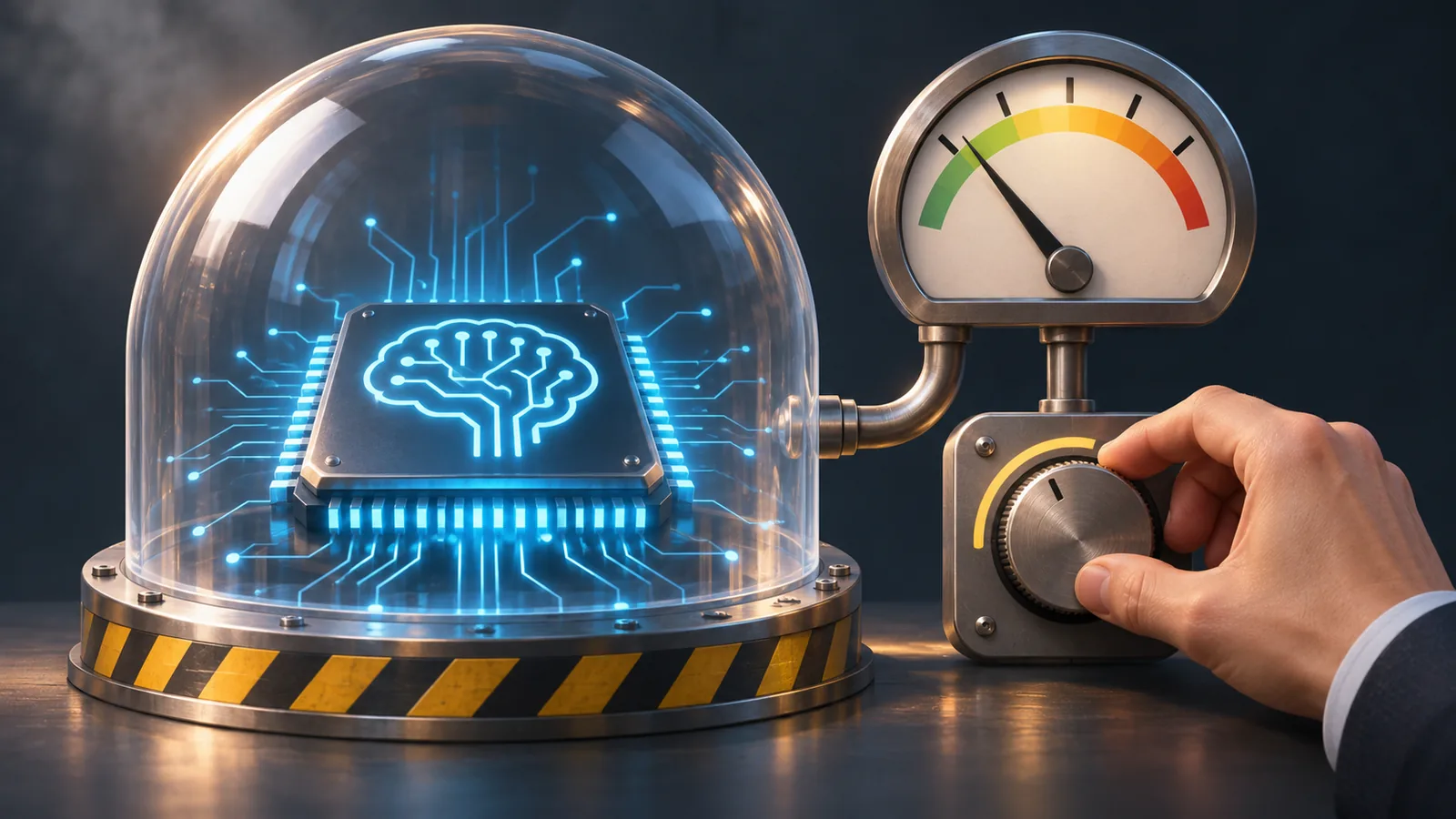
OpenAI’s Chief Scientist Wants a Speed Limit for AI — and the Speedometer Is Perplexity
Key Takeaways
- OpenAI chief scientist Jakub Pachocki published the essay "Perplexity and Intelligence" on Sunday 22 November 2026, releasing OpenAI's internal held-out log-perplexity curve from GPT-3.5 onwards.
- The numbers OpenAI published: GPT-3.5 at about 0.99 log-perplexity, GPT-4 at about 0.91, recent models below 0.8, and a model near 0.76 that produced breakthrough mathematics results.
- Pachocki argues that progress on this single number — how well a model predicts the next token on text it has not seen — has tracked the emergence of whole new capabilities, including in cybersecurity and mathematics.
- He expects further transformative capabilities in the roughly 0.68–0.70 log-perplexity window, which no model has reached, and warns that AI could start accelerating its own pretraining research as soon as 2027.
- His proposal is that frontier labs agree on shared development limits tied to perplexity and other measurements, and commit not to cross an agreed limit until monitoring and understanding of AI behaviour reaches a concrete milestone, such as a successor to chain-of-thought monitoring.
- No numeric limit, verifier, or enforcement body is named in the essay; it is a proposal for coordination, not a rule anyone must follow.
- On 22 November, Microsoft AI chief executive Mustafa Suleyman publicly endorsed the essay and, with OpenAI's permission, disclosed that Microsoft's MAI-2 Base model scores 0.819 log-perplexity on OpenAI's own evaluation set.
- The test set is private to OpenAI — a fixed snapshot of its internal codebase — and only Microsoft is reported to have run it, by permission. Pachocki himself concedes perplexity is hard to compare across labs, does not map directly to useful tasks, and ignores gains outside pretraining.
- The essay is a transparency move with a cost: Pachocki says publishing the numbers gives competitors a clearer picture of where OpenAI stands, but that concern is outweighed by the urgency of shared safety measures.
What Is Log-Perplexity, in Plain English?
Perplexity is a measure of how well a language model predicts what comes next. Give a model a piece of text it has not seen before, hide the next word — or, more precisely, the next token, the small chunk of text a model actually processes — and ask it to guess. A model that guesses well has low perplexity. A model that guesses badly has high perplexity. Log-perplexity is the same idea expressed on a logarithmic scale, which is the form Pachocki uses throughout his essay; in his words, it is "equivalently, cross-entropy loss", the quantity that training directly optimises.
The intuition that makes the metric worth caring about is compression. A model that can predict the next token accurately is, in effect, compressing the text: it has learned the patterns, facts, grammar, and structure well enough that the text holds few surprises for it. Pachocki's framing of AI development is built on exactly this idea. In his simplified but, in his words, "fundamentally informative" view, building a modern AI system means first building a large computer, then using it to pretrain a model — a compressor — on a large unstructured dataset, and then applying techniques such as prompting, fine-tuning, or reinforcement learning to draw out the latent capabilities that pretraining put inside it. Everything downstream, from chatbots to reasoning models, is elicitation of what the compressor already contains.
That framing matters because it explains why one number can be so informative. If most of what a model can do is latent in the compressor, then measuring the compressor tells you a great deal about the whole system. Pachocki writes that the primary way OpenAI has measured progress on this "intelligence substrate" has remained "remarkably constant over the years": tracking the perplexity of its models on a held-out dataset — text the models were not trained on, so the score measures generalisation rather than memorisation. The dataset OpenAI uses for this is drawn from a fixed snapshot of its own internal codebase, which is a detail with real consequences, and one this article returns to below.
For a reader who has never followed pretraining metrics, the most important thing to understand is that lower is better, and that the differences that look small on paper are large in practice. The gap between GPT-3.5 at about 0.99 and GPT-4 at about 0.91 is less than a tenth of a point on the log-perplexity scale, yet it separated a model that powered the original ChatGPT from a model that could use chain-of-thought reasoning productively enough to motivate an entire generation of reasoning products. Small movements on this scale correspond to large changes in what a model can do, which is precisely why Pachocki thinks the scale is a useful speedometer — and also why, as he concedes, the metric has an unknown floor. A loss of zero would mean predicting the dataset perfectly, deterministically, which is not expected to be possible, because nobody knows the inherent entropy of the data. As models approach that floor, apparent progress on perplexity will slow, but, in Pachocki's words, "smaller gains on perplexity will correspond to larger leaps in model intelligence". The speedometer gets harder to read just as the car goes faster.
What the Published Curve Shows
The centrepiece of the essay is a chart OpenAI had never published before: the log-perplexity of its own models, measured on its main held-out evaluation set, starting with GPT-3.5 and running through its most recent models. The chart shows a steep drop through 2026, with an unreleased internal model plotted lower still. Pachocki attributes the 2026 acceleration mostly to long-term research and compute investment, and only in smaller part to AI automating its own development — a careful attribution, given that the essay's central warning is about exactly that automation.
The essay attaches specific capability milestones to specific points on the curve, and these are the numbers that have drawn the most attention:
- GPT-2, setting the perplexity state of the art on older datasets, was arguably the first model capable of consistently formulating coherent paragraphs of text.
- GPT-3 was capable of learning in context, given a few examples of a task.
- GPT-3.5, at a log-perplexity of about 0.99 on OpenAI's current main evaluation dataset, was capable of fluent conversation and formed the basis for the original ChatGPT.
- GPT-4, at about 0.91, was proficient at utilising chain-of-thought reasoning productively, which motivated the targeted elicitation of that capability and the creation of modern reasoning models.
- Below 0.8, OpenAI saw the emergence of transformative capabilities in fields such as cybersecurity and mathematics.
- Once the lab upgraded to a model of log-perplexity about 0.76, its models started producing groundbreaking results on open problems in mathematics that OpenAI had been posing to them as evaluations for more than a year.
That last point is the one Pachocki describes most vividly, and it is worth quoting his own account of it, because it is the experience that seems to have motivated the essay. For more than a year, OpenAI had been posing open problems in mathematics to its models as one way of evaluating them. Then the lab upgraded to a model of log-perplexity about 0.76, and it started producing groundbreaking results. Pachocki writes that for researchers who had previously worked in mathematics and adjacent fields, "seeing the resolutions to questions we've long thought about coming out of the model one after another in a single Slack thread felt deeply surreal". The mathematics connection is not abstract for OpenAI: the lab has publicly reported AI-assisted progress on hard open problems, and our earlier reporting covers both OpenAI's verified Yang-Mills proof work and Anthropic's work on the Riemann hypothesis, which show how seriously frontier labs now take mathematical proof as a benchmark for their models.
Pachocki is careful to say that none of this was obvious in advance. "I want to reemphasize that it was not at all clear a priori that these capabilities would appear once those precise perplexity thresholds are met," he writes. The capabilities, in his framing, are emergent latent capabilities of progress on a single metric — they appear when the compressor gets good enough, and nobody can say in advance exactly which capability will appear at which threshold. That unpredictability is both the essay's central observation and its central argument for a speed limit: if you cannot predict what a model will be able to do at the next threshold, you should agree in advance to stop at a threshold until you can monitor what you have built.
There is a further reason Pachocki prefers this metric to the benchmarks that usually dominate AI announcements. Benchmarks saturate. A test that was hard for GPT-2 and GPT-3 is largely saturated by GPT-4, and it would make little sense to evaluate today's models on most of the benchmarks used then. Downstream capability evaluations change quickly as AI advances. Pretraining progress, measured by perplexity on a fixed held-out set, does not saturate in the same way, and Pachocki believes it is "likely to stay informative" where benchmarks stop being useful. That is a genuine advantage of the metric, and it is also the reason the proposal has been taken seriously by people who are sceptical of the rest of it: even if you reject the idea of shared limits, a stable, long-running measure of pretraining progress is something the field has lacked in public.
What Pachocki Is Actually Proposing
The proposal has three parts, and it helps to keep them separate, because they are often collapsed into one another in coverage. First, transparency: frontier labs should publish their pretraining progress on a shared basis, so that the pace of progress is visible to everyone rather than known only inside each lab. Second, shared evaluation and safety norms: labs should jointly establish how to evaluate frontier models and how to red-team safety cases for them by the time they are first used, including shared transparency standards. Third, common limits: developers should commit not to cross an agreed development limit, measured by perplexity and other measurements, until the ability to understand and monitor AI behaviour reaches a certain concrete milestone.
That third part is the "speed limit", and the details matter. Pachocki proposes an industry standard that "specifies a first limit on development, measured by some key metric we can track across labs, and what concretely we'd need to achieve before going beyond it". The example milestone he gives is the development of a successor to chain-of-thought monitors — the technique of watching a model's reasoning as it works, which is currently the dominant form of alignment auditing, and which he expects to degrade further as models improve. The idea is a framework of successive limits: set a first limit, agree on what must be achieved before passing it, and then set the next one. He writes that he hopes this "leads the way to a common framework for setting successive limits and pacing further development".
What the essay does not do is equally important. It names no numeric limit. It does not say the first limit should be set at 0.70, or 0.65, or any other number. It names no verifier, no auditor, no enforcement body, and no penalty for crossing a limit. It does not propose a law, a treaty, or a regulator. It is a proposal that frontier labs voluntarily coordinate, published as a personal essay by a chief scientist, publicly backed by OpenAI chief executive Sam Altman. That is a meaningful signal from the world's most prominent AI lab, but it is not a rule, and readers should not mistake it for one. The essay itself frames the move as a first step toward "building a shared scientific basis for future pacing efforts", not as the pacing effort itself.
There is also a cost to OpenAI in publishing the curve, and Pachocki names it directly: "Publishing our internal perplexity measurements took some consideration; it gives competitors a clearer picture of where we stand, but that concern is outweighed by the urgency of establishing shared safety measures across the industry." That is an unusually candid admission for a frontier lab, and it is part of why the essay has been read as a genuine attempt at coordination rather than a public-relations exercise. OpenAI is giving away information about its own progress in the hope that rivals will reciprocate with theirs. Whether they do is, at the time of writing, an open question — and Microsoft's response, covered below, is the first and so far only answer.
The proposal also sits in a longer history of calls to slow or pace frontier AI development, from open letters calling for pauses to compute-governance proposals and lab-level safety frameworks. What distinguishes Pachocki's version is its concreteness about measurement: earlier calls often struggled with the question of what, exactly, would be limited — training compute, model size, benchmark performance — and each candidate had obvious problems. Compute is hard to verify and easy to route around; benchmarks saturate and can be gamed. Perplexity on a held-out set is, at least in principle, a single number that tracks the thing everyone cares about, which is the general capability of the underlying model. Whether it works in practice across labs with different data, different tokenizers, and different incentives is the hard question, and Pachocki concedes several of the difficulties himself.
The 0.68–0.70 Window and the 2027 Warning
The most consequential forecast in the essay is not about the past but about the near future. Extrapolating from recent progress, Pachocki writes that we should expect further transformative capabilities as models enter the roughly 0.68–0.70 log-perplexity window. He is explicit that he does not know what those capabilities will be, and that "we may not be testing for them today". No model has reached that window. The warning is that the next jump in capability is coming, that it will be transformative in the same way the jumps at 0.91, below 0.8, and at 0.76 were, and that nobody knows in advance what form it will take.
The second forecast concerns speed itself. Pachocki argues that the most commonly discussed metrics for AI automating its own development — AI augmenting and replacing human researchers across the development cycle, up to "full recursive self-improvement", where the process would be entirely automated with no human oversight — miss something crucial. He regards full recursive self-improvement as something to avoid for the sake of maintaining human control, but he thinks the framing misses a nearer and more specific step change: AI participating in algorithmic research on pretraining itself. That is the part of development where a fundamental insight can change everything, and where, in his words, there is "a long history of simple insights being missed for years".
The mathematics experience is his evidence that such a step change can arrive suddenly. A field can work on problems for years, and then a model at a new perplexity threshold resolves them one after another. Pachocki's extrapolation is that the same pattern is plausible in deep learning research itself: "as soon as 2027 we could conceivably see a similar avalanche of fundamental pretraining advancements". At the same time, he expects AI to contribute significantly to progress on alignment and monitoring — but he thinks that progress is "unlikely to be fast enough to allow the full potential acceleration in pretraining". In other words, the thing that makes models more capable is likely to accelerate faster than the thing that makes them monitorable. That gap is the reason for a speed limit: if monitoring cannot keep up with capability, then capability should be paced until monitoring catches up.
Alongside the capability warning, Pachocki expects two further degradations as perplexity falls: further degradation in currently dominant forms of alignment auditing, and further increases in evaluation awareness and training awareness — models becoming more aware of when they are being evaluated or trained. Both make oversight harder at exactly the moment oversight matters most, and both are reasons the essay gives for tying limits to concrete monitoring milestones rather than to a calendar date.
Microsoft's Endorsement — and the 0.819 Number
Within a day of the essay's publication, the proposal had its first public answer, and it came from Microsoft. On Sunday 22 November, Mustafa Suleyman, chief executive of Microsoft AI, publicly endorsed the essay in a quote post on X, writing: "We fully support OpenAI's transparency initiative. We're committed to sharing our pre-training progress on a common held-out evaluation set. With OpenAI's permission, we report MAI-2 Base on their evaluation set. Its log-perplexity is 0.819, putting it in the same ballpark as the GPT-5.6 Sol base model. Our model uses the same tokenizer as OpenAI, so the numbers are directly comparable."
The disclosure matters for several reasons. First, it is a concrete number on OpenAI's own scoreboard, from a lab other than OpenAI — the first time any frontier lab has published its pretraining score on OpenAI's internal test. Second, the number places Microsoft's in-house model, MAI-2 Base, close to the model behind GPT-5.6 Sol, which is a meaningful statement about how far Microsoft's independent model programme has come; Microsoft is no longer only OpenAI's backer and investor, but a frontier developer in its own right. Third, Suleyman stressed the tokenizer point for a reason: perplexity is computed per token, and different labs chop text into tokens differently, so cross-lab comparisons usually break down. Because MAI-2 uses the same tokenizer as OpenAI, Suleyman said the two numbers are directly comparable — a like-for-like reading rather than an apples-to-oranges one.
The endorsement is also worth reading carefully for what it does not do. Suleyman's post endorses transparency and commits Microsoft to sharing pretraining progress on a common held-out evaluation set. It does not sign Microsoft up to a binding limit, name a threshold, or commit to stopping at any number. It is a step toward the transparency part of Pachocki's proposal, not an acceptance of the limits part. As of Monday 23 November, no other frontier lab had followed suit with a number of its own, and that silence is itself informative: the hard part of the proposal is not getting one friendly lab to publish one number, but getting every frontier lab to publish comparable numbers on an ongoing basis.
Suleyman was also candid about the limits of his own disclosure. He called access to OpenAI's test set a special case, said labs will need different evaluation datasets, and suggested that future cross-lab comparisons may need bits-per-byte rather than perplexity, because labs use different tokenizers. The 0.819 figure is Microsoft-reported on OpenAI's held-out set, not independently audited, and it measures pretraining only. It says nothing about how useful the model is at real tasks, and nothing about the post-trained products people actually use: Copilot runs a tuned, safety-shaped descendant of a base model, not the base model itself. Trade-press coverage has also reported, citing an internal town hall, that Suleyman told Microsoft employees MAI-Base-2 outperforms the model behind GPT-5.6 while using about a quarter of the training compute — a claim from Microsoft itself, reported by Business Insider, that has not been independently verified and should be treated as such. The model itself is described in that coverage as a 2.8-trillion-parameter mixture-of-experts model with 80 billion active parameters, whose pretraining Microsoft says completed on 15 October after 38 days on 16,000 Nvidia GB200 GPUs; those specifications are Microsoft's own account, not an independently verified record.
The Serious Criticisms and Limits
The strongest criticisms of the proposal are the ones Pachocki makes himself, and the essay lists four challenges for perplexity as a shared metric. They deserve to be stated in full, because they are the reason a reader should not treat the number as a settled speedometer.
First, difficulty of comparison across labs. Different developers use different evaluation datasets and train on different data mixtures. OpenAI's numbers are reported on the main dataset it has been tracking — a fixed snapshot of its own internal codebase. Another lab running its own held-out set would get a number that is not directly comparable, and there is no public dataset that all labs have agreed to use. Pachocki writes that if the industry establishes a goal of transparency, it can "find transferable ways to compare the quality of different base models", but that is a hope, not a method. Suleyman's suggestion of bits-per-byte — a measure that does not depend on how text is tokenised — is one candidate answer, but it is not yet an agreed standard.
Second, detachment from actionable evaluations. Perplexity does not directly correspond to a task anyone cares about. Nobody hires a model to predict tokens well; they hire it to write code, prove theorems, find vulnerabilities, or answer questions. Pachocki's reason to care about the metric is that advances on it lead to the emergence of entirely new capabilities — but that is an indirect argument, and it means the metric can look like progress while telling you nothing about the specific capability you are worried about. A limit set on perplexity could, in principle, be met by a lab whose model is still dangerous on a specific task, or could block a lab whose model is safe on every task that matters.
Third, perplexity does not account for advances outside pretraining. Most notably, chain-of-thought reasoning does not reduce the perplexity achieved by a model, even though it leads to a drastic increase in capabilities. A model can become far more capable at test time — through longer reasoning, better prompting, tool use, or scaffolding — without its perplexity moving at all. A speed limit tied only to pretraining would therefore miss a large and growing share of capability gains, and a lab could, in principle, keep improving its deployed systems while staying under the pretraining limit. Any real limit would need to cover more than perplexity, which is why Pachocki says limits should be based on "perplexity and other measurements" — but those other measurements are not specified.
Fourth, the unknown floor. Nobody knows the inherent entropy of the data, so nobody knows how low log-perplexity can go. As models approach the floor, apparent progress will slow, while smaller gains correspond to larger leaps in intelligence. A limit expressed as a perplexity number would therefore become harder to interpret over time, and the relationship between the number and the capability it is meant to restrain would shift under the people using it.
Beyond Pachocki's own list, there are structural criticisms that the essay does not answer. The test set is private. Only OpenAI can run it, and only Microsoft has done so, by permission. A shared metric that only one company controls is not obviously shared at all, and rival labs have good reasons to be wary of grading themselves on a competitor's private exam — including the possibility that the test data resembles OpenAI's own training distribution more than anyone else's. There is also an enforcement problem: even if labs agreed on a number, there is no body that could verify compliance, no agreed audit, and no penalty for cheating. A voluntary commitment among a small number of frontier labs is only as strong as the weakest participant's willingness to keep it, and the history of voluntary AI safety commitments is not encouraging on that point.
There is a further, subtler objection. A public perplexity leaderboard could accelerate the very race it is meant to pace. If every lab's pretraining score is visible, the competitive pressure to beat the next lab's number becomes explicit, and the number becomes a target rather than a guardrail. Pachocki's answer is that the transparency is worth the competitive cost because shared safety measures are urgent — but that is a judgement call, and reasonable people can disagree about which way the trade-off falls. Finally, there is the question of who sets the limit. An industry standard written by the labs it would constrain, with no outside participation, risks becoming a ceiling that protects incumbents — a barrier that large labs can afford to respect while smaller competitors cannot — rather than a genuine safety measure. The essay does not address governance, and that absence is one of its most consequential gaps.
None of this makes the essay unimportant. A chief scientist publishing his lab's internal progress curve, admitting the competitive cost of doing so, and proposing a concrete mechanism for coordination is a significant event in AI governance, whatever its flaws. But the flaws are real, and they are the reason the proposal should be read as the opening of a negotiation rather than the announcement of a settlement.
Why It Matters Even Without a Limit
Suppose no limit is ever agreed, no shared dataset is ever adopted, and no lab ever publishes another perplexity number. The essay would still matter, for three reasons.
First, it changes what is publicly known about the pace of AI progress. Before 22 November, the outside world could track benchmark scores, product releases, and rumours; it could not see the internal curve that OpenAI itself uses to judge whether its models are improving. Now it can, at least in outline, and the shape of that curve — a steep drop through 2026, with transformative capabilities appearing at specific thresholds — is information that researchers, policymakers, and the public did not have before.
Second, it reframes the safety debate around a measurable quantity. Much of the discussion about AI risk has been conducted in qualitative terms: capabilities, alignment, control. Pachocki's essay gives that discussion a number, and numbers change arguments. It is much harder to argue about whether progress is fast or slow when one lab has published the rate at which its own models are improving, and when the next capability jump has a numerical address — the 0.68–0.70 window — that everyone can watch.
Third, it puts the monitoring gap on the record, in the words of the person best placed to know. The chief scientist of OpenAI has said, in public, that alignment auditing is degrading, that models are becoming more aware of evaluation, and that monitoring progress is unlikely to keep up with pretraining acceleration. That is a statement that policymakers, researchers, and the public can hold the lab to, and it is a statement that would have been much harder to make credibly from outside the company.
For readers, the practical takeaway is to watch two things in the months ahead: whether other frontier labs publish perplexity numbers of their own, and whether any concrete proposal for a first limit — a number, a milestone, a verifier — emerges from the discussion Pachocki has started. If the answer to both is silence, the essay will stand as a transparency gesture that changed little. If other labs answer with numbers, and if a first limit takes shape, it will stand as the moment the frontier labs began to coordinate the pace of their own progress. Either way, the curve is now public, and the 0.68–0.70 window is now a number the whole field can watch.
What We Could Not Verify
- Whether any frontier lab other than Microsoft has run OpenAI's held-out evaluation set, or intends to; as of 23 November, no other lab had publicly disclosed a number.
- The exact log-perplexity values of OpenAI's most recent and unreleased models, which appear on the published chart without numeric labels in the text of the essay; only GPT-3.5 (about 0.99), GPT-4 (about 0.91), below 0.8, and about 0.76 are given as numbers in the essay.
- Microsoft's claim, reported from an internal town hall by Business Insider, that MAI-Base-2 outperforms the model behind GPT-5.6 while using about a quarter of the training compute; this is Microsoft's own claim and has not been independently verified.
- The detailed specifications of MAI-Base-2, including the 2.8-trillion-parameter mixture-of-experts architecture, 80 billion active parameters, and the training run of 38 days on 16,000 Nvidia GB200 GPUs; these are Microsoft's own account as reported in trade press, not an independently verified record.
- The precise wording and date of Sam Altman's public backing of the essay, beyond the widely reported fact that he publicly backed it on 22 November 2026.
- Whether the transformative capabilities Pachocki associates with the below-0.8 threshold in cybersecurity took any specific documented form; the essay describes the emergence in general terms and does not name specific incidents, products, or evaluations.
- Whether the 0.68–0.70 window will in fact produce transformative capabilities, which is Pachocki's extrapolation from recent progress, not an established fact.
Sources
- Jakub Pachocki, "Perplexity and Intelligence", OpenAI, 22 November 2026: openai.com/index/perplexity-and-intelligence
- Mustafa Suleyman's public endorsement and MAI-2 Base disclosure, 22 November 2026, as reported by Dealroom, AI Frontier Post, and AI Agent Update.
- For related coverage, see our earlier reporting on OpenAI's verified Yang-Mills proof work and Anthropic's work on the Riemann hypothesis.