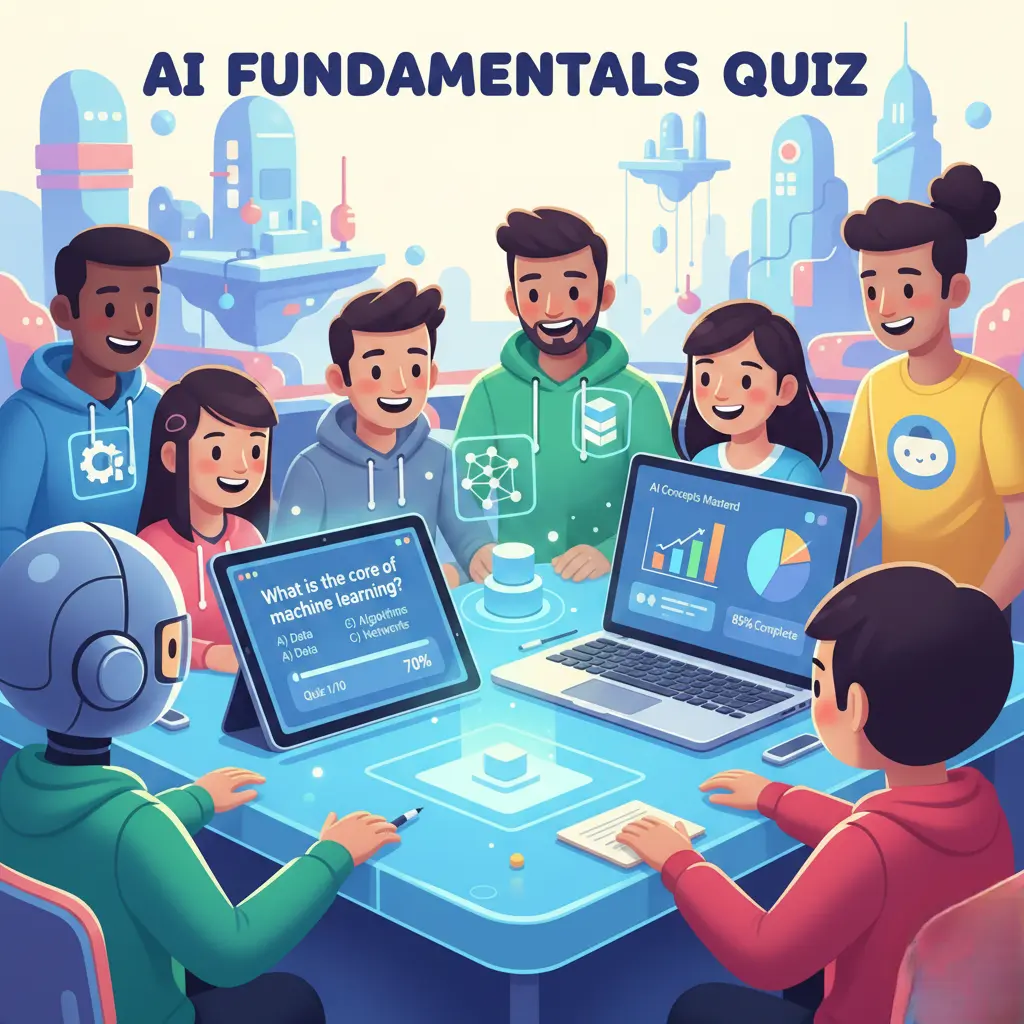
AI Fundamentals Quiz: Master the Basics Today!
If you’re completely new to Artificial Intelligence and want a friendly, simple way to test what you already know, you’re in the right place. This blog is built especially for beginners who want to explore AI fundamentals quiz without feeling overwhelmed. Think of it as your personal starter toolkit, packed with quizzes, micro-assessments, explanations, and easy examples that help you understand where you stand.
Every explanation is designed to be beginner-friendly but backed with professional accuracy, so you learn the right way from the start. The goal of this blog is simple: help you evaluate your AI basics knowledge while learning new concepts in a structured, stress-free way. Don’t worry, everything is written in short, info-packed paragraphs so you can skim, pause, or revisit anytime without losing clarity.
What Are AI Fundamentals?
AI fundamentals are the basic building blocks that help you understand how Artificial Intelligence works. In simple terms, they’re the core ideas behind how machines learn, make decisions, and solve problems. You don’t need technical experience to grasp these concepts, just a willingness to understand how smart systems think. AI fundamentals usually revolve around how data is used, how algorithms spot patterns, and how machines improve over time.
If you want a deeper, beginner-friendly breakdown of these concepts, this AI basics class explains them step by step for future-ready learners. Before taking any AI basics quiz, it’s important to understand the fundamentals. Otherwise, quizzes feel confusing, and you end up memorizing instead of actually learning. When you understand the foundations first, answering questions becomes easier and more meaningful.
Key Concepts You Should Know Before Taking an AI Fundamentals Quiz
Here are the core concepts you’ll see in most beginner-friendly AI questions:
In real life, these concepts power everyday tools. When Netflix recommends a movie you might like, that’s machine learning at work. When your phone unlocks using your face, that’s a neural network recognizing patterns. Think of these fundamentals as the “alphabet” of AI. Once you know them, anything you read or quiz yourself on becomes easier, clearer, and much more fun.
Why AI fundamentals Quizzes Matter for Your Learning Journey
These AI fundamentals quizzes also highlight your strengths and weaknesses. Maybe you understand datasets well but struggle with neural networks, or maybe you can define machine learning but get confused about supervised vs unsupervised learning. When you see which questions felt easy or difficult, you know exactly what to focus on next.
Most importantly, AI fundamentals quizzes boost your learning confidence. Every correct answer reinforces what you know, and every mistake gives you a chance to improve without pressure. It’s a safe, low-stress way to build momentum in your AI education.
How AI Fundamentals Quizzes Improve Knowledge Retention
Testing your knowledge strengthens your memory, it’s like giving your brain a quick workout. When you answer a question, your mind has to retrieve information, and that retrieval process makes learning stick longer. Think of it like driving theory practice
The more mock questions you solve, the better you remember road signs and rules, or like gym training, the more reps you do, the stronger the muscle gets. AI fundamentals quizzes work the same way, helping your “AI fundamentals muscle” grow with every attempt.
AI Basics Pre Assessment (Before You Start Learning)
A pre-assessment is a quick “before you begin” quiz that helps you understand how much you already know. Teachers often use pre-assessments to get a clear picture of a student’s starting point, and in the same way, AI beginners can use them to measure their current level before diving deeper into lessons. It acts like a baseline check, showing what concepts you’re comfortable with and which ones need more attention.
Think of it as a warm-up quiz, the way athletes stretch before a workout. It prepares your mind, activates your memory, and gives you a quick preview of what you’ll be learning next. With this small pre-assessment, you’ll get a friendly starting point that helps you learn AI more intentionally and confidently. This makes your learning journey smoother because you won’t waste time revisiting what you already understand.
Sample AI Basics Pre Assessment Questions (Beginner Level)
True or False: AI systems learn from data rather than being manually programmed for every task. Why it matters: This checks if you understand the core difference between traditional software and AI.
Which one describes machine learning best?
A) Computers memorizing rules
B) Computers learning patterns from examples
C) Computers guessing randomly
Explanation: Machine learning is all about learning from examples, not guesswork or rigid rules.
AI uses datasets mainly for…
A) Decoration
B) Training models
C) Slowing computers down
Explanation: Datasets act like study material, the model learns patterns from them.
True or False: A neural network works similarly to how the human brain connects information.
Explanation: This analogy helps beginners visualize how AI links data points together.
Which scenario shows supervised learning?
A) A system grouping unlabeled images automatically
B) A model trained using images already labeled “cat” or “dog.”
C) A robot exploring a maze without instructions
Explanation: Supervised learning always involves labeled examples.
AI in daily life: Which one is an example?
A) A regular calculator
B) Netflix recommending a movie
C) A lamp turning on
Explanation: Recommendation systems are powered by machine learning.
True or False: AI can make predictions but cannot improve from mistakes.
Explanation: AI models improve as they get more data or fine-tuning.
Which device uses pattern recognition?
A) A simple alarm clock
B) Your phone unlocking through Face ID
C) A basic TV remote
Explanation: Face ID works by identifying patterns in your facial features.
AI Fundamentals Quiz
This is the core quiz section of your learning journey, a friendly yet professionally designed set of questions that checks how well you understand AI fundamentals quiz. These aren’t boring textbook-style questions; they’re simple, practical, and built around everyday scenarios so you can recognize how AI shows up in real life.
Each question touches on a different foundational concept, giving you a balanced mix of pattern recognition, model training, data usage, learning types, and decision-making. Answer them honestly, and treat this as a self-check rather than a test. Think of it as your AI warm-up challenge with clean, clear wording.
AI Fundamentals Quiz With Questions + Detailed Answers
A music app suggests songs you never searched for but enjoy. What AI concept is happening here?
Answer: Recommendation systems learn your listening patterns and predict what you’ll like, just like a friend who knows your taste.
Your phone groups similar photos (pets, beaches, food) automatically, which learning method is this?
Answer: This is unsupervised learning, where the system finds similarities on its own, much like sorting clothes by vibe rather than labels.
A model keeps repeating the same mistake until it gets more labeled examples. What is it missing?
Answer: It needs more quality-labeled data. Without examples, it’s like learning vocabulary without ever seeing full sentences.
An AI predicts tomorrow’s weather using 10 years of climate data. What is this an example of?
Answer: Data-driven forecasting, where patterns from past information help predict future outcomes.
A chatbot becomes more accurate after being fine-tuned with customer conversations. What changed?
Answer: Fine-tuning adjusted its parameters, similar to giving someone targeted practice instead of general lessons.
A self-checkout machine identifies fruit based on shape and color. What AI skill is this?
Answer: Image classification, which works like recognizing objects from a distance based on visual clues.
Your email app automatically filters spam, which concept is at work?
Answer: Supervised learning trained with labeled examples of “spam” and “not spam.”
A student trains a model using only 200 images and gets poor accuracy. What issue might be happening?
Answer: Underfitting, the model didn’t see enough variety, like studying only one chapter for a full exam.
A navigation app suggests faster routes after learning traffic patterns. What improvement is this?
Answer: Reinforcement learning behavior, improving decisions based on previous outcomes.
A robot vacuum learns your room layout over time. What AI behavior is this?
Answer: Mapping and pattern adaptation, similar to how you gradually learn your way around a new house.
A system clusters customers by their purchasing habits without labels. What is this an example of?
Answer: Unsupervised learning, grouping people by hidden patterns like sorting music by mood.
Why might an AI model fail in real-world testing despite perfect training performance?
Answer: Overfitting, it memorized the training data and never learned to handle new situations.
Which scenario shows the need for a larger dataset?
Answer: When the model can’t generalize because the data lacks diversity, like judging all dogs after seeing only one breed.
A model identifies dogs but mistakes small dogs for cats. What problem does this show?
Answer: Weak feature extraction. It’s focusing on the wrong details, like confusing animals from far away.
A voice assistant adapts to your accent over time. What’s happening behind the scenes?
Answer: Continuous learning. It fine-tunes itself using your speech patterns, just like you get used to someone’s accent gradually.
AI Basics Quiz
AI fundamentals quiz dive into how AI works behind the scenes, but AI basics focus on the simplest introductory ideas, perfect for complete beginners. Think of fundamentals as the “engine,” while basics are the “dashboard buttons” you first learn to use. This section is designed with easier, entry-level questions that help you build confidence before tackling deeper concepts.
If the earlier quiz felt advanced, this one acts like a gentle warm-up. You’ll find simple, friendly questions here that reinforce core ideas without complexity. If you want to review those concepts in plain language first, this AI basics guide walks beginners through them step by step before moving forward in their AI learning journey.
Beginner-Level AI Basics Quiz With Answers + Mini Explanations
When Siri answers your question, what type of technology is being used?
Answer: AI-powered voice recognition, it listens, interprets, and responds like a digital assistant trained to understand speech.
Netflix recommending a show based on what you watched earlier is an example of what?
Answer: Recommendation systems study your viewing habits, the way a friend suggests movies based on your taste.
Your phone unlocking using your face relies on what AI skill?
Answer: Pattern recognition, the system learns your facial structure, just like recognizing a familiar person in a crowd.
A chatbot answering basic customer questions is using what?
Answer: Natural language processing reads your message and picks the most suitable response.
Google Maps showing traffic in real time is powered by what?
Answer: Data analysis, the system learns from thousands of signals to predict congestion.
When your keyboard predicts the next word you’re about to type, what is it doing?
Answer: Predictive text modeling, which guesses the next word based on your previous typing patterns.
A photo app automatically tagging your dog as “dog” is an example of what?
Answer: Image classification, the app recognizes visual features like ears, shape, and fur patterns.
A spam message going directly to the spam folder happens due to what?
Answer: Email filtering, the system checks message patterns and decides if it’s suspicious.
A smart speaker adjusting volume based on background noise is using what?
Answer: Environmental sensing, it listens to surroundings and adapts, like turning down music during conversation.
When YouTube auto-play chooses the next video for you, what is happening?
Answer: Behavior prediction, the system anticipates what you’ll likely watch next based on your history.
AI Basics Post Assessment Answers (Check Your Improvement)
A post-assessment is a quick quiz taken after learning, designed to help you measure how much you’ve improved. It works as a mirror that reflects your progress, showing what concepts you’ve mastered and which ones may still need a little polishing. When you compare your post-assessment results with your earlier pre-assessment results, you can clearly see the difference.
They don’t just measure knowledge, they highlight growth. Even small improvements matter because they show you’re building real understanding, not just memorizing terms. Use this moment as motivation: every step forward means you’re getting more confident, more skilled, and more prepared to continue your AI learning journey.
How to Study AI Fundamentals Quiz Effectively
Learning AI fundamentals quiz doesn’t have to feel overwhelming. A simple roadmap can make the process clear and manageable. Start with beginner-friendly videos or tutorials to understand the core concepts, and watch short, focused lessons instead of long, dense lectures. Once you feel comfortable with the basics, try mini-projects or hands-on exercises.
Even tiny projects, like building a simple chatbot or analyzing a small dataset, help solidify your understanding and give practical context to what you’ve learned. To avoid overwhelm, break your learning into short, consistent sessions rather than cramming.
Finally, stay consistent and patient. AI is a broad field, but regular practice, curiosity, and applying concepts in small projects will steadily build your confidence and skills. Think of it as exercising your brain daily, small, steady practice yields better results than sporadic, long bursts.
Recommended Free Resources to Learn AI Basics
Teachable AI Playground
Explore AI concepts interactively by tweaking simple models and seeing instant results, like a sandbox for beginners.
YouTube – Two Minute Papers
Quick, fun videos that explain cutting-edge AI research in plain, beginner-friendly language.
AI Experiments by Google
Hands-on mini-projects and playful demos that make learning AI feel like experimentation rather than studying.
Learn Prompting
A free platform focused on practical AI prompting skills for chatbots and generative AI tools.
Khan Academy – Intro to Algorithms
Lightweight lessons on the logic behind AI algorithms, using intuitive analogies and real-life examples.
OpenAI Tutorials
Free step-by-step guides to experiment with AI tools safely, without prior coding knowledge.
YouTube – CodeEmporium AI Series
Short, scenario-based tutorials showing how small AI models solve everyday problems.
AI Dungeon (Free Mode)
An interactive text-based game where you experiment with AI storytelling – great for understanding generative AI.
Data Literacy Project – AI Basics
Beginner-friendly exercises to understand how AI uses data, with real-world mini scenarios.
Hugging Face – Learn NLP
Free beginner exercises for natural language AI models using fun, approachable datasets.
Final Thoughts – Your AI Learning Journey Starts with Simple Steps
Starting your AI fundamentals quiz journey may feel like stepping into a huge, complex world, but every expert begins with small, simple steps. Quizzes, mini-projects, and hands-on exercises are your guides along the way, tools to help you learn, not tests to stress over. Remember, the goal is understanding, not perfection.
Each question you answer, each concept you practice, builds your confidence and strengthens your foundation for bigger challenges ahead. Keep curiosity alive, stay consistent, and celebrate every small win. With steady practice and a friendly, beginner-focused approach, you’re well on your way to mastering AI fundamentals quiz, one step at a time.