Toyota Will Build Waymo’s Next Robotaxi in Japan
Key Takeaways
- Toyota Waymo robotaxi plans were announced on 30 October 2026: Toyota will manufacture 2027 bZ4X electric vehicles and integrate Waymo’s self-driving system at its Takaoka factory in Japan.
- Testing and validation of the autonomous bZ4X fleet will begin in Japan in 2027, starting with a small fleet, with deployment in the United Kingdom and other right-hand-drive markets planned for later years.
- The deal turns an April 2025 exploratory agreement into a concrete programme: a named vehicle, a named factory, and a named year for first operations — but no UK launch date, city, fleet size or price has been announced.
- Waymo’s self-driving hardware will be fitted on the Toyota assembly line, not retrofitted afterwards, making the bZ4X the fourth vehicle platform in Waymo’s fleet after the Jaguar I-Pace, the Zeekr-built vehicle and the Hyundai Ioniq 5.
- This is a test and validation programme, not a commercial service launch. A UK passenger service would still need its own regulatory approval, which has not been announced.
Introduction
The robotaxi industry has a manufacturing problem, and on 30 October 2026 Toyota and Waymo announced a serious attempt to solve it. Waymo, the self-driving business owned by Google parent Alphabet, will get its next robotaxi from the world’s largest carmaker: Toyota will build 2027 bZ4X electric SUVs and integrate Waymo’s autonomous driving system at its Takaoka plant in Toyota City, Japan. Testing begins in Japan in 2027, and the United Kingdom is the named next market — eventually, not immediately.
That distinction between eventually and immediately is the whole story. Robotaxi announcements are easy to over-read, because they sound like services launching when they are, in most cases, programmes starting. This one is unusually concrete about the factory and the vehicle, and unusually honest, by omission, about everything else: no fleet size, no UK date, no city, no fare, no cost per vehicle. Read carefully, it is a manufacturing deal with a test programme attached, and its importance lies in the factory line, not in a launch date.
What the two companies actually announced
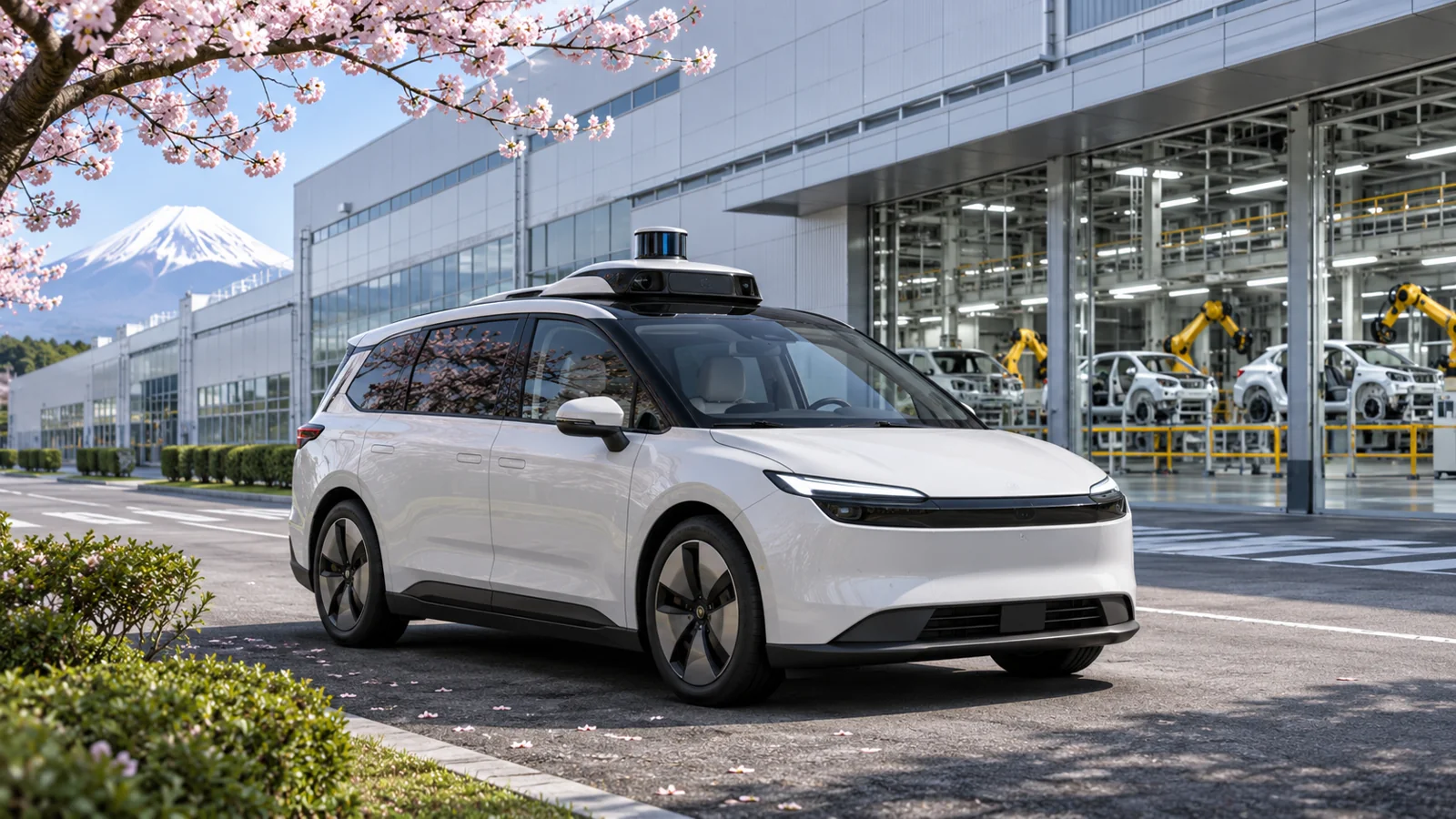
Under the partnership announced on 30 October 2026, Toyota will manufacture the 2027 bZ4X vehicles and integrate Waymo’s self-driving system at Takaoka. The key detail is integration on the assembly line. Waymo’s sensors and computers will go into the vehicles as they are built, under one roof, rather than being retrofitted onto finished cars at a separate facility. That matters for scale: retrofitting is slow, expensive and hard to quality-control at volume, while factory integration is how the car industry has always produced vehicles in large numbers. If robotaxis are ever to be built in the tens of thousands rather than the hundreds, they will have to be built this way.
The programme’s first phase is testing and validation in Japan, starting in 2027. Toyota executive vice president Nakajima said initial operations would involve a small number of vehicles, according to coverage of the announcement. That is a test fleet, not a public service: the vehicles will be validated in real Japanese conditions before any commercial operation is contemplated. The companies say the vehicles are intended for other right-hand-drive markets including the UK, and for other Waymo markets in later years, but they have given no dates for those deployments, named no UK city, and announced no UK passenger service.
Waymo co-chief executive Dmitri Dolgov said the company chose Toyota for the legendary safety, reliability and quality of its cars. That is marketing language, but the underlying point is commercial rather than poetic: Waymo needs a vehicle supplier that can build to automotive quality standards at volume, and Toyota needs a credible route into autonomous ride-hailing without building the self-driving system itself. Each side is buying what the other already does well.
From exploration to a factory line
The October 2026 announcement formalises an alliance that began 18 months earlier. In April 2025, Toyota and Waymo signed a preliminary agreement to explore developing and deploying a new autonomous vehicle platform. Exploration agreements are cheap to sign and often lead nowhere; this one has now produced a named vehicle, a named plant and a named year, which is the difference between a press release and a programme.
That progression matters for the UK in particular. Waymo has been testing its autonomous Jaguar I-Pace vehicles in London for months, and plans to launch a robotaxi service there once it receives the necessary permits. The Toyota agreement would add a second, purpose-built vehicle model for its international operations, while the Jaguar programme continues. But a UK deployment of the bZ4X is not the same thing as a UK service launch. In Great Britain, the Department for Transport opened applications in May 2026 for operators seeking to run pilots involving self-driving vehicles in taxi, bus and private-hire-style services. The Toyota and Waymo announcement did not identify a UK operating area or link the proposed future deployment to a particular British pilot, and it announced no UK automated passenger service approval. Readers in the UK should therefore treat the bZ4X as a vehicle that may one day serve them, not as a service they can book.
Japan is a different story, and the choice of Japan first is deliberate. Japan drives on the left, like the UK, so a right-hand-drive vehicle validated in Japan transfers more easily to Britain than a left-hand-drive American vehicle would. Japan also has a regulatory and social context that makes it an attractive first market: an ageing population, driver shortages in some areas, and a government that has encouraged autonomous vehicle testing. Separately, Waymo said in September 2026 that it is aiming for fully driverless commercial rides in Tokyo in 2027 with Nihon Kotsu and the GO app, scaling to about 100 vehicles, pending regulatory approval. That Tokyo plan is distinct from the bZ4X test fleet, and the two should not be merged into a single launch: one is a commercial service ambition using an existing approach, the other is a new vehicle platform entering testing.
Why factory integration changes the economics
Waymo’s existing fleet shows why this deal matters. The Jaguar I-Pace, the Zeekr-built vehicle and the Hyundai Ioniq 5, which is due to deploy soon, give Waymo three platforms; the bZ4X becomes the fourth. Each platform added through retrofitting or small-batch conversion carries its own engineering cost, its own maintenance story and its own supply chain. A vehicle designed from the start to carry Waymo’s system, built on a high-volume Toyota line, changes the unit economics in a way that matters more than any single city’s launch date: it is the difference between a fleet assembled by hand and a product manufactured at scale.
It also changes the risk profile. A purpose-built robotaxi can be designed around the sensor suite — sensor placement, cleaning, cooling, power and crash safety — rather than having sensors bolted onto a vehicle designed for a human driver. It can omit or redesign driver controls, rethink the interior for passengers who never drive, and be serviced through Toyota’s dealer and parts network rather than a bespoke workshop. None of those advantages are visible in a test fleet of a small number of vehicles, but they are the reason a carmaker of Toyota’s scale gets involved at all: Toyota is not joining a science project, it is positioning a factory for a product category it expects to exist.
What has not been disclosed is equally informative. Waymo did not disclose sensor specifications, unit volumes or per-vehicle cost, and Toyota has not published a production target for the bZ4X robotaxi variant. Without those figures, no honest estimate of the programme’s scale or cost is possible, and any article claiming a fleet size or a launch fare is inventing it. The companies have also said nothing, in this announcement, about privately owned Toyotas carrying the Waymo Driver: that remains an exploration, not a product, and it should not be reported as if a self-driving Toyota you can buy is on the way.
What to watch next
Watch for four milestones, in order. First, the start of testing in Japan in 2027: does the small fleet actually appear, and does it expand? Second, any UK regulatory step that is specific to the bZ4X — a named pilot, a named city, or an operating approval — rather than a general statement about future deployment. Third, any production or volume figure from Toyota, which would turn a test programme into a manufacturing commitment. Fourth, the fate of the separate Tokyo commercial plan with Nihon Kotsu and GO, which will show whether Waymo can convert testing into a paid service in Japan before the bZ4X arrives at scale.
For UK readers, the practical takeaway is patience with a purpose. A Toyota-built Waymo robotaxi is now a real programme with a factory and a date for testing, which is more than most robotaxi announcements ever achieve. It is not yet a service, and the gap between a test fleet in Japan and a ride in London is measured in regulatory approvals and years, not in press releases. The factory line at Takaoka is the news; the ride itself is still to come.
To understand the autonomous systems behind this deal, see our explainer on AI agents and how they operate, and for the wider technology market, our guide to the best AI tools of 2026.