Exciting Innovations: The Latest Trends in AI Technology
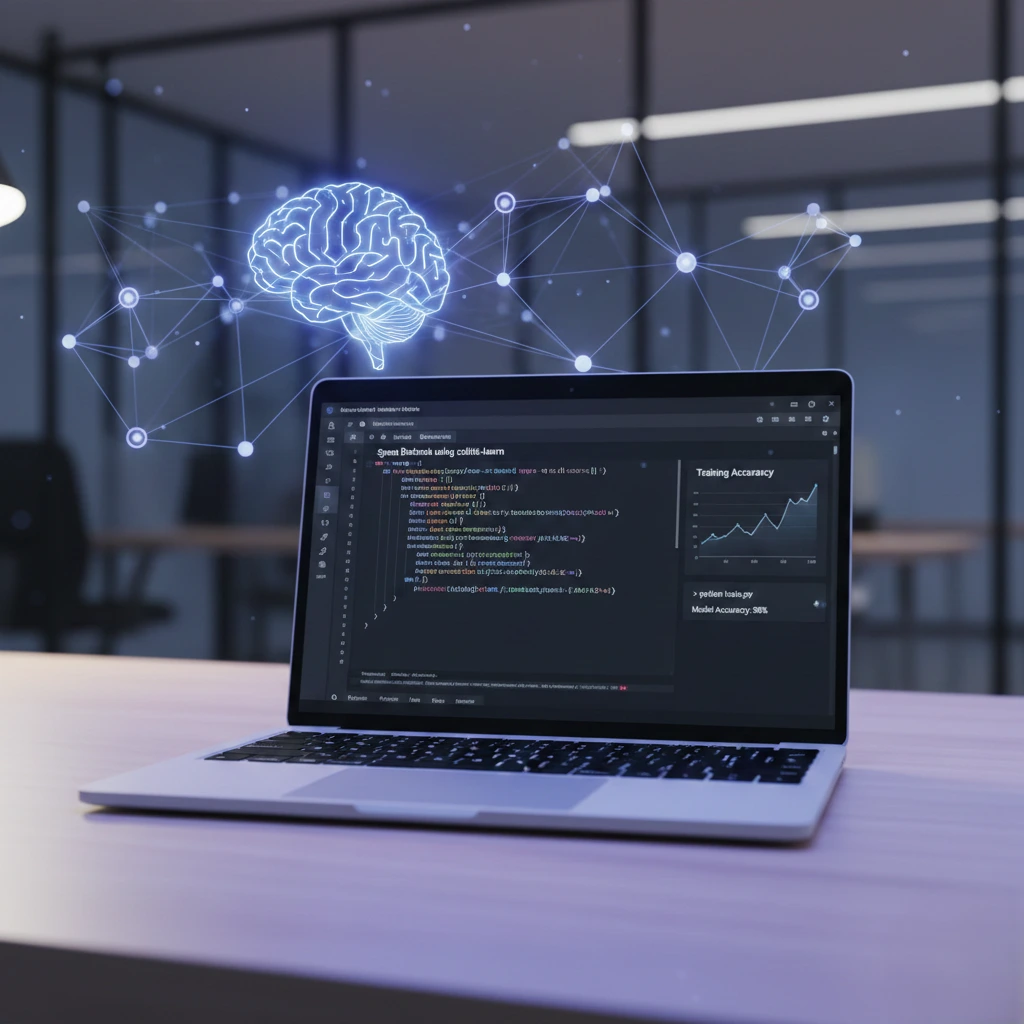
The latest trends in AI technology and AI development are evolving faster than ever, especially after the massive breakthroughs of 2024-2025. What once felt experimental is now powering real products, coding workflows, and everyday consumer devices. You’ll also see how these advancements are transforming everyday coding, from real-time debugging to agent-based development pipelines.
Smarter edge hardware, on-device inference, and energy-efficient chips are making phones, wearables, and household gadgets surprisingly powerful. At the same time, multimodal models and autonomous AI systems are reshaping how enterprises automate work and how developers build software. Let`s discuss insights from global industry reports, developer surveys, and the latest product launches, giving you a futuristic, practical overview of where AI is genuinely heading next.
Latest Trends in AI Technology
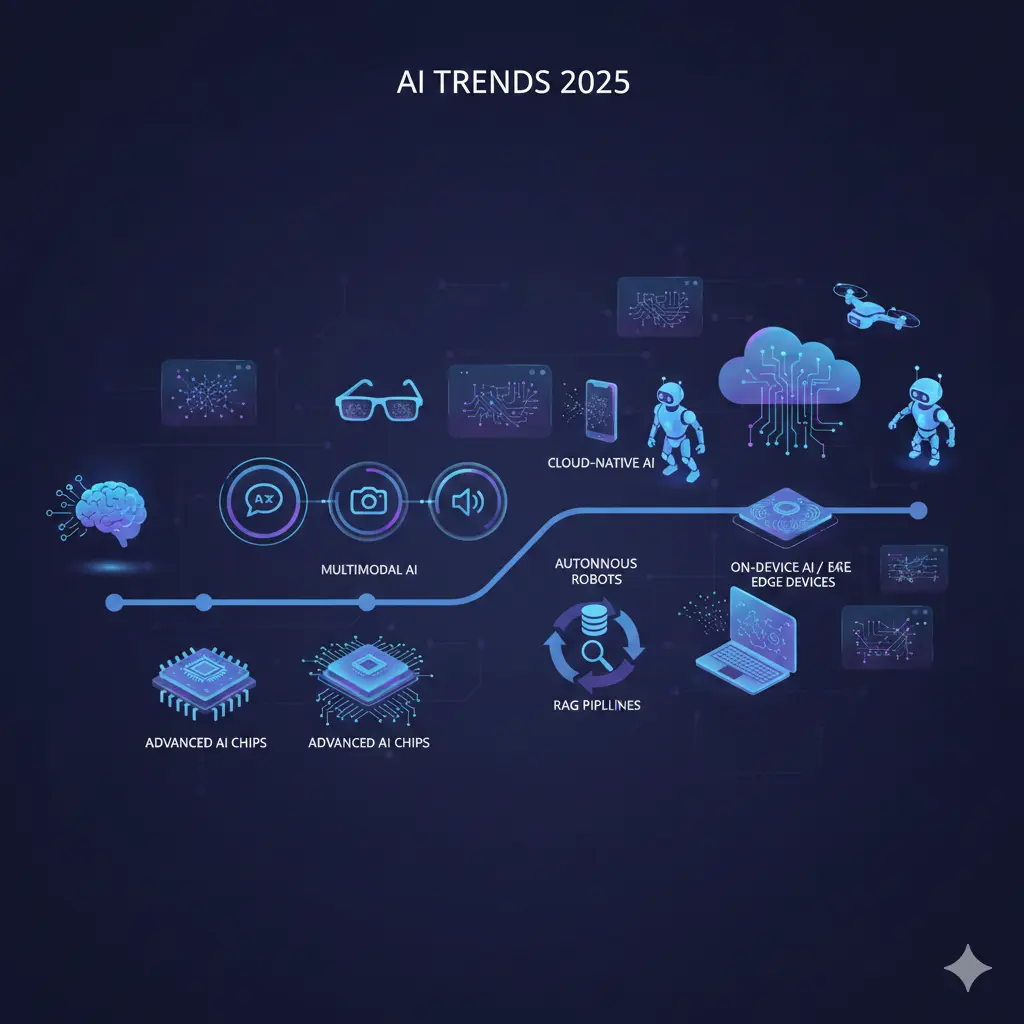
The latest trends in AI technology are redefining how machines think, compute, and interact with the real world. This section highlights the hardware upgrades, new AI capabilities, and tech shifts shaping 2025. AI breakthroughs are now visible everywhere, from smartphones and laptops to cars and home devices, and even in large-scale industrial automation.
Faster chips, multimodal processing, and on-device intelligence are turning everyday tools into powerful AI-enabled systems. Each trend in this section dives deeper with fresh, updated insights, giving you a clear view of how modern AI hardware and real-world applications are transforming the tech landscape. You can also check new emerging top ai trends for 2026.
Multimodal AI Models (Text + Image + Audio in One)
Multimodal AI models like GPT-5, Gemini, Claude, and Llama 3.2 can understand and generate text, images, audio, and video simultaneously, making them one of the biggest trends in AI technology in 2025. Instead of working in separate modes, these models merge all inputs at once, allowing richer reasoning, smoother interactions, and far more natural communication.
New capabilities are emerging rapidly: real-time video understanding, audio-image fusion for smarter context detection, and agentic multimodal actions where AI can see, listen, plan, and execute tasks across different media formats. Among the Latest Trends in AI Technology, this shift is transforming content creation, research, gaming, search, and accessibility. Creators can storyboard videos instantly, researchers can analyze visuals and text together, and gamers can experience AI-driven worlds that adapt to both voice and movement.
On-Device AI & Edge AI (AI Without Internet)
This trend is taking off because it delivers huge advantages: faster responses, stronger privacy, offline AI features, and dramatically lower cloud costs for companies. Everyday examples are already here, smartphones summarizing calls offline, wearables analyzing health signals in real time, and cars using local AI for safety decisions without depending on internet latency. Edge AI also makes AI more personal.
This leads to hyper-customized experiences that feel faster and more secure. Looking forward, nearly every device, from appliances to AR glasses, will run its own mini-LLMs locally. This shift will blur the line between “online” and “offline,” making intelligence feel built-in rather than cloud-dependent. Devices can host small, fine-tuned models that adapt to a user’s habits, preferences, and workflows without sharing data externally.
Autonomous AI Systems (Robotics, Self-Driving, Smart Factories)
We’re seeing rapid progress across industries: Tesla’s FSD updates are pushing self-driving closer to mainstream adoption, humanoid robots like Figure 02 and Optimus are performing complex workplace tasks, Amazon’s warehouse robots are speeding up logistics, and precision robotic systems are assisting surgeons during operations. A major shift is underway: companies are moving from AI tools to AI workers.
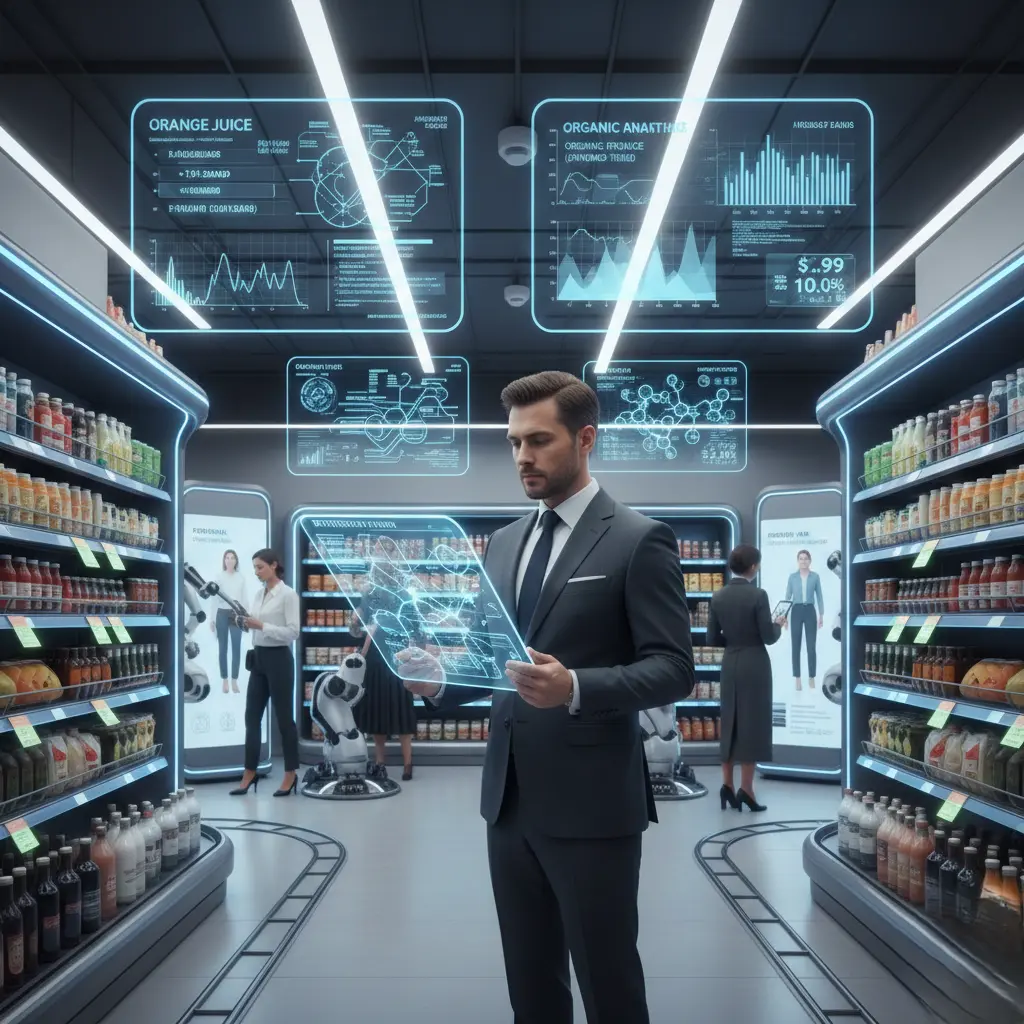
Robots are now trained through simulation and reinforcement learning, mastering millions of scenarios before entering the real world. A major highlight among the Latest Trends in AI Technology is the rise of AI-operated retail stores that manage inventory, security, and customer flow with minimal human involvement. Analysts expect autonomous robotics to become a trillion-dollar industry by 2030, driven by demand for automation and 24/7 intelligent machines. AI is no longer a future idea, it’s becoming the backbone of factories, transport systems, and next-generation workplaces.
Generative AI for Video, 3D & Simulation
These systems can generate full movie scenes, lifelike 3D objects, and simulated game environments, turning simple prompts into cinematic sequences. One of the Latest Trends in AI Technology is how creators can now storyboard films, design worlds, and produce professional footage without cameras or large teams. Beyond content creation, generative video and 3D AI are reshaping entertainment, engineering, training, and industrial design, turning imagination into instantly usable, high-quality reality.
Simulation-based generative AI is now a core technology for robotics and self-driving development. Engineers use AI-generated virtual environments to train robots, drones, and autonomous cars safely across millions of scenarios before deploying them in the real world. Businesses are using these tools in powerful ways, real estate teams create virtual staging for listings, eCommerce brands build 3D product models, and factories rely on digital twins to test workflows and optimize operations.
AI Chips & Specialized Hardware
Platforms like NVIDIA Blackwell, AMD MI300X, Google TPU v6, and custom silicon from Apple, Tesla, and Meta are redefining how quickly and efficiently AI models can run. Modern AI chips are optimized for the demands of large language models: massive memory bandwidth, parallel processing, and energy-efficient inference.
This hardware evolution is paving the way for AI PCs, decentralized compute networks, and devices that can run mini-LLMs natively. As specialized chips continue to advance, AI will feel less like a cloud service and more like an integrated part of every device we use, always available, always intelligent.
Latest Trends in AI Development
The latest trends in AI development focus on how engineers, researchers, and AI teams are building smarter, more efficient systems in 2025. Instead of just training bigger models, development is shifting toward creating intelligent workflows that combine autonomy, memory, reasoning, and personalization.
This section explores the new foundations of modern AI engineering, advanced agent frameworks, better retrievers, scalable RAG pipelines, and training methods that reduce cost while improving accuracy. Developers are designing systems that think, plan, and adapt, rather than simply generate text. The result is a new era of AI development built around efficiency, modularity, and real-time intelligence.
AI Agents & Autonomous Workflows
AI agents are models that can think, plan, take actions, use tools, and complete multi-step tasks without constant human input. Platforms like CrewAI, LangChain Agents, AutoGPT 2.0, and Devin-style coding agents show how far this trend has evolved. Agents don’t just generate text; they execute workflows. They research topics across multiple sources, write and debug code, schedule meetings, summarize documents, manage operations, and even coordinate with other agents to finish complex tasks.
Companies are now adopting agents for internal operations, from customer support and HR tasks to financial analysis and product development. Instead of relying solely on static chatbots, businesses are building agent-powered pipelines that run continuously and autonomously. Looking ahead, agents will mature into full “AI employees” that handle specialized roles, maintain context, and operate with long-term memory, becoming a core part of every company’s digital workforce.
RAG 2.0, Vector Databases & Knowledge Graphs
It has become one of the biggest AI development trends for businesses because it delivers higher accuracy, domain-specific intelligence, and trusted outputs. Modern RAG systems are evolving fast. RAG 2.0 introduces context compression, fusion retrievers, hybrid search that blends BM25 with vector search, and memory layers that help AI maintain long-term context. Agents now rely on RAG pipelines to perform deeper reasoning, fact-checking, and structured decision-making.
The ecosystem is rapidly expanding with tools like Pinecone, Weaviate, Qdrant, Milvus, and graph databases such as Neo4j. A major highlight among the Latest Trends in AI Technology is the rise of RAG 2.0, no longer just a tool, but the backbone of accurate, enterprise-grade AI. Industries are already using advanced RAG: finance boosts risk analysis with real-time retrieval, healthcare delivers evidence-based summaries, and companies build private ChatGPT-style assistants trained on internal documents.
Open-Source AI Models Gaining Power
Fine-tuning is now easier than ever, enabling teams to adapt models to specific tasks without massive compute costs. Companies are embracing self-hosted AI for privacy-sensitive applications, while the community continues to drive innovation through shared datasets, tools, and plug-ins. A notable shift, highlighted among the Latest Trends in AI Technology, is hybrid adoption, where enterprises combine open-source models with commercial systems to balance performance, support, and customization.
On a larger scale, governments and national research labs are leveraging open-source AI to build sovereign AI systems, ensuring control, security, and local adaptation. Open-source AI isn’t just an alternative, it’s shaping the AI ecosystem, accelerating experimentation, democratizing access, and allowing organizations worldwide to deploy powerful AI without depending solely on large tech providers.
Low-Code / No-Code AI Development
AI development is no longer limited to engineers. Low-code and no-code platforms are making it possible for non-programmers to build intelligent applications quickly. Tools like Bubble AI, Webflow AI, Zapier AI, OpenAI Canvas, and Retool AI empower business teams to create AI-driven workflows and apps without writing a single line of code. Teams can automate tasks, integrate AI with existing tools, and deploy custom solutions in days instead of months.
AI workflows for customer support, marketing, data analysis, and internal operations are now built through simple visual interfaces. A key highlight in the Latest Trends in AI Technology is the rise of citizen developers, non-technical creators launching micro-SaaS tools powered by AI. These platforms turn ideas into deployable products instantly, accelerating innovation beyond traditional engineering teams. Low-code and no-code AI is making intelligent software creation accessible to all, reshaping how companies build and experiment in 2025.
Cloud-Native AI & Efficient Deployment
With serverless GPUs, inference optimization, and distributed training, companies can scale AI workloads without managing heavy infrastructure. Platforms like AWS Bedrock, Azure AI Studio, and GCP Vertex AI are leading this shift, one of the Latest Trends in AI Technology, by making deployment faster, cheaper, and more reliable. Techniques like quantization, model distillation, LoRA fine-tuning, and pruning let models run with lower memory and compute costs while still delivering high accuracy.
Enterprises are now orchestrating full AI pipelines, combining multiple models, retrievers, and agents to deliver complex services end-to-end. By optimizing both hardware and software, cloud-native AI is enabling organizations to deploy cutting-edge systems faster and more sustainably, solidifying deployment efficiency as a key trend in AI development for 2025.
Industry-Wise AI Trends
Latest trends in AI technology are reshaping industries far beyond traditional tech. From healthcare and finance to retail, education, manufacturing, and cybersecurity, intelligent systems are redefining operations, decision-making, and user experiences. Hospitals use AI for diagnostics and treatment planning, banks automate risk analysis, retailers enhance personalization, and manufacturers optimize production. Even cybersecurity teams leverage AI to detect threats in real time.
AI in Education
AI is revolutionizing education with personalized learning systems that adapt to each student’s pace, style, and strengths. Intelligent AI tutors help learners prepare for exams, acquire new skills, and get instant feedback, making learning more interactive and efficient. We break this down further in our guide on latest trends in ai for education.
Schools and universities are using automated grading to save time and provide detailed student insights, enabling teachers to focus on guidance rather than paperwork. AI-powered education agents assist with course planning, research, and assignments, while VR and immersive learning create interactive classrooms where concepts come alive.
AI in Retail & E-commerce
Inventory management is now AI-driven, predicting demand, optimizing stock levels, and reducing waste. Personalization engines deliver tailored product recommendations, while AI pricing tools adjust offers dynamically for maximum competitiveness. Generative AI helps create product descriptions, images, and marketing content quickly, saving time for creative teams.
Customer support is enhanced with AI chat agents that handle queries, guide purchases, and resolve issues 24/7. Together, these technologies create seamless shopping experiences and operational efficiency, making AI an indispensable part of modern retail and e-commerce strategy.
AI in Finance
AI is rapidly reshaping the finance sector, making operations faster, smarter, and more secure. Fraud detection systems analyze transactions in real time, identifying unusual patterns and preventing losses before they occur. Credit scoring and lending decisions are now enhanced with AI, allowing more accurate assessments based on diverse data sources.
Trading algorithms leverage machine learning to execute high-speed trades and optimize investment strategies. Risk modeling has also improved, with AI predicting market fluctuations, portfolio risks, and systemic vulnerabilities more effectively than traditional methods.
Conclusion
The latest trends in AI technology and the latest trends in AI development are evolving at lightning speed, reshaping how we work, create, and interact with machines. From multimodal models and autonomous systems to RAG pipelines and low-code AI, innovation is constant and transformative.
For tech enthusiasts, staying updated is essential, as breakthroughs and tools emerge every month. The future promises even smarter devices, more capable agents, and AI integrated seamlessly into daily life. Following these trends now prepares you to harness AI’s next wave, where imagination meets powerful, real-world applications. You can discuss about latest trends in marketing that will evolve in 2026.