Will AI Replace Graphic Design? What the Data Says in 2026
The Short Answer: No, AI will not replace graphic design, but it has already replaced certain types of design work. By mid-2026, the industry will have split into two lanes: production-level tasks that AI handles faster and cheaper, and strategic creative work that still demands human judgment, cultural fluency, and brand thinking. Designers who adapted early are thriving. Those who didn’t are competing with $20/month subscriptions.
Why “Will AI Replace Graphic Design” Is Still the Wrong Question
Every year since 2023, the most-searched career-anxiety query in the creative industry has been some version of “will AI replace graphic design?” and every year, the answer gets more nuanced, not because the technology has slowed down, but because the evidence keeps confirming the same pattern. AI replaces tasks, not disciplines.
What the Research Confirms
According to McKinsey’s research on the economic potential of generative AI, approximately 26% of tasks in arts and design occupations are automatable. That leaves nearly three-quarters of the work untouched, the parts that require strategy, empathy, client collaboration, and the kind of taste that no model can replicate from a training dataset.
The Floor Has Risen
Here is what has changed in 2026: basic design competence is now accessible to anyone with a browser. If your value proposition as a designer was “I can make things look clean,” you are now competing with Canva Magic Studio, Adobe Firefly, and a dozen other AI-powered design platforms that let non-designers produce polished assets in minutes.
A Personal Confession
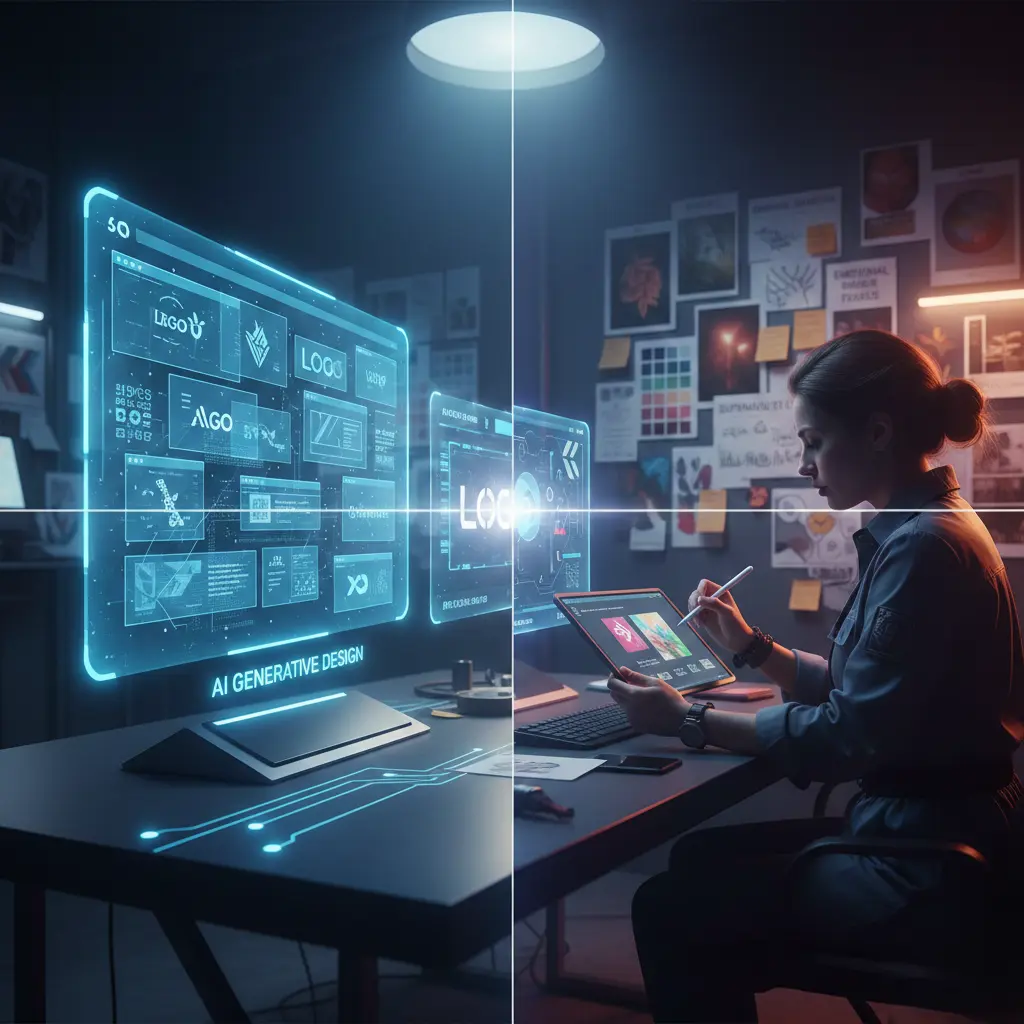
Full transparency: I am living proof of this shift. The images you see throughout this article? I made them with AI. My social media cover and logo? Also AI-generated. I am a content strategist and blog owner who wants to save budget on routine visual assets and it worked.
That does not mean designers are irrelevant. It means the type of work I would have hired a designer for has changed. The real question is not whether will AI replace graphic design. It is whether you are doing the kind of design work that AI cannot commoditize.
What AI Can Already Do in Graphic Design (and Do Well)
Let’s be honest about the current capabilities. As of 2026, AI design tools can:
Adoption Is No Longer Optional
Adobe’s 2024 State of Creativity Report found that 77% of creative professionals already use generative AI in some phase of their workflow. By now, that number is almost certainly higher. The adoption curve flattened. AI is not an experiment anymore. It is infrastructure.
What This Means for Business Owners
Routine visual assets, internal presentations, basic social posts, and email headers no longer require a designer on retainer. The Canva Visual Economy Report showed that small businesses and non-designers are handling these tasks in-house, cutting production costs by 40-60% on commodity design work.
My Own Budget Decision
I experienced this firsthand. When I launched this blog, I had two choices: spend $300-$500 on custom article graphics and social media branding, or use AI tools to generate them myself for the cost of a monthly subscription.
I chose the latter, not because I do not value design, but because at that stage, my budget needed to go toward content, distribution, and growth. The visuals I created with AI were good enough for the job they needed to do, and that phrase “good enough” is exactly what designers need to pay attention to.
Where This Hits Hardest
The designers most affected are those in production-focused roles:
| Role | Risk Level | Why |
|---|---|---|
| Production Artist | 🔴 High | Repetitive asset resizing, formatting, and fully automatable |
| Template Designer | 🔴 High | AI platforms generate and customize templates on demand |
| Junior Photo Retoucher | 🟠 Medium-High | Background removal and color correction are now one-click tasks |
| Entry-Level Social Media Designer | 🟠 Medium-High | Canva AI + brand kits reduce the need for dedicated designers |
| Stock Illustration Creator | 🔴 High | AI image generators produce unlimited variations instantly |
If your work lives in this column, the urgency is real, not because the jobs vanished overnight, but because the budgets for them did.
What AI Still Cannot Do (and Why It Matters)
Here is the counterweight. When people ask will AI replace graphic design, they are usually picturing the output, the final JPEG, the polished logo, the Instagram carousel. But professional graphic design was never really about the output file. It is about the decisions that lead to it.
The Human-Only Layer
AI cannot:
These are the skills that separate a $500 logo from a $50,000 brand identity. And they are exactly the skills that the shifting demand for creative roles now rewards most.
What I Learned Making My Own AI Visuals
When people debate will AI replace graphic design, they often overlook the human judgment behind every “generated” result. I chose the color palette, defined the visual tone, and rejected dozens of outputs before landing on something that actually felt right.
The AI did the rendering, but I did the designing, even if I lack formal design training. That creative judgment layer? That is what professional designers bring at a level I simply cannot match, and when my brand grows to the point where it needs a cohesive identity system across multiple touchpoints, I will hire a human designer. No question.
The Industry Data Agrees
The World Economic Forum’s Future of Jobs Report 2025 listed graphic design among declining roles, but simultaneously ranked creative direction, UX/UI design, and brand strategy among the fastest-growing. The work did not disappear. It migrated upward.
Will Graphic Design Jobs Disappear by 2030?
Short answer: Some will, most will not, and new ones will emerge. The U.S. Bureau of Labor Statistics projects a roughly 3% decline in traditional graphic design employment through 2032. That is modest, not a collapse. But it masks a deeper restructuring beneath the surface.
Roles Declining vs Roles Rising
| Declining | Rising |
|---|---|
| Print layout designer | Brand systems designer |
| Production artist | AI-augmented creative lead |
| Basic web banner designer | UX/UI designer |
| Template customizer | Design operations manager |
| Manual photo retoucher | Creative technologist |
The Real Pattern
The pattern is clear: execution roles shrink while strategy roles expand. For anyone asking will AI replace graphic design, the reality is that if you’re a student or early-career designer in 2026, your path isn’t disappearing, it’s being rerouted. By 2030, the designers who thrive will be those who can use what AI does well and lead in everything it cannot.
What Academics Are Saying
As Kai Riemer, Professor of Information Technology at the University of Sydney, has noted in his research on AI and creative work, automation does not eliminate professions, it redefines the boundary between what is routine and what is genuinely creative. Every time a tool automates the routine layer, the bar for what counts as professional-grade creative work rises.
Can AI Make Logos Better Than Humans?
This is one of the most common sub-questions whenever someone searches will AI replace graphic design and the honest answer is: AI can make more logos, not better ones.
The Volume Trap
Run any AI logo generator, Looka, Brandmark, or Midjourney with a logo prompt, and you will get dozens of options in minutes. Some will look sleek. A few might even feel usable. But dig deeper, and the problems surface:
My Logo Is AI-Generated, Here’s What I Know
I’ll use myself as a case study here. My logo is AI-generated, and I’ll be the first to admit it works for now it’s clean, recognizable enough for a personal brand blog, and cost me almost nothing. But when people ask will AI replace graphic design, this is where the answer becomes clear: that logo would not hold up for a funded startup, a consumer product line, or a brand fighting for shelf space, because there is a ceiling to AI-generated branding and that ceiling is exactly where professional designers live.
When “Cheap” Gets Expensive
For a freelancer launching a side project? An AI logo might be fine. For a business investing in long-term brand equity? It is a false economy. The cost of rebranding after an AI-generated identity fails to differentiate is always higher than doing it right the first time.
The ROI of Professional Brand Design
Business owners should think about design investment the same way they think about legal or accounting help: the cheap option works until it does not, and the stakes determine which option you need. According to a Lucidpress brand consistency study, consistent brand presentation across all platforms can increase revenue by up to 23%. This directly challenges the idea of will AI replace graphic design, because that level of consistency requires a designed system, not a collection of AI-generated one-offs.
The 80/20 Design Investment Rule
How I Apply This Personally
This is exactly what I practice. My blog images, social covers, and quick visual assets? AI-generated and budget-friendly. But when it comes time to build a full brand identity, pitch deck for investors, or customer-facing product experience, that is when the budget opens up for professional design.
Because the ROI equation changes at that level. This is where the question of will AI replace graphic design meets business reality. The answer is a resource allocation decision, not a binary yes or no.
Should you Learn Figma or AI Image Tools?
If you are a design student or career-switcher in 2026, this is probably your most pressing practical question. Here is the direct answer: learn Figma first, then layer in AI tools.
Why Figma First
Why AI Tools Second (but Not Optional)
What Google’s Design Team Recommends
As Google’s design team noted in their 2025 AI design guidelines, the most effective AI-assisted workflows happen when designers treat generative tools as a starting point for iteration, not a final deliverable. This perspective directly addresses the debate around will AI replace graphic design, showing that AI works best as a creative partner rather than a replacement. The designers who understand this distinction are the ones building the most compelling portfolios right now.
The 2026 Designer Toolkit
The Hybrid Advantage
The designers commanding the highest rates in 2026 are not the ones who chose either traditional tools or AI. They are the ones who integrated both, using AI to move faster through low-stakes production while reserving their creative energy for high-stakes strategic work.
What Working Designers and Industry Leaders Are Saying
The conversation around will AI replace graphic design has shifted dramatically among practitioners. The panic of 2023-2024 has given way to pragmatism.
Chris Do on Floor vs Ceiling
Chris Do, founder of The Futur and one of the most-followed design educators online, has consistently argued that AI raises the floor but does not change the ceiling. Designers who were already operating at a strategic level, solving business problems through visual communication, have found AI to be an accelerant, not a threat.
Paula Scher on Ideas vs Machines
Paula Scher, the legendary Pentagram partner, put it even more bluntly in a 2025 interview: “The computer never had the idea. The person has the idea.” That sentiment holds even as the “computer” gets exponentially more capable at executing.
What Studios Are Reporting
Design studios that integrated AI early report measurable gains:
The Business Model Shift
The studios struggling are the ones that sold deliverables, charging per logo, per layout, per banner. AI collapsed the perceived value of the deliverable. The studios thriving are the ones that sell outcomes, brand differentiation, conversion improvement, and user experience quality.
Conclusion
Here is what you need to remember, segmented by who you are:
If You Are a Designer:
If You Are a Student:
If You Are a Business Owner:
One Last Personal Note
I started this article as someone who uses AI for my own visuals, every image here, my social cover, my logo. I did it to save budget, and I do not regret it, but I also know exactly where AI stops being enough and professional design starts being necessary. That line is clearer than ever in 2026.
The question of will AI replace graphic design has a definitive answer: AI replaced the commodity layer of design. It elevated the strategic layer. Where you fall on that spectrum determines whether AI is your biggest threat or your greatest tool.
FAQs
Is it worth learning graphic designing in 2026
Yes, learning graphic design in 2026 is worth it because demand remains strong even as technology evolves. While many ask will AI replace graphic design, AI is more likely to enhance human creativity than eliminate it. Designers who master both core design skills and AI tools will have a competitive advantage.
Is graphic designing growing or decreasing
Graphic design is growing overall, driven by demand in digital media, branding, and UX/UI. Even though some people wonder will AI replace graphic design, the field is evolving rather than shrinking. Designers who adapt to new tools and trends are seeing more opportunities than ever.
Is there a shortage of graphic designers
There isn’t a widespread shortage of graphic designers, but demand for skilled designers often exceeds supply. Many ask will AI replace graphic design, yet companies still seek designers who combine creativity with strategic thinking. Those who upskill in both traditional design and AI tools stand out in the job market.