Open Future AI Review 2026: Legit or Just Hype?
This Open Future AI review found a real, free, and genuinely useful tool for one job — discovering AI apps you did not know existed. It is not a scam. But it is also not a source you should trust blindly. The directory hides a few uncomfortable details behind its “world’s largest” headline, and once you see them, you use the site very differently. Here is everything we checked, the good and the awkward, in one place.
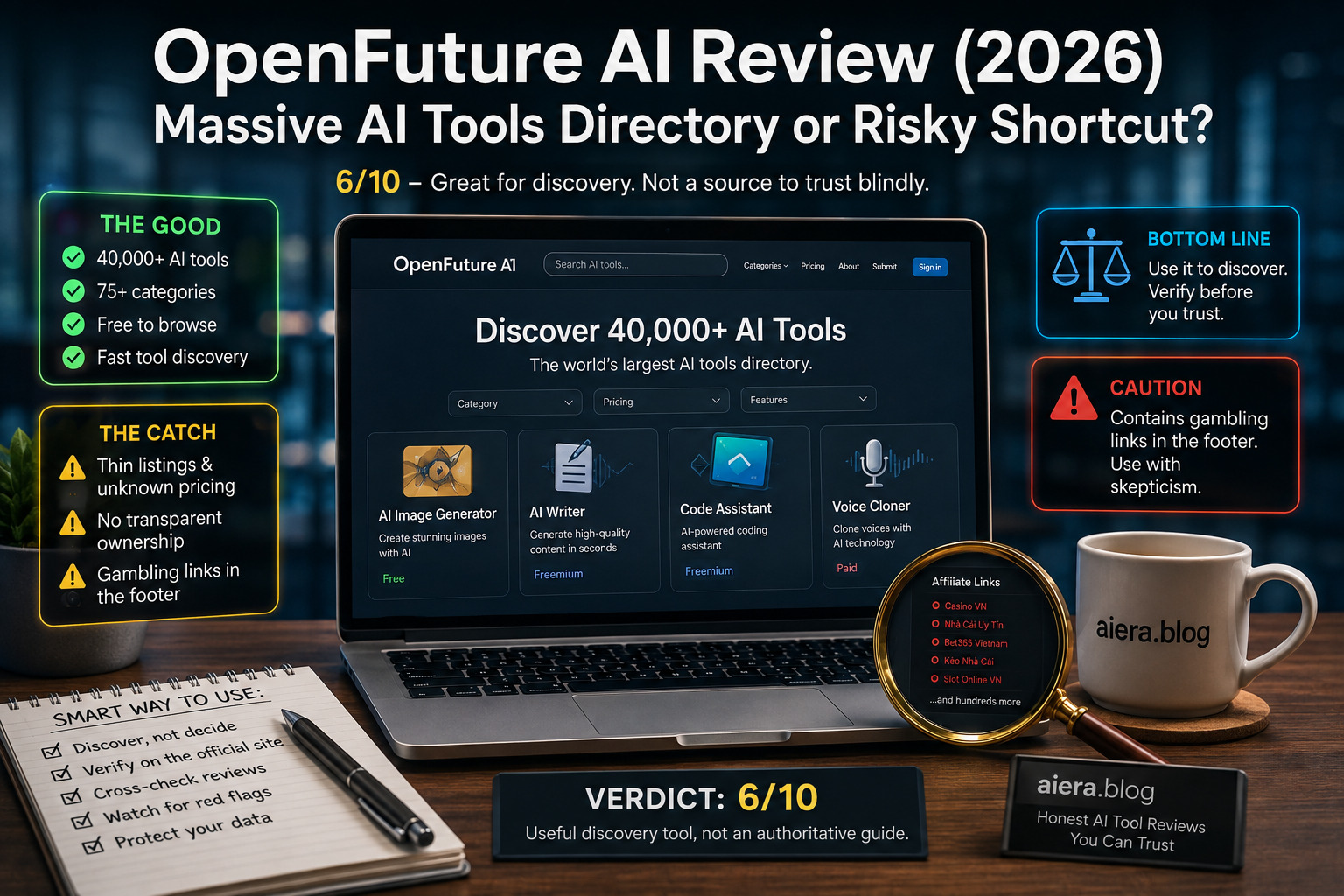
Our verdict: 6 out of 10 — a discovery net, not a decision-maker. Great for finding tool names fast, weak for deciding whether any of them is safe to pay for.
What is OpenFuture AI?
OpenFuture AI is a free, web-based directory of artificial intelligence tools that lives at openfuture.ai. It is often mistaken for a chatbot or a writing app. It is neither. Think of it as a Yellow Pages for the AI boom: you search, filter by category, click a listing, read a one-line summary, and hit a button that sends you to the actual tool on its own website.
When we browsed the platform in 2026, it listed more than 40,000 tools across roughly 75 categories, covering everything from image generators and developer utilities to legal assistants and niche corners like motion capture. Browsing is free, no account required. There is an optional Google or Discord login, and tool makers can submit their own products — some paying for promoted placement. The interface is clean and the filters work, so as a fast way to answer “what AI tools exist for X,” it does its job.
The “Open Future” name confusion, cleared up
Search “open future ai” and you land in a mess of unrelated results. Before we judge anything, it helps to separate four different things that share a similar name.
| Name | What it actually is |
|---|---|
| OpenFuture AI (openfuture.ai) | The AI tools directory reviewed here. |
| Open Future (openfuture.eu) | A European digital-policy think tank. No connection to the directory beyond a similar name. |
| Tenstorrent “Open Future” | A hardware company’s campaign for open AI chips and software. Unrelated. |
| “OpenFuture AI philosophy” | A vague “open AI development” concept some thin blogs invented for traffic. Ignore it — it is not a product. |
If a page describes OpenFuture AI as a writing assistant, a “philosophy,” or lists clothing prices for it, treat that page as unreliable. It is a tools directory, full stop.
Inside the directory: what is actually good
Credit where it is due. The size is real, and size matters when you are hunting for an obscure tool. The catalogue is one of the largest around, and the category and price filters make it easy to narrow tens of thousands of entries down to a shortlist in seconds. Popular sections like productivity, marketing, and developer tools are dense, and there are genuinely useful niche pockets you will not find on smaller, hand-curated lists.
For pure discovery, that breadth is the selling point. If you want to see the full landscape of, say, AI SQL assistants or voice tools, OpenFuture AI will surface names that neat little “top 10” posts miss entirely. This is the same reason we keep it on our radar when we build out our own best AI tools to use in 2026 shortlists — it is a good starting map, even if it is a poor final answer.
The catch: thin listings, hidden owners, and a strange footer
Here is where the shine comes off. Three problems stood out when we looked closely.
1. The listings are thin. A large share of entries carry placeholder pricing like “price unknown” even for tools that launched months ago. Descriptions are a single generated line — fine for spotting a name, useless for comparing two tools. And the community rating system barely functions: most listings we opened had zero votes, so you cannot tell a great tool from an abandoned one.
2. Nobody’s name is on it. The About page talks about a mission to become the world’s largest AI directory, but never names a single human being. No founder, no team page, no company registration, no address. The only trace of a person is a category called “Matt’s picks” — and who Matt is, nobody says. For a plain content site, anonymity is not a crime. For a platform that decides which AI tools get pushed to hundreds of thousands of visitors, it matters, because you cannot judge editorial independence when you do not know who the editor is.
3. The footer nobody talks about. Scroll to the very bottom of the homepage, past the tools and filters, and you find an affiliate section stuffed with hundreds of outbound links. They do not point to AI tools. They point overwhelmingly to Vietnamese-language gambling, betting, and casino sites, packed in as plain anchor text. That single detail explains a lot: the rock-bottom automated trust scores, the site’s heavy branded traffic from Vietnam, and why the operators might prefer to stay anonymous.
Is OpenFuture AI safe and legit?
Safe to browse? Broadly, yes. You can search listings without an account or payment, and the outbound “visit site” links go where they claim. Nothing on the directory itself asks you for money or sensitive data beyond that optional login.
The automated trust scanners cannot agree, which tells you something on its own. One well-known scam checker gives openfuture.ai one of the lowest scores on its platform and flags it as suspicious — almost certainly triggered by that gambling-link footer. Another scanner rates the same domain as middling and safe to interact with. There is no Trustpilot, G2, or Capterra profile to break the tie, which is itself a signal about how the platform positions itself.
The real risk starts after you leave the site. OpenFuture AI does not test, vet, or verify the privacy practices, pricing claims, or security of the tools it lists. Anyone can submit a product, so many listings are closer to ads than reviews. Before you upload documents, business data, or payment details to any tool you found there, check that provider yourself. A useful habit for any directory is spotting the red flags of an untrustworthy platform before you hand over anything valuable — inclusion in a directory is not a safety certificate.
Best OpenFuture AI alternatives (2026)
OpenFuture AI is one of many directories born in the 2023 gold rush. If its thin listings frustrate you, these are the usual alternatives — each with its own trade-off.
| Directory | Best for | Watch out for |
|---|---|---|
| OpenFuture AI | Raw discovery, obscure niche tools | Thin listings, anonymous owners, gambling-link footer |
| Futurepedia | Popular tools, cleaner interface | More sponsored and promoted placement |
| Toolify | Tools ranked by traffic and trends | Also an aggregator — still verify each tool |
| There’s An AI For That | Task-based search across a huge catalogue | Ad-heavy; listing quality varies |
None of these vet tools for you either. The right move is the same everywhere: use a directory to find options, then verify each one independently — which is exactly how we approach every write-up in our Tool Reviews hub.
Should you list your AI tool on OpenFuture AI?
If you build AI products, a listing looks tempting: free submission and a backlink from a domain with real authority. But weigh two things first. The site’s search traffic has been sliding through 2026, well down from its late-2025 peak, and most of that traffic is people typing the site’s own name — not buyers browsing for tools like yours. Second, a backlink sitting on the same domain as a wall of gambling links carries baggage. If you are chasing link equity, that footer is not the neighbourhood you want your brand’s link to live in. A paid promotion here can still make sense for early visibility, but go in with clear expectations, not the “largest directory” hype.
How to use OpenFuture AI the smart way
- Use it to discover, not to decide. Treat every listing as a lead, not a recommendation.
- Verify on the tool’s own site. Confirm real pricing, features, and a privacy policy before you sign up.
- Ignore “recommended” labels. Some placements are paid, and the ratings are mostly empty.
- Cross-check with a second source. Independent reviews and real user feedback catch what a one-line summary hides.
- Never enter sensitive data based on a directory listing alone.
Frequently asked questions
Is OpenFuture AI legit? Yes, as a directory. It is a real, functioning site with genuine tool listings and working links. What is not transparent is who runs it and how it makes money, so treat its recommendations with healthy skepticism.
Is OpenFuture AI safe to use? Browsing is low-risk — no payment or account is needed. The risk begins with the third-party tools it links to, which it does not vet. Verify each tool before trusting it with your data.
What is OpenFuture AI used for? Discovering AI tools by category and price across a very large catalogue. It is a search-and-compare interface, not an AI model or chatbot.
Is OpenFuture AI free? Yes, it is free to search and browse. Tool makers can submit listings for free and pay for promoted placement.
What are the best OpenFuture AI alternatives? Futurepedia, Toolify, and There’s An AI For That are the most common alternatives, each with its own strengths and the same caveat: verify tools independently.
Final verdict
OpenFuture AI is two things wearing one domain. It is a large, free, occasionally handy catalogue of AI tools — and an anonymous, thinly maintained site whose real business model has little to do with helping you choose software. As a discovery net, it earns its 6 out of 10. As a source you would trust to tell you what is safe or worth paying for, it does not. Use it to build a list, then do the real homework yourself. That is the honest, hands-on standard we hold every tool to at aiera.blog — and by that standard, OpenFuture AI is useful, not authoritative.