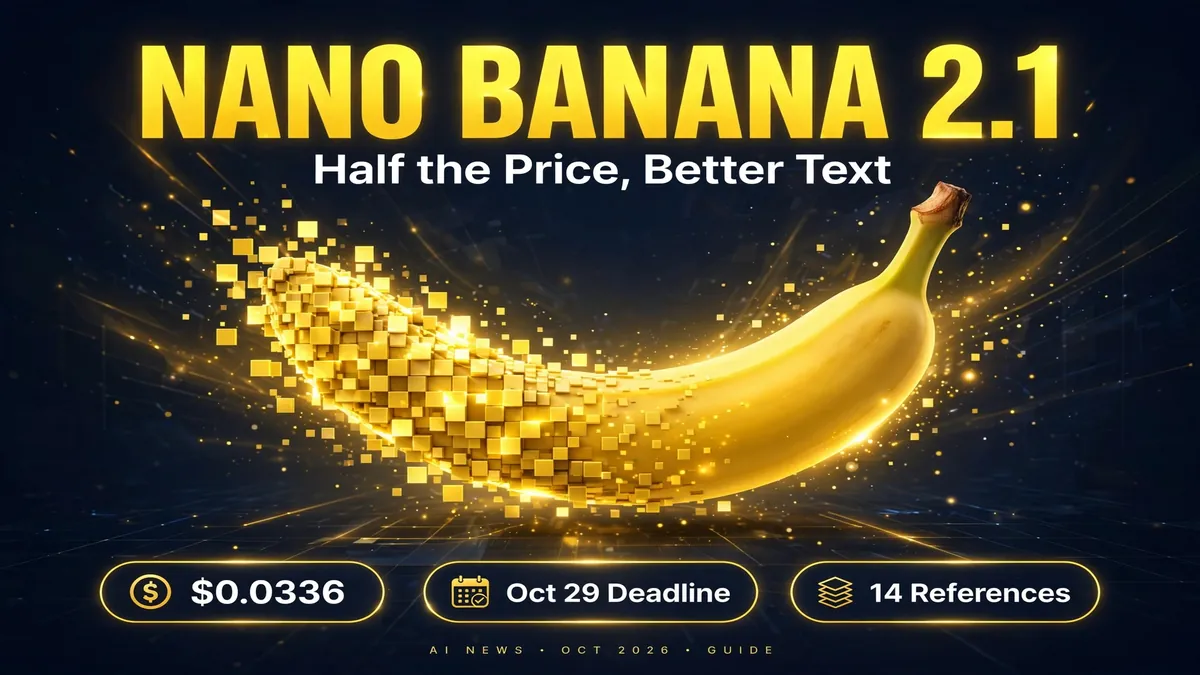
Nano Banana 2.1: Half the Price, Better Text — and Why You Must Migrate by Oct 29
Key Takeaways
- Google has released Nano Banana 2.1 (model ID
gemini-nano-banana-2.1), generally available since October 6, 2026. - It halves image generation costs to $0.0336 per 1,000 images, renders text better, supports up to 14 reference images, and adds mask editing.
- Nano Banana 2 shuts down on October 29, 2026. Workflows pinned to 2.0 will break after that date unless migrated.
- It is the default image model across the Gemini app, AI Mode in Search, Flow, Stitch, and Ads. You can try it free before paying for API use.
- Google’s “outperforms across the board” claim has no published side-by-sides. Treat it as marketing. The price cut and shutdown date are confirmed facts.
Google has released Nano Banana 2.1 (model ID gemini-nano-banana-2.1), generally available since October 6, 2026. It halves image generation costs, renders text better, and supports more reference images. And it comes with a hard deadline: Nano Banana 2 shuts down on October 29, 2026.
If you build on Google’s image stack, here is what changed and what to do before the cutoff.
What Improved in 2.1
- Price: $0.0336 per 1,000 images, half the cost of 2.0
- Text rendering: notably better at rendering legible text inside images (a historic weak point for image models)
- Reference images: up to 14 (up from 2.0’s limit)
- Mask editing: new in-painting style editing controls
- Ranking: #5 in text-to-image on LMArena (preliminary)
Why Text Rendering Matters So Much
For years, AI image models could draw almost anything except words. Ask for a poster with a headline, and you got beautiful gibberish. Letters melted. Words repeated. Text was the tell that an image was AI-made.
That weakness shaped how people used these tools. Designers generated backgrounds and added text themselves in other software. Marketers avoided any creative with words in it. Every workflow had a manual step to work around the model’s blind spot.
Better text rendering removes that step for many use cases. Product mockups with labels, social graphics with headlines, diagrams with annotations: all become one-step generations instead of two-step composites. If your work involves any words inside images, this is the improvement that changes your process. Test it with your actual typography needs, though. “Better” does not mean perfect, and small text or unusual fonts still deserve a close look.
What You Can Do With 14 Reference Images
Reference images tell the model what to keep consistent: a character’s face, a product’s shape, a brand’s colors. More references mean tighter control across a set of images.
Here is what the higher ceiling unlocks. A product line shoot: feed all your product angles once, then generate lifestyle scenes that keep every item accurate. A character series: lock the character from multiple angles, then place them in new scenes without drift. A brand kit: supply logos, colors, and style samples, then generate on-brand creatives in bulk.
The practical advice is to use references deliberately. Fourteen slots do not mean you should fill all fourteen every time. Each reference narrows what the model can do. Use enough to lock what matters, and leave room for the model to be creative with the rest.
The October 29 Deadline
This is the part with a real consequence: Nano Banana 2 will be shut down on October 29, 2026. Any workflows, apps, or automations pinned to the 2.0 model need to move to 2.1 before then or they will break.
Shutdowns like this are not unusual, but they are unforgiving. There is no grace period mentioned. If your code calls the old model ID on October 30, it fails. The fix is small, a model ID change, but only if you remember every place the old ID lives: backend code, automation scripts, no-code tools, and any hardcoded configs.
Migration Walkthrough
Here is the migration as a careful sequence, expanded from the quick checklist:
- Find every reference to the old model. Search your codebase, your automation platforms, and your docs for the 2.0 model ID. Do not forget staging environments and scheduled jobs.
- Update the model ID to
gemini-nano-banana-2.1in your API calls. Make the change in one place if your code is well factored, or in every call site if it is not. - Re-test prompts, especially ones with text. Text rendering changed between versions, so outputs with typography need fresh review. What looked right on 2.0 may render differently on 2.1.
- Check reference image counts. If you used the maximum references before, note the new 14-image ceiling and adjust any logic that capped the old limit.
- Confirm pricing in your cost projections. Costs halve, which is good news, but update your budgets and any customer-facing pricing that assumed the old rates.
- Run a full end-to-end test before October 29. Generate through your whole pipeline and inspect the outputs. Do this at least a few days early, so surprises have time to get fixed.
Cost Math: What Half Price Really Means
$0.0336 per 1,000 images is an abstract number until you scale it. Generate 10,000 images in a month and you pay about $0.34. Generate 100,000 and you pay about $3.36. Generate a million and you pay about $33.60. These are derived straight from the published rate, and they show why the halving matters: image generation at this price stops being a budget line item and becomes background cost.
That changes what is worth automating. Thumbnail variants, ad creative testing, personalized imagery: all become cheap enough to do at volume. The constraint shifts from cost to quality control. When images cost fractions of a cent, the expensive part is reviewing them, not generating them. Build your workflow around that reality.
Where You Can Use It
Nano Banana 2.1 is the default image model across Google’s stack: the Gemini app, AI Mode in Search, Flow, Stitch, and Ads. You can try it free in Flow or AI Mode before committing API spend.
Each surface fits a different user. The Gemini app is for quick personal generations. AI Mode puts image generation inside search. Flow is the creative tool where the model shines for filmmakers and designers. Stitch brings it to UI design workflows. Ads bakes it into campaign creative. If you are new to AI image tools, our Muse Image guide covers a comparable model to help you calibrate expectations.
Mask Editing: What Is New
Mask editing is the in-painting style control new in 2.1. In plain terms: you select part of an image and ask the model to change only that part. Swap a background, fix an object, change clothing, all without regenerating the whole image.
This matters because regeneration is a lottery. Every new generation changes everything, including the parts you liked. Mask editing keeps what works and changes what does not. For iterative creative work, it is the difference between steering and starting over.
A Note on the Claims
Google says 2.1 “outperforms across the board,” but has not published side-by-side comparisons. Treat that as marketing until independent evaluations land. The price cut and the shutdown date, however, are confirmed facts worth acting on.
The LMArena ranking, #5 in text-to-image, is preliminary. Leaderboard positions move as more votes come in and as new models release. It is a useful signal, not a verdict. The claims you can bank on are the ones with dates and prices attached: October 29 for the shutdown, $0.0336 per thousand images for the cost.
Pros and Cons
Strengths: half the price of 2.0; much better text rendering; 14 reference images; new mask editing; free to try across Google’s apps; a hard shutdown date that forces a clean migration instead of lingering on old versions.
Weaknesses: performance claims unverified; LMArena ranking preliminary; text rendering improved but not perfect; migration is mandatory, not optional, which is work even when the new version is better.
Frequently Asked Questions
When does Nano Banana 2 shut down?
October 29, 2026. Migrate to 2.1 before then.
How much does Nano Banana 2.1 cost?
$0.0336 per 1,000 generated images, half of version 2.0.
Is Nano Banana 2.1 free to try?
Yes. It is available in the Gemini app, AI Mode, and Flow without API setup.
What is the model ID for API calls?
gemini-nano-banana-2.1. Update any code still pointing at the 2.0 model before October 29.
How many reference images can I use?
Up to 14, raised from the 2.0 limit.
Will my 2.0 prompts work the same on 2.1?
Mostly, but re-test anything with text in the image. Rendering changed, so verify outputs before relying on them.
Sources: CellCog, Let’s Data Science, Fello AI. Release October 6, 2026.