QuillBot AI Detector: How Accurate Is It in 2026?
QuillBot AI Detector AI writing tools have become common for students, marketers, writers, businesses, and researchers. As more people use tools such as ChatGPT, Claude, and Gemini, the need to identify AI-generated text has also increased.
QuillBot offers an AI detection tool that analyzes written content and estimates whether it was created by a person, generated by AI, or produced through a mixture of human and AI assistance.
The important question is not simply whether the tool can detect AI. The bigger question is how reliable those results are.
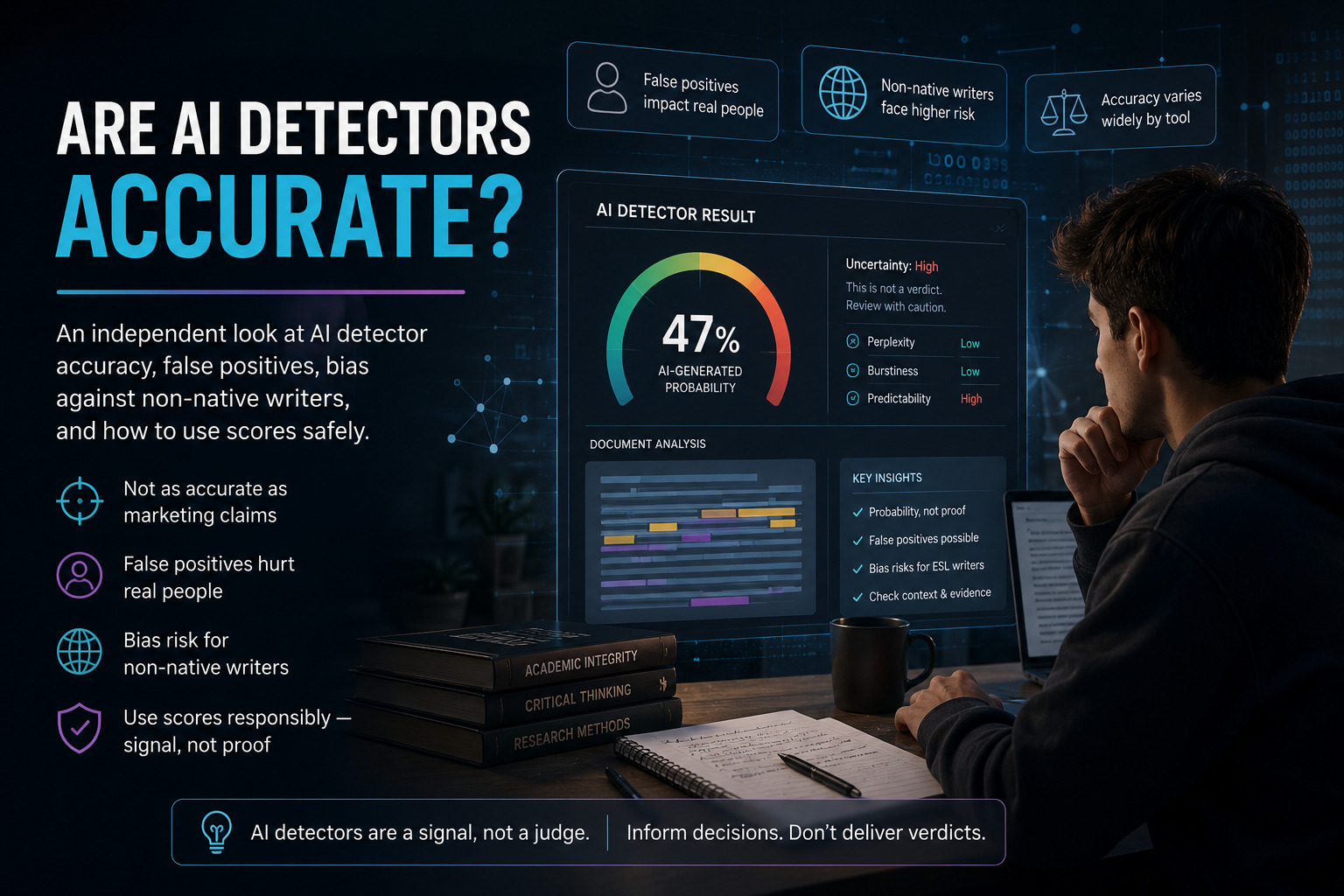
QuillBot states that its detector uses linguistic patterns, sentence structure, word probability, and other signals to analyze text. It also warns that AI detection is not 100% accurate and that results should be treated as probability estimates rather than final proof.
Key Takeaways
- QuillBot analyzes text for patterns associated with AI-generated writing.
- It supports detection across modern AI systems including ChatGPT, GPT-5, Claude, Gemini, Llama, and others.
- The tool can identify mixed human and AI-assisted writing.
- Longer text generally produces more reliable results than very short samples.
- Paraphrased and AI-edited content can be harder for any detector to classify.
- Human-written academic, legal, or highly structured text can sometimes receive an AI score.
- No AI detector should be treated as absolute proof of AI authorship.
What Is QuillBot AI Detector?
QuillBot AI Detector is a tool designed to analyze text and estimate the likelihood that AI writing software was involved in creating it.
Instead of only giving a simple yes-or-no answer, the system can analyze individual sections of writing and identify patterns that may indicate AI assistance.
According to QuillBot, its detector is designed to work with text generated by modern large language models, including ChatGPT, GPT-4, GPT-5, Claude, Gemini, Copilot, Llama, and other AI systems.
The tool is useful for several groups:
- Students checking their own work
- Teachers reviewing assignments
- Editors reviewing submitted content
- Publishers checking articles
- SEO teams reviewing website content
- Businesses managing AI-assisted writing
- Researchers examining written material
It is important to understand that the tool does not prove who actually wrote a piece of content. It analyzes writing patterns and provides an estimated likelihood of AI involvement.
How Does It Work?
The system uses several stages to analyze submitted text.
1. Text Input
The user pastes or uploads written content for analysis.
QuillBot processes the submitted text and prepares it for its detection model.
2. Text Processing
The system breaks the content into sections and analyzes the writing at a detailed level.
QuillBot says its detector uses sentence-level analysis, which allows it to identify specific sections that may contain AI-generated patterns instead of treating the entire document as one block.
3. Pattern Analysis
The detector looks at characteristics such as:
- Word patterns
- Sentence variety
- Predictability
- Repetition
- Sentence structure
- Word choice
- Writing style
These signals are used to estimate whether the writing resembles content generated by AI systems.
4. Detection Score
The result is presented as a confidence or probability score rather than a definitive statement.
QuillBot explains that its results should be treated as signals and not as proof of authorship.
How Accurate Is It?
There is no single accuracy percentage that applies to every piece of writing.
Detection performance can change depending on the length, topic, writing style, AI model used, and amount of human editing.
QuillBot says its detector is independently evaluated using the RAID benchmark, which includes outputs from systems such as ChatGPT, GPT-4, GPT-5, Claude, Gemini, Mistral, and Llama.
The company also says that its models are regularly updated as AI writing systems change.
However, QuillBot itself makes an important point: no AI detector can provide 100% accuracy.
This means users should avoid treating a score as a final verdict.
| Content Type | Expected Detection Difficulty |
|---|---|
| Long, unedited AI text | Generally easier |
| Short AI text | More difficult |
| AI text with human editing | Variable |
| Heavily paraphrased text | More difficult |
| Formulaic academic writing | Can create false positives |
| Legal or technical writing | Can be difficult |
| Mixed human and AI writing | More complex |
QuillBot recommends using longer samples because longer content generally provides more reliable results than very short text. Its current documentation says text of 300 words or more tends to produce more reliable scores.
Which AI Models Can It Detect?
The detector is designed to identify writing associated with several major large language models.
These include:
- ChatGPT
- GPT-4
- GPT-5
- Google Gemini
- Anthropic Claude
- Microsoft Copilot
- Meta Llama
- Mistral
QuillBot says it regularly updates the detector as AI models evolve. This is important because detection systems need to adapt when newer language models produce different writing patterns.
Still, detecting content from a specific AI model is not the same as identifying its exact source with certainty.
A detector may recognize patterns associated with AI writing without knowing which person, account, prompt, or AI system actually produced the content.
Can It Detect Paraphrased AI Content?
Paraphrasing creates an additional challenge for AI detection.
A person can take AI-generated content and substantially edit its wording, structure, sentence length, or organization. This can change the characteristics that detection systems analyze.
QuillBot says its detector has been trained on paraphrased and rewritten AI content and is designed to recognize AI-assisted text even after certain changes.
However, QuillBot also acknowledges that heavily paraphrased or lightly AI-edited content can be harder for AI detectors to classify.
This is one reason why two AI detectors can sometimes produce different results for the same article.
The important point is that AI detection is a classification problem, not a digital fingerprint that can identify the exact origin of every sentence.
False Positives and False Negatives
Two common problems affect AI detection.
False Positive
A false positive occurs when human-written content is incorrectly identified as AI-generated.
This can happen with writing that is highly structured, repetitive, formal, or predictable.
Examples may include:
- Academic definitions
- Legal writing
- Technical documentation
- Structured templates
- Formal business writing
QuillBot specifically notes that formulaic human writing can sometimes receive higher AI scores than expected.
False Negative
A false negative occurs when AI-generated content is classified as human-written.
This can become more likely when AI-generated text has been significantly edited or changed.
Because both errors are possible, an AI detection score should not be used as the only evidence when making serious decisions.
QuillBot vs Other AI Detectors
There are several AI detection platforms available today. Their results may differ because they use different models, training data, scoring methods, and thresholds.
| Tool | Common Use |
|---|---|
| QuillBot | AI detection and writing tools |
| GPTZero | Education and AI detection |
| Originality.ai | Publishing and content teams |
| Copyleaks | Education and businesses |
| Turnitin | Academic integrity |
The best tool depends on the use case.
For example, an SEO agency may want a quick content screening tool, while a university may need a broader academic integrity system.
More importantly, different results do not automatically mean that one detector is broken. AI detection is probabilistic, so different systems can interpret the same writing differently.
Is It Free?
QuillBot provides a free AI detection tool.
According to its current information, free users can scan text without paying. Premium accounts mainly provide additional features such as larger or batch file uploads and expanded detection functionality.
QuillBot’s current detector documentation also lists different usage limits between free and premium plans. These limits can change, so users should check the current product page before relying on specific limits.
The core detection function is therefore accessible without requiring a premium subscription.
How to Use It Properly
Getting a useful result depends partly on how the detector is used.
Use Enough Text
Very short samples provide less information for analysis.
QuillBot currently recommends using longer content for more reliable results.
Review the Detailed Results
Do not only look at the final percentage.
Review which sentences or sections were flagged and consider whether their writing style explains the result.
Compare With Original Drafts
If authorship matters, drafts, revision history, notes, and previous writing samples can provide useful context.
Do Not Treat the Score as Proof
A high AI probability does not prove that someone used AI.
QuillBot itself advises users not to rely on AI detection alone when making decisions that could affect someone’s academic standing or career.
Pros and Cons
Pros
- Easy to use
- Fast analysis
- Free access
- Sentence-level feedback
- Supports major AI models
- Supports multiple languages
- Can identify mixed human and AI writing
- Useful for initial content screening
Cons
- No AI detector is 100% accurate
- False positives can occur
- Edited AI content can be difficult to identify
- Short text may provide weaker results
- Formulaic writing can sometimes be flagged
- Different AI detectors can disagree
Is the Result Reliable Enough to Trust?
The answer depends on what you mean by “trust.”
For initial screening, the tool can be useful. It can highlight sections that deserve additional review and provide an indication of possible AI involvement.
For serious accusations, however, the result should not stand alone.
QuillBot itself describes its results as probability estimates rather than verdicts.
That distinction matters.
A detector does not know whether a writer used an AI tool for an entire article, asked AI to improve one paragraph, used a grammar checker, or simply wrote in a predictable style.
It analyzes the text that is placed in front of it.
The best approach is therefore to combine detection results with writing history, drafts, author context, and human review.
Frequently Asked Questions
Is QuillBot AI Detector accurate in 2026?
It can provide useful AI-writing signals, but it is not perfect. Accuracy depends on factors such as text length, writing style, AI model, and the amount of editing or paraphrasing. QuillBot states that its results are probability estimates rather than definitive verdicts.
Can it detect ChatGPT?
Yes. QuillBot says its detector is designed to analyze content produced by ChatGPT and other major large language models, including GPT-4 and GPT-5.
Can it detect human-written content?
It attempts to distinguish human-written text from AI-generated writing, but no detector can guarantee perfect classification. Human writing can sometimes be incorrectly flagged, especially when it follows highly predictable or formulaic patterns.
Can it detect paraphrased AI text?
QuillBot says its detector is trained on paraphrased and rewritten AI content. However, the company also acknowledges that heavily paraphrased or AI-edited writing can be harder for detection systems to classify accurately.
Is the detector free?
Yes. QuillBot currently offers AI detection for free users. Premium users receive additional features, particularly around file uploads and expanded functionality.
Can an AI detector prove someone used AI?
No. An AI detector can estimate the likelihood that text contains AI-generated patterns, but it cannot prove who wrote the content or establish authorship by itself. QuillBot specifically advises users not to rely on detection alone for high-stakes decisions.
Final Verdict
QuillBot provides a useful way to screen written content for signs associated with AI-generated text.
Its support for modern AI models, sentence-level analysis, multilingual detection, and mixed human-AI classification makes it more useful than a simple yes-or-no checker.
However, accuracy should always be considered in context.
Longer, unedited AI text may be easier to classify, while short, heavily edited, paraphrased, or highly structured writing can create more uncertainty.
The most responsible approach is simple: use the result as a signal, not a verdict.
For writers, editors, educators, and businesses, that makes the tool useful for starting a review rather than ending one.