Are AI Detectors Accurate? What 2026 Research Shows
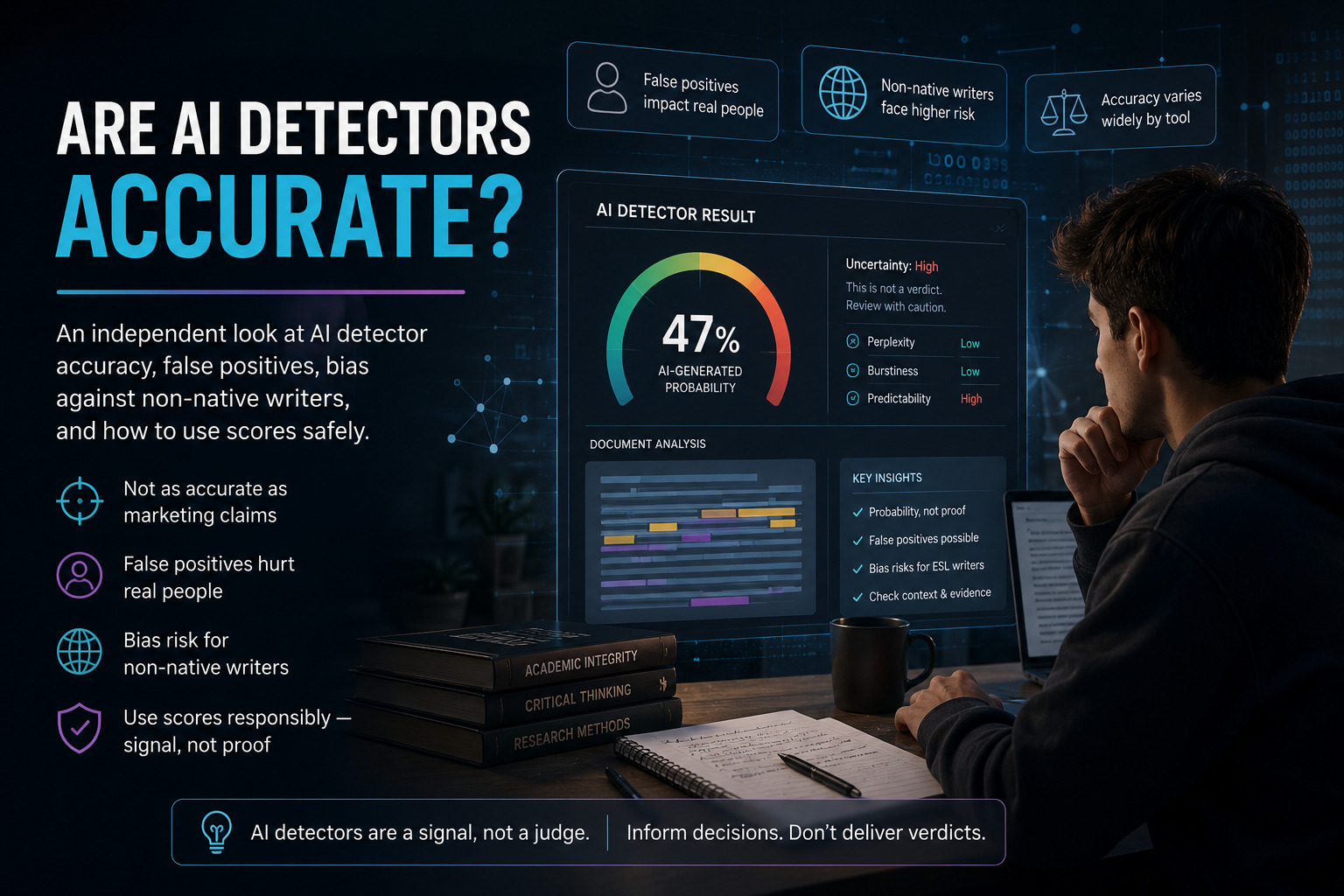
Short answer: not as accurate as the marketing claims. An AI detector does not hand you a clean “human” or “AI” verdict — it returns a probability, and that number is far shakier than a “99% accurate” badge suggests. Vendor pages advertise near-perfect scores, but independent 2026 research puts real-world accuracy much lower once text is edited, paraphrased, or written by a non-native English speaker. And the bigger problem is not the AI that slips through — it is the human writing wrongly flagged as machine-made. This guide covers what the latest studies actually found and how to read a detector score without getting someone falsely accused.
What an AI detector actually does
An AI detector — also called an AI checker or AI content detector — scans a piece of text and estimates the probability that a large language model produced it. It does not prove who wrote the text. It is also not the same as a plagiarism checker, which matches your writing against existing sources, or an AI humanizer, which rewrites machine text to dodge detection.
Most detectors work by measuring two things. Perplexity is how predictable the word choices are; burstiness is how much sentence length and rhythm vary. AI writing tends to be smoother and more predictable, so detectors flag that pattern. Newer tools add transformer-based classifiers trained on large samples of human and AI text. Tools like Turnitin’s AI writing detection use this deep-learning approach, but the underlying signals remain probabilistic — which is exactly why the accuracy question is complicated.
How accurate are AI detectors, really?
There is no single accuracy figure that applies to every model, language, and document length. That alone should make you cautious of any tool promising one.
Vendors typically claim 95% to 99%-plus accuracy. Independent testing tells a more modest story. In one widely cited comparison, ten popular detectors averaged around 60% accuracy on a controlled test set, with the best free tool reaching the high 70s and the best paid tool the mid 80s. Hands-on reviewers repeatedly land in the 70% to 85% range on realistic text — and accuracy falls further once content is lightly edited or run through a paraphraser.
The most rigorous independent evaluations reinforce this. The RAID benchmark, which tests detectors across millions of text generations, found that once you demand a low false-positive rate — the setting you would need before accusing a specific person — most detectors fall apart. A 2025 University of Chicago Booth working paper compared leading commercial tools and found wide gaps between them: one detector held near-zero error rates and was the only one to stay under a strict false-positive cap even against humanizer tools, while others saw false negatives climb sharply depending on the AI model. In other words, “accurate” depends entirely on which tool, which threshold, and which kind of text.
The false-positive problem is the one that matters
A false negative means AI-generated text slips through undetected — irritating, but low-stakes. A false positive means a real person’s genuine writing is flagged as AI. That is the outcome that ends careers and academic standing.
The scale is easy to underestimate. A 5% false-positive rate sounds small, but across a university of 50,000 students submitting four papers a year, that is thousands of wrongful flags annually. This is why researchers and even some detector companies now stress the same point: a detector score is a signal, not evidence.
Are AI detectors biased against non-native English writers?
This is the finding that matters most for a global audience, and it is the part vendor listicles tend to skip. A landmark Stanford study tested seven detectors on essays by non-native English speakers and found they were flagged as AI-generated roughly 61% of the time on average — with about a fifth of those human-written essays unanimously misclassified. The same detectors almost never made that mistake on native English writing.
The cause is structural. Perplexity-based detection treats predictable, simpler sentence construction as a sign of AI. Non-native writers often use more standard, less varied phrasing, which produces low perplexity — and trips the detector. If you write English as a second language, this is not a hypothetical risk.
To be fair to the tool makers, the picture is not one-sided. Turnitin’s own expanded study of roughly 2,000 English-language-learner samples reported no statistically significant bias for documents over 300 words, and Pangram reported a 0% false-positive rate on the same benchmark that exposed the original bias. Better-trained newer models may genuinely reduce the problem. But for the older, perplexity-driven detectors still in wide use, the risk is real — and readers writing in a second language deserve to know that before trusting a score.
Why schools are quietly backing away (2025–2026)
The clearest signal about detector reliability is what institutions are doing, not what vendors are saying. Through 2025 and into 2026, universities began switching AI detection off. Curtin University disabled it from the start of 2026; Vanderbilt turned off Turnitin’s detector citing reliability concerns; and institutions including the University of Cape Town and the University of Queensland pulled back during 2025.
Even the incumbent is repositioning. Rather than leaning on a raw “percentage AI” verdict, Turnitin has shifted toward writing-process transparency — draft timelines and policy profiles — a tacit acknowledgment that the score alone was never enough to decide a case.
The humanizer arms race
Any accuracy figure has a shelf life. “Humanizer” or “bypasser” tools rewrite AI output to read as human, and they defeat most detectors. Detection vendors respond — Turnitin added bypasser detection in 2025 — but this is a moving target, not a solved problem. Each new AI model and each new humanizer resets the board, which is one more reason to treat today’s benchmark as a snapshot rather than a guarantee.
How to use AI detector scores responsibly
- Treat the score as a signal, never as proof. No detector output should decide an accusation on its own.
- Corroborate. Look at drafts, version history, or a short conversation about the work before concluding anything.
- Give the benefit of the doubt on short passages and on writing by non-native English speakers, where false positives cluster.
- Set clear policies up front so students and writers know what AI use is allowed and how detection is used.
- For publishers and SEO teams, use detectors to sanity-check your own edited drafts — not to publicly accuse anyone.
For more on how modern AI writing tools like ChatGPT and Claude are reshaping this space, keeping an eye on the tools themselves is as important as watching the detectors.
Frequently asked questions
Can an AI detector be 100% accurate?
No. Every detector carries a margin of error, and any tool claiming perfect accuracy should be treated with suspicion. False positives — human text flagged as AI — are always possible.
Can AI detectors detect ChatGPT, Claude, and Gemini?
Usually, for unedited text from these models. Accuracy drops on newer models, mixed human-AI writing, and content that has been paraphrased or “humanized.”
Do AI detectors flag human or paraphrased writing as AI?
Yes. Simple, predictable, or non-native English writing is more likely to be misflagged, and paraphrasing tools can push both false positives and false negatives higher.
Are free AI detectors reliable?
Free tools offer a rough signal and can be useful for a quick check, but independent tests generally show lower accuracy than paid options. Never rely on a single free result.
Can a teacher rely on an AI detector alone to prove cheating?
No. A detector score is one input. It should always be weighed alongside human judgment, the student’s writing history, and the institution’s academic policy.
The bottom line
AI detectors are a useful signal and a poor judge. The 2026 research is consistent: accuracy varies widely by tool and text type, false positives fall hardest on non-native writers, and no detector should decide an accusation by itself. At aiera.blog, we treat detector scores as one input among many — helpful for informing a decision, never for making it. Use them to raise a question, not to deliver a verdict..