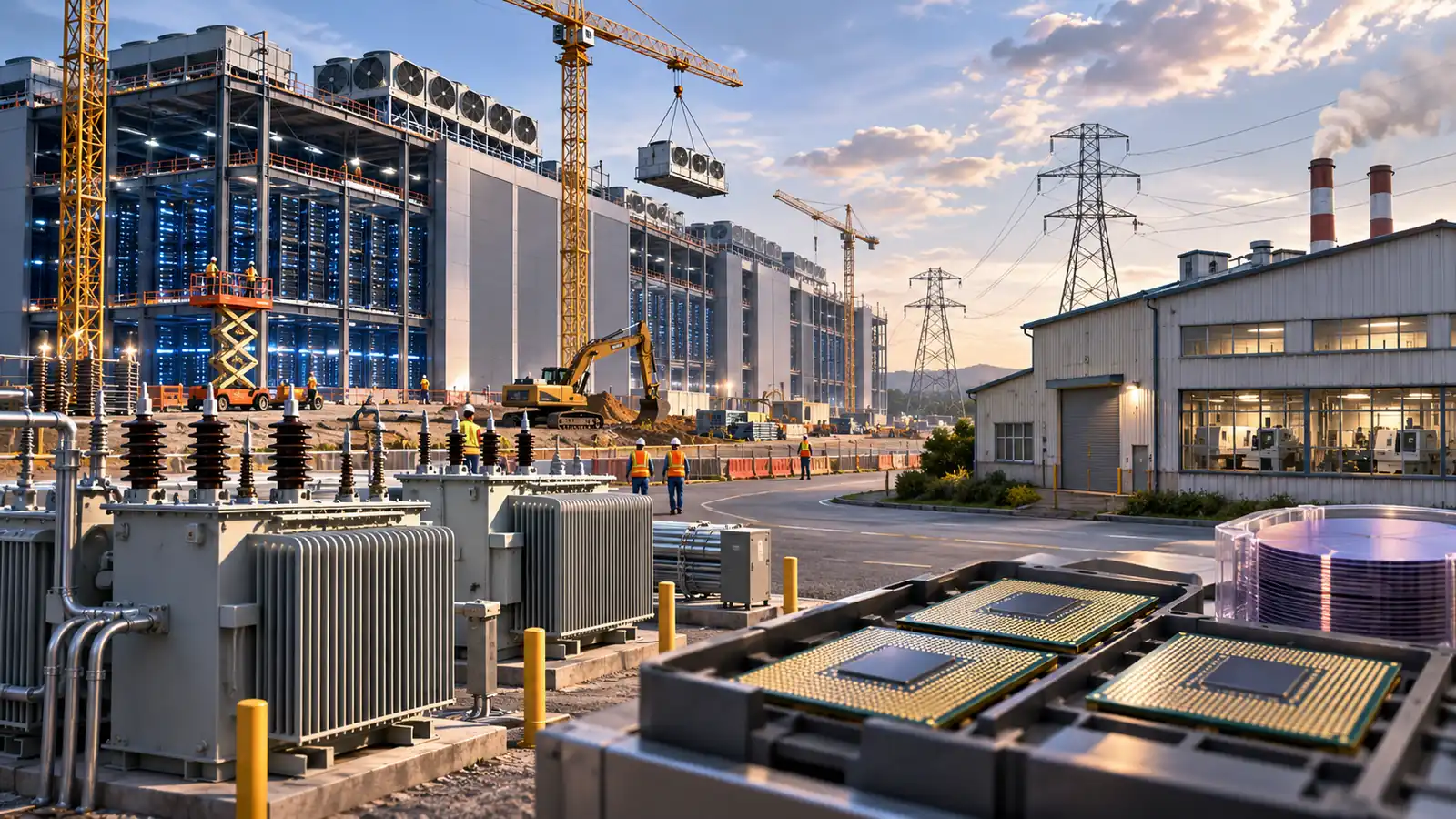
AI’s $1.3 Trillion Build-Out Is Squeezing the Rest of the US Economy
Key Takeaways
- The Wall Street Journal reported on 23 November 2026 that the AI build-out has become the major force behind US economic growth, while pushing other parts of the economy aside.
- UBS economist Jonathan Pingle estimates the AI boom has accounted for more than half of US economic growth over the past year.
- Columbia economist Stijn Van Nieuwerburgh estimates nearly $1.3 trillion will go into the US AI build-out this year alone.
- Some NAND flash memory products have more than quadrupled in price over the past year, according to FactSet data cited by the Journal. The same chips go into iPhones, Nintendo Switch consoles, cars, dishwashers and karaoke machines.
- The five big hyperscalers — Alphabet, Amazon, Meta, Microsoft and Oracle — have issued about $277 billion in debt so far in 2026, against $108 billion in all of 2025, according to Fitch Ratings.
- US AI-infrastructure companies have issued $212 billion in stock this year through October, according to S&P Global Market Intelligence.
- AI-related debt is now about a fifth of all debt issuance this year, up from about a tenth in 2025, according to Dealogic and Goldman Sachs figures reported by the Journal.
- Data centres are also competing for gas turbines, transformers, circuit breakers and experienced electrical workers, making it harder for utilities to secure the same equipment.
- Because the build-out supports growth and adds to inflation through higher chip prices, it strengthens the Federal Reserve's case for raising interest rates, according to Pingle — making borrowing dearer for the sectors already being squeezed.
- The counter-argument: a build-out is not a bubble. The spending creates real capacity, suppliers are expanding, and the test is whether AI revenues and productivity gains eventually justify the cost.
A Boom Big Enough to Move the Whole Economy
The artificial-intelligence build-out has become the major force behind US economic growth. That is the central claim of a Wall Street Journal report published on 23 November 2026, and it describes a change in the shape of the American economy rather than a single company's results. The build-out is far-reaching: spending on data-centre construction, on semiconductors and computing gear, on generators, backup batteries and cooling systems. Hotels near data centres are seeing revenue growth rise. Even Polaris, the snowmobile maker, said it was seeing strong demand for off-road vehicles from contractors building data centres.
"The tentacles of AI are remarkable," said UBS economist Jonathan Pingle, in the Journal's report. He estimates that the AI boom has accounted for more than half of the nation's economic growth over the past year. If one sector, broadly defined, is producing more than half of all growth, then the economy's headline numbers depend heavily on that sector. Growth that looks broad-based may in fact be narrow, and an economy that looks strong may be strong in one place and weak in others.
Columbia University economist Stijn Van Nieuwerburgh estimates that nearly $1.3 trillion will go into the AI build-out alone in the US this year — more than 1.6 times Belgium's GDP, according to syndicated coverage of the Journal's report. His longer-range analysis, cited in that coverage, puts total data-centre and related AI infrastructure spending at about $10.3 trillion from 2025 to 2032, averaging roughly 3.6% of GDP a year: a larger share of the economy, on that measure, than the historic canal, railroad, highway or telecom build-outs. Those comparisons carry a warning, though: the railroads and highways were built over decades and lasted for generations, while much of the equipment in a data centre may need replacing within a few years.
The Growth Arithmetic: Strong Headlines, Weak Foundations
When a company spends billions building a data centre, that spending shows up in the national accounts as investment. Servers, chips, generators and cooling systems all add to gross domestic product, as do the construction jobs, the concrete and the electrical work. That is why Pingle's estimate matters: if the AI boom has accounted for more than half of US economic growth over the past year, then more than half of the growth in the world's largest economy is coming from a single investment wave, and the rest of the economy is contributing less than half between it.
Investment-led growth is lumpy: it arrives in large waves, and it can stop suddenly if financing dries up or expectations change. A data centre adds to GDP while it is being built, but once it is finished the construction jobs go away, and what remains is a building with a small number of operating staff. A typical data centre employs only about 50 full-time workers, roughly half of them contractors, according to Virginia's legislative auditors, as cited in commentary on the Journal's story. The spending is enormous. The lasting employment is not.
The growth arithmetic also hides what is happening underneath. If the build-out is more than half of all growth, then the economy outside the build-out is growing slowly, or not at all. Home building, for example, has been weak while data-centre construction has soared. That contrast is the heart of the crowding-out story: the same economy that is producing record AI investment is producing weak housing investment, and the two facts are connected, not coincidental.
What "Crowding Out" Actually Means
"Crowding out" is a term economists use for a situation in which one kind of spending displaces another. In the textbook version, the story is about government borrowing: when the government borrows heavily, it pushes up interest rates, and higher rates make it more expensive for businesses and households to borrow, so private investment falls. The version described in the Journal's report is broader and more physical. Many of the things the AI build-out is vacuuming up — chips and electricity, labour and money — are resources that other businesses also need. The result is a version of what economists call "crowding out", but the mechanism runs through prices and availability, not only through interest rates.
The distinction matters, because it changes who feels the squeeze and how. In the textbook version, the squeeze is felt through the cost of borrowing, spread thinly across the whole economy. In the version described by the Journal, the squeeze is felt through the price of specific inputs — memory chips, gas turbines, transformers, skilled electricians — and it falls hardest on the businesses that need those inputs most. A carmaker that needs memory chips feels it directly. A utility that needs a transformer feels it directly. A small electrical contractor in northern Virginia that loses its experienced staff to a data centre feels it directly.
Chips: The Memory Squeeze Hits Everything With a Circuit Board
The impact is most evident in surging prices for the memory and storage chips — especially those known as DRAM and NAND flash memory — that go into data centres. Some NAND products have more than quadrupled in price over the past year, according to FactSet data cited by the Journal. A fourfold rise in the price of a component that goes into almost everything electronic is the kind of shock that ripples through the whole manufacturing economy.
The reason is straightforward. Data centres need enormous quantities of memory and storage, and AI workloads in particular need fast memory for training and fast storage for the vast datasets models work with. Memory manufacturers have limited capacity, and when the largest buyers in the world — the hyperscalers — start buying at a scale never seen before, and signing long-term supply contracts that lock up capacity for years ahead, there is less left for everyone else. Manufacturers have publicly said they are sold out through 2026, and industry reporting suggests no meaningful new capacity arrives before late 2027.
The effects are visible in products that have nothing to do with AI. The same memory chips that go into data centres also go into consumer electronics such as iPhones and Nintendo Switch consoles, and memory also goes into dishwashers, karaoke machines and cars. When the price of that memory quadruples, the cost of making those products rises, and the companies that make them must choose between absorbing the cost, passing it on to customers, or stopping production.
Framework Computer, a San Francisco-based personal-computer maker, illustrates the choice. "We have had to pass those price increases through to customers," Nirav Patel, the company's chief executive, told the Journal. The company has paused production on chip-powered memory expansion cards it lists at $50 and $125, letting them sell out rather than raising prices beyond what most customers would pay. The car industry is feeling the same pressure: Steve Downing, chief executive of automotive supplier Gentex, told conference attendees in November 2026 that higher memory costs create "massive headwinds on the profitability side", according to syndicated coverage of the Journal's report. Cars now contain large amounts of memory, and when memory prices rise fourfold, the cost of building a car rises with them — and carmakers cannot simply pass the whole increase on to buyers without losing sales.
The Debt Binge: $277 Billion and Counting
The second channel of crowding out runs through the credit markets. The five big hyperscalers — Alphabet, Amazon, Meta, Microsoft and Oracle — have issued about $277 billion in debt so far in 2026, according to Fitch Ratings, against $108 billion in all of 2025. That is more than two and a half times the previous year's total, and the year is not yet over. Fitch's figures, reported in November 2026, put the increase in stark terms: from less than $50 billion a year between 2020 and 2024, to about $108 billion in 2025, to approximately $277 billion in 2026 as at 11 November. Fitch has warned that this borrowing could increase volatility in global corporate bond markets in 2027 and tighten funding conditions for other companies.
The borrowing is not limited to the hyperscalers. US AI-infrastructure companies have issued $212 billion in stock this year through October, according to S&P Global Market Intelligence, and data-centre operators have issued billions more in debt of their own. AI-related debt has accounted for about a fifth of all debt issuance this year, up from about a tenth in 2025, according to Dealogic and Goldman Sachs figures reported by the Journal. One in five dollars of new corporate debt is now tied to AI.
This matters for the rest of the economy in two ways. First, when the largest and most creditworthy borrowers in the world start issuing debt at this scale, they absorb a large share of the capital investors have available. Other companies can still borrow, but they compete for money with borrowers whose needs are enormous and whose appetite seems, for now, unlimited. Second, when the supply of bonds rises sharply, yields tend to rise, and borrowing becomes more expensive for everyone. The effect so far has been modest, according to figures reported in syndicated coverage of the Journal's story: AI debt has raised other corporate borrowing costs by only about 0.05 percentage point, and may have cut non-AI investment by roughly $10 billion. Those are small numbers against the size of the US economy — but they are early numbers, and the effect will grow if the borrowing keeps growing.
There is a further point about the debt. The hyperscalers are among the most profitable companies in history, and for most of the AI build-out they funded their investments mainly from existing cash flows and equity. The turn to debt is new, and it changes the character of the build-out: debt has to be repaid, or refinanced, on a timetable, while equity does not.
Power Gear and Workers: The Physical Bottlenecks
The third channel of crowding out is the most physical of all, and the hardest to solve with money alone. Data centres need enormous amounts of electricity, and to get it they need equipment: gas turbines, transformers and circuit breakers. They are investing in that equipment at a scale that is making it harder for utilities to secure the gear they need, because the data centres are willing to pay higher prices.
Benjamin Boucher, an energy supply-chain analyst at Wood Mackenzie, told the Journal that in some cases energy-equipment manufacturers are expanding capacity to meet the moment. But because there is so much uncertainty over the staying power of the data-centre building boom, manufacturers of massive pieces of equipment such as gas turbines have been hesitant to do so. A gas turbine factory is a large, expensive investment, and a manufacturer that builds one assuming data-centre demand will last a decade will be in trouble if that demand falls away after three years. The hesitation is rational — and it is why the bottleneck persists: demand is certain and immediate, supply is uncertain and slow to expand, and the gap is filled by higher prices and longer waiting times.
The same logic applies to the workers who build and maintain data centres. Utilities and other companies are competing with data centres for workers, and in areas with high concentrations of data centres, like Loudoun County, Virginia, the competition is particularly intense. "In our area, data centers are taking the experienced employees, promising set hours, no on-call and better pay and benefits," said Rodney Baker, general manager of M.E. Flow, an electrical, heating, cooling and plumbing business with locations in northern Virginia. The company has created a training programme to try to alleviate the shortage of skilled workers. But a training programme can produce new workers over time; it cannot produce experienced workers immediately. The shortage is not only a shortage of people, but a shortage of experience, and experience is the one thing that cannot be manufactured quickly.
The power demands of the build-out also have a carbon dimension inseparable from the economics. Data centres that cannot get enough grid power increasingly bring their own generation, often gas-fired, to the site. Our earlier reporting on the carbon emissions from AI data centres, based on International Energy Agency figures for 2030, sets out how fast data-centre electricity demand is growing. And a recent case study of Anthropic's data centres found that about 87% of the company's power could come from gas and 11% from coal by 2028.
Who Is Being Crowded Out?
Home builders are among the most exposed. Housing construction has been weak while data-centre construction has soared, and the two are connected through more than one channel: data-centre construction bids up the price of labour, equipment and materials, and it also bids up the cost of borrowing, through the interest-rate channel described below. A home builder that cannot hire electricians, cannot get a transformer, and cannot borrow cheaply is a home builder that builds fewer homes — and a shortage of housing is already one of the most pressing economic problems in the United States.
Small and medium-sized manufacturers are also exposed. Framework Computer and Gentex are examples, but they stand for a much larger group of companies that use memory chips, need electrical equipment, or employ skilled tradespeople. These companies do not have the purchasing power of a hyperscaler, nor the balance sheets to absorb a fourfold increase in the price of a key component. They pass what costs they can on to customers, absorb what they cannot, and stop making products when neither is possible.
Utilities are a third group. A utility that needs a transformer to connect a new housing development, or a gas turbine to meet peak demand, now competes with data-centre operators willing to pay more and commit to larger orders. The result is longer waiting times and higher prices for the equipment the grid itself needs — a particular kind of crowding out, because the grid is the infrastructure on which everything else depends, including the data centres themselves. And then there are the borrowers: every company that needs to issue debt, and every household that needs a mortgage, is affected when the largest borrowers in the world flood the bond market.
It is also worth asking who is not being crowded out, because the answer is revealing. The hyperscalers are not: they are the ones doing the crowding. The memory manufacturers are not: they are selling everything they can make, at prices they could not have imagined two years ago. The construction companies that specialise in data centres are not: the Journal's reporting notes that data-centre construction margins are more than double those on non-tech projects, which is why labour and equipment are pulled towards data centres and away from everything else. Crowding out is not a general condition of the economy. It is a redistribution, from the many to the few, from the small to the large, from the slow to the fast.
The Interest-Rate Channel: When the Fed Makes a Weak Sector Weaker
There is one more channel of crowding out, and it is the one Pingle regards as the most important. It runs through the Federal Reserve. The build-out is both bolstering the economy and, through higher prices for chips and the like, adding to inflation. That combination — stronger growth and higher inflation — contributes to the Federal Reserve's case for raising interest rates, or at least for not cutting them. Higher interest rates then make borrowing more expensive for the sectors that are already weak, above all housing.
"It is an odd feature of this business cycle that the Federal Reserve is going to make a weak sector even weaker," said Pingle, who began his career as an economist at the central bank. In a normal cycle, the central bank raises rates to cool an overheating economy, and the sectors that cool first are the ones that were hottest. In this cycle, the heat is coming from one sector, and the cooling will fall on others. Housing, sensitive to mortgage rates, will feel the effect first and hardest. The AI build-out will not feel it directly, because the hyperscalers borrow in the bond market rather than from banks, and their investment decisions are driven by a strategic race unlikely to be stopped by a quarter-point change in interest rates.
Bubble or Build-Out? The Counter-Arguments
It would be a mistake to present the crowding-out story as if it had only one side. The question of whether this is a bubble or a build-out is the most important question in the American economy today, and the counter-arguments deserve to be taken seriously.
First, a build-out is not the same as a bubble. A bubble is a rise in asset prices driven by speculation, with no corresponding increase in real productive capacity. A build-out is an increase in real productive capacity: data centres, chips, power systems, fibre networks. The spending is real, the buildings are real, and the capacity they create will exist for years, even if the companies that built them change hands. The railroads were overbuilt in the nineteenth century, and many railroad companies went bankrupt, but the railroads themselves remained and served the economy for a century. The same could be true of data centres.
Second, supply responds. Memory manufacturers are expanding capacity, even if it takes time. Energy-equipment manufacturers are expanding capacity in some cases, even if hesitant in others. Training programmes, like the one created by M.E. Flow, are producing new skilled workers, even if they cannot produce experienced workers overnight. The bottlenecks in this article are real, but they are not necessarily permanent.
Third, the productivity gains from AI have not yet arrived, and they will change the calculation when they do. The build-out is expensive now because it is building capacity ahead of demand. If AI systems deliver large productivity gains — making workers more productive and companies more efficient — then the returns will justify the cost, and the crowding out will look, in retrospect, like a temporary price paid for a permanent gain. That is the bet the hyperscalers are making, and it cannot be judged yet, because productivity gains take years to appear.
Fourth, the debt. The hyperscalers are among the most profitable companies in the world, and their debt levels, while rising fast, are still modest relative to their cash flows and market values. Oracle is the most stretched of the group, but the group as a whole is not in the position of a company that has borrowed recklessly.
These counter-arguments are real, but they answer a different question from the crowding-out story. The crowding-out story is not a claim that the build-out will fail. It is a claim that the build-out is already imposing costs on the rest of the economy, and that those costs are being paid now, by identifiable businesses and households, while the benefits are still in the future and still uncertain.
What to Watch Next
Memory prices come first. If NAND and DRAM prices keep rising, or stay at current elevated levels, the squeeze on electronics, cars and appliances will continue. If they fall as new capacity comes online or demand cools, the squeeze will ease. Memory prices are the most visible and immediate measure of crowding out.
Second, hyperscaler borrowing. Fitch expects AI-linked bond issuance to remain elevated in 2027, and Goldman Sachs has projected hyperscaler issuance could reach roughly $400 billion in 2027, up from about $250 billion expected for 2026 — forecasts, not facts, and the Fitch figure of $277 billion for 2026 already exceeds the earlier Goldman forecast for the full year. The question is not only how much is borrowed, but at what price: if yields on hyperscaler bonds keep rising, it is a sign investors are becoming more selective. Reuters reported in July that most hyperscaler bonds issued in 2026 were already trading at higher yields than at issuance.
Third, the Federal Reserve and the physical bottlenecks. If the Fed raises rates, or signals it will keep them higher for longer, the interest-rate channel of crowding out will intensify, and housing will feel it first. If gas turbine and transformer waiting times shorten, and the supply of skilled electrical workers improves, the physical squeeze will ease. If they lengthen, it will worsen.
Fourth, most important of all, AI revenue: the build-out is ultimately justified, or not, by the revenue AI systems generate and the productivity gains they deliver. If revenues grow fast enough to cover the cost of the infrastructure, the build-out will be vindicated. If revenues disappoint, the build-out will slow, and the crowding out will be replaced by a different problem — what to do with a vast stock of data centres built for a demand that did not arrive.
What We Could Not Verify
This article is based on the Wall Street Journal's report of 23 November 2026, as reflected in the Journal's own published excerpts and in syndicated summaries of the story. The full text sits behind a paywall, and this article's author could not read it in full. Figures attributed to the Journal — including the estimates from Jonathan Pingle and Stijn Van Nieuwerburgh, the FactSet NAND price figures, the S&P Global Market Intelligence stock issuance figure, and the Dealogic and Goldman Sachs debt-share figures — are as reported in the Journal's published excerpts and in syndicated coverage, and they are attributed as such. They have not been independently verified against the underlying data sources.
Two figures come only from syndicated summaries of the Journal's reporting, not from the Journal's own published excerpts this article's author was able to read: the estimate that AI debt has raised other corporate borrowing costs by about 0.05 percentage point and may have cut non-AI investment by roughly $10 billion, and the longer-range estimate of about $10.3 trillion in data-centre and related AI infrastructure spending from 2025 to 2032. Both should be treated as reported estimates rather than independently verified facts. The Fitch figures — about $277 billion in 2026 as at 11 November, against $108 billion in all of 2025 — were verified against Fitch's own reporting as covered by independent news outlets. Goldman Sachs projections for 2026 and 2027 are forecasts, presented as forecasts. The figure of about 50 full-time workers at a typical data centre comes from Virginia's legislative auditors, as cited in commentary on the Journal's story, and has not been independently verified.
It reports what the Journal reported, sets out the counter-arguments, and leaves the judgement to the reader.