Latest Trends in AI Marketing: What Smart Marketers Need to Know Now 2026
The latest trends in AI marketing center on AI-powered search visibility, generative content workflows, predictive personalization, and the emergence of agentic AI that can execute tasks autonomously. For marketers, founders, and early-career professionals, understanding these shifts is no longer optional, it’s essential for staying competitive in a rapidly evolving digital landscape. The brands winning today treat AI as a strategic amplifier, not a replacement for human insight.
What Are the Latest Trends in AI Marketing?
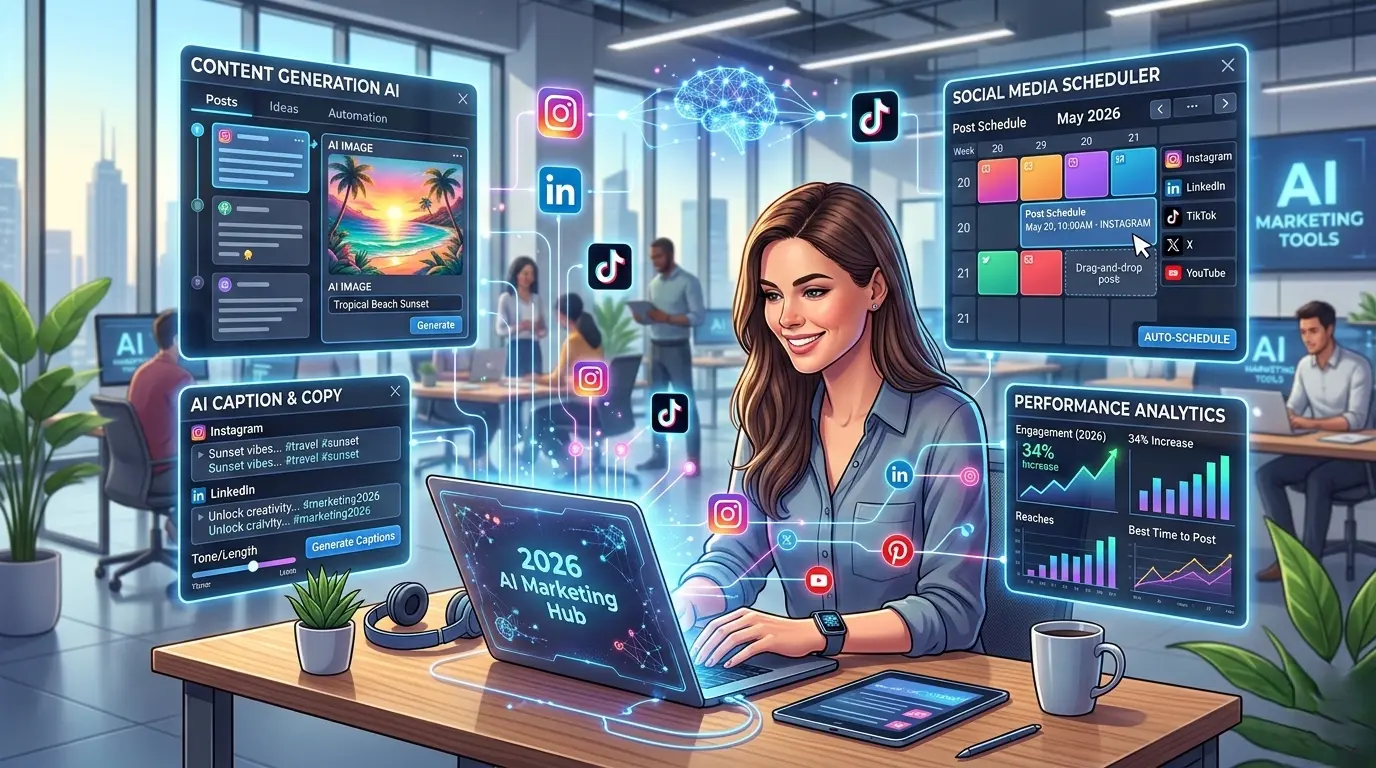
AI marketing has moved far beyond chatbots and basic automation. In 2026, artificial intelligence will influence how content gets discovered, how customers experience brands, and how campaigns optimize themselves in real time.
Here’s a quick overview of the trends reshaping the field:
Let’s break down each of these trends and what they mean for your strategy.
Trend 1 AI-Powered Search & the Rise of AI Overviews
The way people find information online is fundamentally changing, a shift highlighted in the latest trends in AI marketing. Google’s AI Overviews, Bing’s Copilot, and other AI-powered search features now synthesize answers directly in search results, often before users even click a link.
According to recent analysis from Search Engine Land, AI Overviews now appear in over 30% of informational queries, significantly altering click-through behavior for traditional organic listings. For marketers, this means that ranking on page one is no longer enough. Your content must be structured to be cited by AI systems, not just indexed by crawlers.
What this means for your strategy:
The shift to AI-powered search isn’t a future prediction, it’s happening now. Marketers who adapt their content strategy for AI citation will maintain visibility; those who don’t risk becoming invisible in the new search landscape.
Trend 2 Generative AI for Content Creation (Beyond First Drafts)
Generative AI tools have become mainstream in marketing departments worldwide, reflecting the latest trends in AI marketing. The conversation has matured it’s no longer whether to use AI for content, but how to leverage it without compromising quality, originality, or trust.
Data from Salesforce’s State of Marketing report reveals that 71% of marketers now use generative AI tools in their workflows, with high-performing teams being 2.5 times more likely to leverage AI for customer insights and content creation. However, the same research shows that top performers pair AI efficiency with rigorous human oversight.
The evolution of AI content workflows:
| Stage | 2023 Approach | 2026 Best Practice |
|---|---|---|
| Research | Manual keyword research | AI-assisted topic clustering and intent analysis |
| Drafting | AI writes full drafts | AI generates outlines; humans write with AI support |
| Editing | Basic grammar checks | AI suggests improvements; humans ensure voice and accuracy |
| Optimization | Manual SEO tweaks | AI recommends optimizations; humans approve changes |
Key considerations for content teams:
The most effective content strategies in 2026 use AI as a force multiplier, handling repetitive tasks and surfacing insights while humans focus on strategy, voice, and value creation.
Trend 3 Predictive Analytics & Customer Intelligence
AI’s ability to analyze patterns and predict behavior is reshaping the landscape, a key aspect of the latest trends in AI marketing. Predictive analytics now power everything from email send-time optimization to dynamic pricing and churn prevention.
Research from Boston Consulting Group (BCG) on AI-driven personalization shows that brands implementing AI personalization strategies effectively see revenue increases of up to 25%, along with significant improvements in customer retention and lifetime value. The key differentiator? These brands use AI to anticipate needs, not just react to behaviors.
Practical applications of predictive AI:
Getting started with predictive analytics:
Predictive analytics isn’t just for enterprise brands anymore, a shift seen in the latest trends in AI marketing. Accessible tools and platforms have democratized these capabilities, making them practical for businesses of all sizes.
Trend 4 Agentic AI & Autonomous Marketing Workflows
Perhaps the most significant emerging trend is the rise of “agentic AI” artificial intelligence systems that don’t just assist but can autonomously execute multi-step tasks with minimal human intervention.
According to Gartner’s marketing technology predictions, agentic AI will automate up to 30% of campaign management tasks by 2027. This includes everything from adjusting ad spend based on real-time performance to automatically generating and testing creative variations.
What makes agentic AI different:
| Traditional AI Tools | Agentic AI |
|---|---|
| Respond to prompts | Initiate actions based on goals |
| Complete single tasks | Execute multi-step workflows |
| Require constant input | Operate with defined autonomy |
| Assist humans | Act as autonomous collaborators |
Early use cases in marketing:
Considerations for adoption:
Agentic AI represents a significant leap, from AI as a tool to AI as a team member. Marketers who understand how to direct and collaborate with these systems will have a substantial operational advantage.
Trend 5 Conversational AI & Advanced Chatbots
Conversational AI has evolved dramatically from the scripted, frustrating chatbots of years past, reflecting the latest trends in AI marketing. Today’s AI assistants can manage complex, multi-turn conversations, understand context, and deliver genuinely helpful responses.
The new conversational AI landscape:
Applications driving real value:
The brands seeing the best results from conversational AI focus on genuine helpfulness rather than deflection. When AI truly solves problems, customer satisfaction increases, and operational costs decrease.
Trend 6 AI Ethics, Transparency & Trust Signals
As AI becomes more pervasive in marketing, consumers and regulators are paying closer attention to how it’s used. Ethical AI practices and transparency are transitioning from nice-to-have values to competitive necessities.
Key developments in AI ethics for marketers:
Building trust through transparency:
Brands that proactively embrace transparency, a key focus in the latest trends in AI marketing, will build stronger customer relationships. Those who obscure their AI use risk backlash when the truth emerges.
What Should Marketers Pay Attention to in 2026?
Looking ahead, several emerging developments in the latest trends in AI marketing deserve attention from forward-thinking marketers:
Multimodal AI integration:
AI systems are increasingly capable of processing and generating text, images, audio, and video together, a development at the forefront of the latest trends in AI marketing. Marketers can expect tools that create cohesive, multi-format campaigns from unified briefs.
Voice and visual search growth:
As AI assistants become more capable, voice and visual search are set to grow, reflecting the latest trends in AI marketing. Optimizing for these modalities requires approaches different from traditional text-based SEO.
AI-native platforms:
New platforms built entirely around AI interaction, rather than retrofitting AI into existing interfaces, are emerging reflecting the latest trends in AI marketing. Early adopters may discover fresh channels for reaching and engaging audiences.
Zero-click discovery:
More user needs will be met directly in AI interfaces without requiring clicks to external sites, a shift highlighted in the latest trends in AI marketing. Brands must develop strategies for value delivery and attribution to succeed in this new environment.
According to insights from Adobe’s Digital Trends Report, leading companies are already prioritizing AI integration for customer experience and real-time optimization recognizing that competitive advantage will belong to those who master AI-human collaboration earliest.
Preparing for 2026:
How Are Smart Marketers Using AI Right Now?
The most effective marketers aren’t using AI to replace their work, they’re using it to amplify their capabilities and focus their time on what matters most.
Current high-value applications:
Common pitfalls to avoid:
The pattern is clear: smart marketers, following the latest trends in AI marketing, use AI to handle repetitive and analytical tasks while investing their own time in strategy, creativity, and relationship building.
What Will Give You a Competitive Edge?
In a landscape where everyone has access to similar AI tools, differentiation comes from how you use them and what you bring that AI cannot.
Strategic differentiators:
Building sustainable advantage:
The edge belongs to marketers who view AI as infrastructure, essential but not sufficient, and continue developing distinctly human capabilities alongside it.
Expert Insight: Lessons from the Field
Personal Experience
Over time, working closely with SEO and digital marketing tools has made one thing very clear: the latest trends in AI marketing show that AI has shifted from an experimental add-on to a core part of modern marketing workflows. In day-to-day SEO and content optimization, AI now plays a key role in keyword research, intent analysis, content structuring, and performance evaluation.
However, real results don’t come from blindly relying on automation. The most effective outcomes I’ve seen happen when AI is used to speed up analysis and uncover patterns, while strategic decisions such as search intent alignment, content depth, and brand voice are still guided by human judgment.
Brand Perspective
From a broader brand perspective, our approach to AI marketing is rooted in practicality and long-term growth rather than hype. We focus on integrating AI into existing SEO and marketing systems in a way that improves efficiency, insight, and scalability without compromising quality or trust.
This means using AI to enhance research, personalization, and optimization while maintaining clear standards for accuracy, transparency, and user value. Aligned with the latest trends in AI marketing, brands that treat AI as a strategic support system rather than a shortcut are best positioned to build sustainable visibility and long-term authority.
Conclusion
As you navigate the latest trends in AI marketing, it’s clear that AI-powered search is already reshaping visibility, making optimization for AI citations and featured snippets just as important as traditional rankings. Generative AI can significantly speed up workflows, but human oversight is still essential to maintain quality and originality. Meanwhile, predictive analytics enables deeper personalization, requiring strong data infrastructure, while the rise of agentic AI makes governance frameworks for autonomous marketing systems increasingly critical.
Transparency remains critical, being open about AI use builds trust and aligns with evolving consumer expectations and regulations. Even so, true differentiation still comes from human strengths like original insights, expertise, and authentic connection. The marketers who win are those who start now, experiment continuously, and adapt fast. AI marketing is no longer optional; the real question is how to integrate it strategically while preserving the human elements that create lasting value.
FAQ
What is the AI trend in marketing 2026?
In 2026, AI marketing trends focus on hyper-personalization, AI-powered search optimization, predictive analytics, and autonomous marketing systems blending human creativity with machine intelligence for smarter campaigns.
Which AI tool is trending in Marketing?
Generative AI platforms like ChatGPT, Jasper, and MidJourney are leading the trend, helping marketers create content, design visuals, and predict customer behavior faster than ever.
What is the 30% rule in AI?
The 30% rule suggests that AI should handle roughly 30% of tasks to maximize efficiency without sacrificing human creativity or oversight, striking the perfect balance between automation and control.
What is the 1% rule in marketing?
The 1% rule in marketing emphasizes incremental improvement: small, consistent optimizations just 1% at a time compound into significant growth and long-term competitive advantage.
What is the 4th law of AI?
The 4th law of AI highlights ethical and responsible use: AI systems must be transparent, accountable, and aligned with human values to prevent misuse and build trust with users.