AI Hallucinations in Legal Filings: The Complete Risk, Governance, and Verification Guide for Law Firms
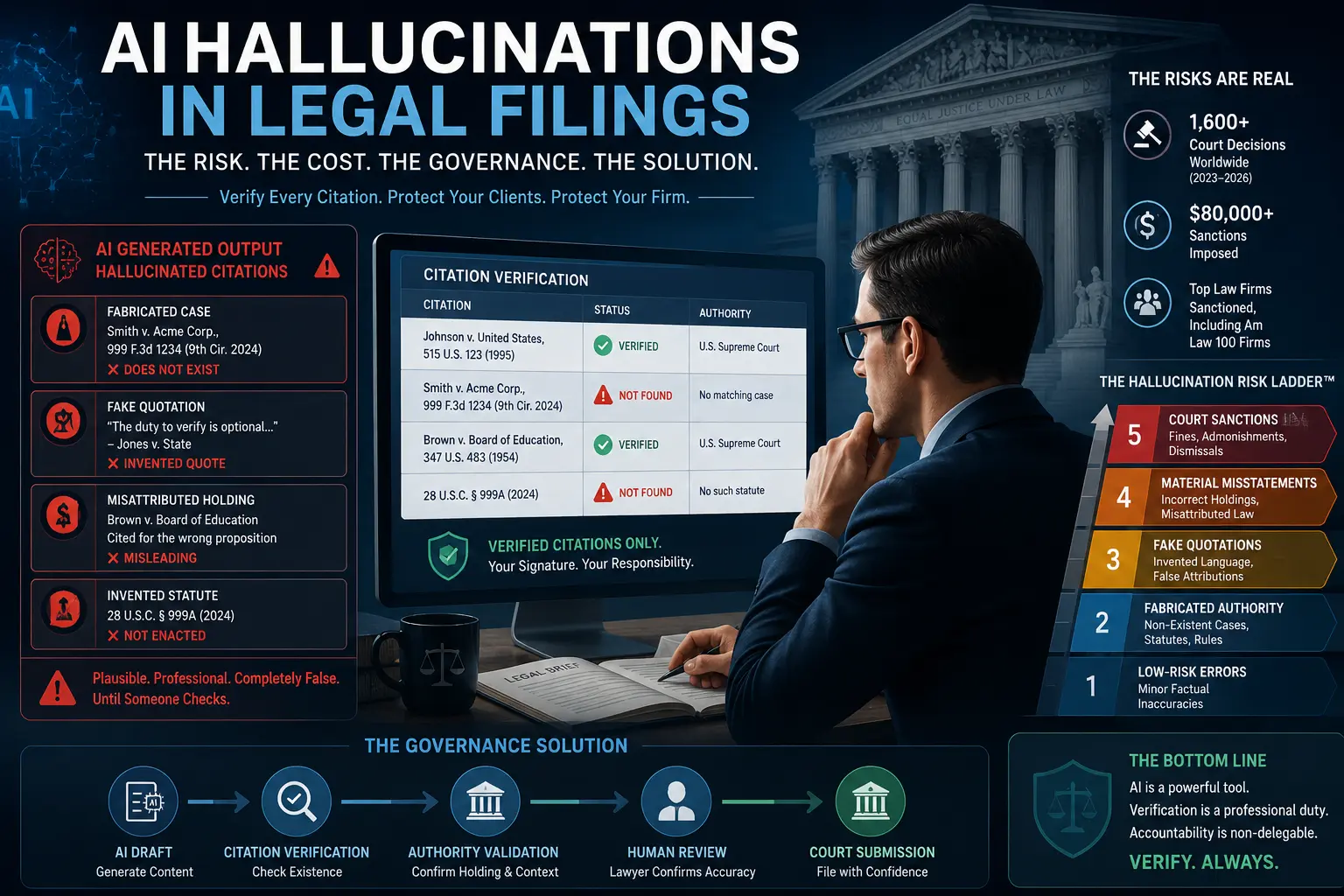
AI hallucinations in legal filings fabricated cases, invented quotations, and false citations generated by artificial intelligence tools have produced more than 1,600 documented court decisions worldwide, with sanctions ranging from formal admonishments to penalties exceeding $80,000. Courts have converged on a single controlling principle: the duty to verify every citation is non-delegable, and it applies regardless of which tool produced the error. This guide from Aiera.blog examines why hallucinations occur, what they cost, how courts and regulators are responding, and most importantly the frameworks law firms can deploy today to use AI productively without ever appearing in a sanctions database.
What Are AI Hallucinations in Legal Filings?
An AI hallucination is output generated by an artificial intelligence system that is presented as factual but is false, non-existent, or materially inaccurate. In the context of legal filings, hallucinations are uniquely dangerous because they imitate the most trust-laden artifact in the profession: the citation.
In litigation documents, legal AI hallucinations typically appear in four forms:
Each form sits at a different point on the risk spectrum, which is why Aiera.blog developed the AI Hallucinations Risk Ladder™ presented later in this guide. But all four share one property that makes them more dangerous than ordinary research errors: they are formatted to look correct. A fabricated medical claim looks wrong to a specialist on its face. A fabricated citation looks exactly like a real one until someone attempts to retrieve the case.
Why AI Hallucinations Occur: The Technical Root Cause
The mechanism behind AI hallucinations in legal research is well understood, and understanding it is now arguably part of a lawyer’s duty of technological competence.
Prediction, Not Retrieval
Large language models the systems behind ChatGPT, Claude, Gemini, and Copilot are text prediction engines. They generate the statistically most plausible next words given a prompt. They are not databases. A general-purpose chatbot does not query Westlaw, Lexis, PACER, or any court records system when it answers a legal question. It produces text that resembles the legal writing in its training data.
Legal citations are a worst-case scenario for this architecture. Citation formats are rigidly structured party names, volume number, reporter abbreviation, page, court, year which means a language model can assemble a perfectly formatted citation from statistical patterns without any underlying case existing. The model is not lying; it has no concept of truth to violate. AI hallucinations are simply the byproduct of this process: the model is completing a pattern.
Why Legal-Specific Tools Still Hallucinate
A persistent misconception among legal tech buyers is that purpose-built legal AI eliminates the risk of AI hallucinations. The sanctions record contradicts this. In early 2026, the Fifth Circuit imposed a $2,500 sanction on an attorney whose brief contained hallucinated authority drafted with the assistance of vLex and Thomson Reuters’ CoCounsel commercial, legal-specific platforms, not consumer chatbots.
Retrieval-augmented generation (RAG) where the model is forced to ground its output in documents fetched from a verified database dramatically reduces AI hallucination rates. It does not reduce them to zero. Retrieval systems can fetch the wrong authority, summarize a real case inaccurately, or blend retrieved content with generated content in ways that introduce subtle errors. The compliance conclusion courts have reached is unambiguous: there is no safe harbor based on vendor reputation. The verification obligation attaches to the signature on the filing, not to the software behind it.
The Scale of the Problem: What the Data Shows (2023-2026)
The most widely referenced data source on this issue is the AI Hallucinations Cases Database maintained by legal researcher Damien Charlotin, which tracks court and tribunal decisions worldwide in which judges found or strongly implied that a party relied on hallucinated content. The database, updated daily, has grown past 1,600 identified cases.
| Period | Documented pattern | Key signal |
|---|---|---|
| 2023 | ~10 rulings in the first tracking year | Mostly pro se litigants; Mata v. Avianca defines the category |
| 2024 | ~37 rulings | Licensed lawyers increasingly responsible |
| 2025 | Sharp acceleration; Am Law 100 firms implicated | $31K sanction involving the 14th-largest US firm |
| Early 2026 | More than one new decision per day | 17 suspected-hallucination decisions noted in a single day (March 31, 2026) |
Three caveats make every figure above a floor rather than a ceiling. Many AI hallucinations are never detected. Many that are detected never appear in a written decision. And most state trial court rulings never reach searchable databases, placing them beyond the reach of any tracker.
The composition of offenders has also inverted. In 2023, roughly seven of ten hallucinations came from self-represented litigants. By 2025, licensed lawyers and the professionals working under their supervision accounted for the majority of new incidents in many months. AI hallucinations in legal filings began as a pro se phenomenon. They are now, statistically, a lawyer problem.
This shift is occurring against near-universal adoption: roughly 79% of lawyers report using AI tools in some capacity, according to figures cited from the 2025 ABA TechReport. As AI hallucinations become more common, the gap between adoption speed and verification discipline is the defining governance challenge in legal technology today and the reason legal AI compliance has moved from an IT concern to a partner-level obligation.
Landmark Cases: How Courts Have Responded
The case law on AI citation errors now spans hundreds of decisions, but a handful of rulings define the doctrinal landscape every firm should know.
Mata v Avianca: The Template Case
In 2023, attorneys at a small New York firm filed a brief in the Southern District of New York citing multiple cases generated by ChatGPT a textbook example of AI hallucinations, since the cases did not exist. When the court could not locate the authorities and demanded copies, counsel returned to the chatbot, which produced fabricated opinions, and those were filed as well.
Judge P. Kevin Castel sanctioned the attorneys and imposed a $5,000 penalty, finding that counsel had abandoned their professional responsibilities by failing to verify a single citation and then compounded the failure when challenged.
Three features of Mata explain its enduring influence:
- The verification failure, not the AI use, drew the sanction. No rule prohibited consulting ChatGPT. The violation was filing unverified output under a Rule 11 signature.
- Candor after discovery mattered enormously. The court’s strongest language targeted conduct after the hallucinations surfaced the evasions and the fabricated case copies.
- The reputational penalty dwarfed the monetary one. The $5,000 fine is a footnote; the case itself is now a permanent fixture of legal ethics training worldwide.
Courts now cite Mata less as precedent and more as proof that the profession has been on notice since 2023. The practical effect: “I didn’t know AI could do this” has stopped functioning as mitigation, and ignorance of AI hallucinations is no longer a defense.
The $31,000 Multi-Firm Sanction: Diffusion of Responsibility
A 2025 sanctions order arising from filings involving the 14th-largest US law firm with two firms collaborating on the matter resulted in $31,000 in sanctions after AI hallucinations in the form of fabricated authorities reached the court. The judge described the episode as a collective failure, driven substantially by communication gaps between teams: each side assumed the other had verified the citations.
For legal operations professionals, this case is the most instructive in the entire database. The failure was not one careless lawyer. It was the absence of a workflow that assigned verification responsibility by name. Large-firm AI governance fails most often not at the tool level but at the handoff level.
Dec v Mullin: The Ceiling of Leniency
On March 30, 2026, the Seventh Circuit decided Dec v. Mullin, involving an appellate brief that cited two non-existent cases and included a false quotation in a standard-of-review section. Counsel initially denied using AI at oral argument, later admitted the citations had been copied from an unlocatable brief, and apologized for the verification failure.
The court admonished the attorney but declined further sanctions, reasoning that the errors were unintentional, counsel was contrite, and the hallucinated authorities supported a legal standard that was not in dispute. Dec v. Mullin also addressed an emerging question: the obligations of opposing counsel who receive a hallucinated pleading discussed in the FAQ below.
The decision marks the outer boundary of judicial patience: unintentional, immaterial, promptly acknowledged errors may earn an admonishment instead of a fine. They still earn a published rebuke with the attorney’s name on it.
The Repeat-Offender Pattern
In April 2026, a federal judge in Philadelphia sanctioned a New Jersey attorney $5,000 for filing a brief containing AI hallucinations, after previously sanctioning the same attorney $2,500 for the same category of error. The attorney’s explanation, that time pressure led to a shortcut, is precisely the fact pattern courts have stopped tolerating. Separately, at least one Am Law 100 firm has faced allegations of resubmitting fabricated authority after already receiving monetary sanctions and a warning that case-terminating sanctions could follow.
The escalation curve across the documented cases is consistent: warnings, then four-figure fines, then five-figure penalties, then stacked remedies Rule 11 sanctions, contempt findings, fee-shifting, and disciplinary referrals arising from a single incident. Documented penalties now reach $86,000 at the high end, with public commentary increasingly raising disbarment for egregious repeat conduct.
The Hallucination Risk Ladder™
Most discussions of legal AI hallucinations treat them as a binary the citation is real or it is not. In Aiera.blog’s analysis of the sanctions record, that framing obscures how risk actually compounds. Hallucinations escalate through six distinguishable levels, and the appropriate firm response differs at each rung.
| Level | Description | Typical example | Consequence profile |
|---|---|---|---|
| Level 1 | Minor factual errors | Wrong filing date, misspelled party name, incorrect procedural detail | Embarrassment; credibility erosion if recurring |
| Level 2 | Misinterpreted legal concepts | AI summary inverts a burden of proof or conflates standards | Flawed strategy; client harm risk |
| Level 3 | Incorrect authority references | Real case cited for a proposition it does not support | Opposing counsel exploitation; judicial skepticism |
| Level 4 | False citations | Fabricated quotation inside a real, correctly cited case | Rule 11 exposure; sanctions likely if filed |
| Level 5 | Fabricated precedent | Entirely non-existent cases cited as controlling authority | Sanctions highly likely; disciplinary referral possible |
| Level 6 | Court sanction exposure | Filed fabrications discovered by court or opposing counsel | Monetary sanctions, contempt, bar referral, reputational damage, potential malpractice claim |
Two properties of the ladder deserve emphasis.
First, escalation is silent. A Level 2 misinterpretation in a research memo becomes a Level 5 fabrication in a brief through nothing more than copy-paste. The risk level is determined not when the content is generated but when it is filed. This is why the Legal AI Verification Workflow™ below positions its controls between drafting and filing rather than at the point of generation.
Second, Levels 1-3 are where detection is cheapest. Every Level 6 incident in the public record passed through Levels 4-5 undetected. A firm that builds detection capability at Levels 1-3 where errors are caught in memos and drafts rather than filings almost never experiences Level 6. The sanctions database is, in effect, a list of organizations with no controls below Level 6.
The Financial Impact on Law Firms
The direct sanctions are the smallest line item. A realistic accounting of what a single hallucination incident costs a firm includes at least five categories:
| Cost category | Typical range | Notes |
|---|---|---|
| Court-imposed sanctions | $1,000 – $86,000 | |