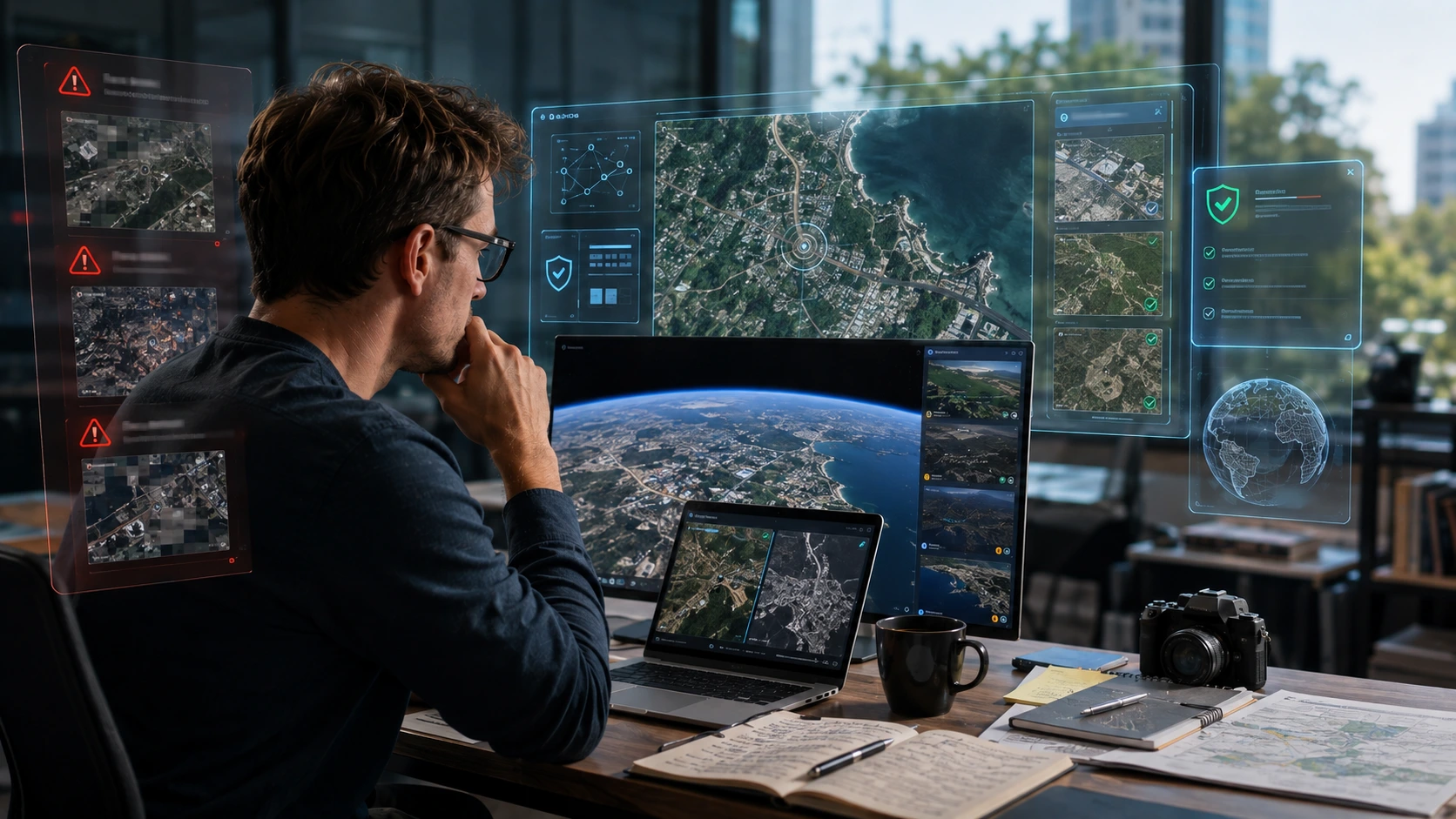
AI Video Surveillance Explained: Cameras That Understand What They See
Key Takeaways
- AI video surveillance means cameras that understand a scene — people, vehicles, objects and behaviour — rather than simply recording motion.
- The biggest everyday benefit is far fewer false alarms, because the system can tell a person apart from a shadow, rain, an animal or a swaying branch.
- Edge AI moves the analysis inside the camera itself, which speeds up alerts and can reduce how much raw video has to leave the premises.
- The main uses today are retail, warehouses and logistics, transport hubs, workplaces and public safety — plus counting people and searching footage in seconds.
- The main concerns are facial recognition, bias in training data, and what happens to footage once it is stored or shared.
- Under data-protection rules such as GDPR, identifiable video counts as personal data, and biometric monitoring tools fall into the EU AI Act’s high-risk category.
- Privacy-by-design approaches — on-device masking, anonymisation and strict access controls — aim to collect identity only when it is genuinely needed.
What AI video surveillance actually means
For decades, a security camera did one job: record. If something happened, a human had to watch the footage back and hope the right moment had been captured. AI video surveillance changes the job description. The camera, or the software behind it, analyses the picture as it arrives, recognises what is in it, and decides whether anything is worth flagging. A person crossing a boundary at night, a vehicle stopping in a no-parking zone, a bag left unattended, a crowd building up in one corner of a station — these are events the system can now spot on its own.
That shift is part of why interest in the topic is rising. Google Trends lists “artificial intelligence for video surveillance” as a breakout rising query in the United States over the past seven days, a sign that more people are searching for an explanation of what these systems actually do rather than just shopping for cameras. The short answer is that modern surveillance is less about watching and more about understanding.
It is also a growing market. Vidiana, citing analysts, puts the AI video surveillance market at around $3.9 billion in 2024 and about $12.5 billion by 2030. That figure is an analyst projection reported by Vidiana, not a measured result, and projections of this kind are routinely revised. Still, the direction of travel is clear: the intelligence that used to live in a back room full of servers is moving into the camera itself, and buyers are paying for understanding, not just recording.
From pixel motion to scene understanding
The old way of detecting something was crude. A traditional camera compared one frame with the next and raised an alert whenever enough pixels changed. Rain, headlights, a tree in the wind, a cat crossing a lawn — all of them changed pixels, so all of them triggered alerts. Operators learned to ignore the system, which defeated the purpose of having it.
Deep learning changed that bargain. Trained on large numbers of examples, a model learns the shape and movement patterns of a person, a vehicle or an animal, and can therefore say not just that something moved but what it was. As the FastEgy guide to AI in video surveillance puts it, the move from raw motion to genuine understanding is the foundation everything else is built on, because once a camera knows what it is looking at, accurate alerts, intelligent footage search and behaviour analysis all become possible.
That understanding shows up in practical features. A shop can ask to be alerted only when a person enters a restricted zone after closing, and to ignore animals and foliage entirely. A warehouse can flag a vehicle loitering by a gate. An operator investigating an incident can search for every clip containing a person, or every vehicle that passed in an hour, instead of scrubbing through hours of footage by hand. None of this is magic, and no system is perfect — placement, lighting and camera quality still matter — but for the core job of telling people and vehicles apart from everything else, modern AI detection is dependable enough that businesses now build their daily routines around it.
Edge AI: the intelligence moves inside the camera
Early AI surveillance sent video to a central server or to the cloud for analysis. The clear direction now is edge AI, where the processing happens inside the camera. The camera carries its own processor — in some professional ranges, a dedicated system-on-chip running deep-learning models directly on the device — and analyses the scene on the spot.
There are three practical reasons for that shift. The first is speed: there is no round trip to a server before an alert can fire. The second is resilience: each camera keeps working even if the network or internet connection drops. The third is privacy, and it matters more than the other two. An edge camera can analyse a scene and send only a result — a person was detected in a danger zone, or twelve people are in a room — rather than streaming raw video elsewhere for processing. Less video leaving the premises means less footage to store, secure and account for.
This does not mean video never leaves the camera. When an incident needs identifiable evidence — a theft, a break-in, an accident — organisations may still need to keep recognisable footage. The privacy-by-design answer, described in detail by Axis Communications’ approach to on-device masking, is to separate the two jobs: routine monitoring uses masked video in which people, faces or number plates are obscured before the stream leaves the device, while an encrypted, unmasked stream goes to safeguarded storage that only authorised roles can open. Edge processing is a privacy advantage, not a privacy guarantee on its own — passwords, encryption, patching and access control still decide whether the design holds.
Why false alarms fall — and why that matters
If AI surveillance delivered only one benefit, it would be this: it stops crying wolf. An alerting camera that pings its owner dozens of times a night about shadows and rain trains its owner to ignore it, and an ignored alert protects nothing. By recognising that the moving thing is a cat, a shadow or weather rather than a person, an AI camera simply does not send those pointless notifications. The alerts that do arrive are worth looking at.
For businesses with professional monitoring, the same reduction means operators spend their attention on real events rather than drowning in noise, which makes monitoring both cheaper and more effective. It also changes staffing: instead of people watching banks of screens around the clock — a task humans are bad at sustaining — people verify alerts, make judgement calls and respond physically, while the system does the tireless watching. The strongest setups combine the two, with AI providing constant, accurate attention and humans providing judgement. AI does not replace security staff; it changes what their shift is spent doing.
Where AI video surveillance is actually used
Retail
Shops use AI cameras for two jobs at once: loss prevention and understanding the store. Cameras can flag suspected theft behaviour, count footfall, show which displays attract attention and when extra staff are needed, and help manage car parks through number-plate recognition. The same footage that deters theft also informs staffing and layout decisions, which is why retailers were among the earliest adopters.
Warehouses and logistics
Distribution hubs use AI cameras for safety compliance and for tracking goods rather than people. Systems spot workers entering danger zones, flag missing hard hats, warn about pedestrians near industrial vehicles, watch for obstructed emergency exits and give early notice of smoke or overheating equipment. Cameras can also trace parcels along a production line. In many of these jobs, identifying individuals is not the point at all — the system only needs to know that a person is somewhere they should not be, or that a parcel went the wrong way.
Transport and public spaces
Local authorities and transit operators use AI cameras to manage traffic flow, monitor public spaces and respond to emergencies faster, adjusting services based on passenger volume. Airports analyse how crowded checkpoints are so staff can redirect passengers in real time, and detect unsafe behaviour on tarmacs or unattended bags. Stadiums and venues rely on real-time crowd analysis to prevent dangerous build-ups before trouble starts.
Workplaces and industry
Offices use AI to optimise space, such as seeing how meeting rooms are actually used, and to grant access to authorised personnel. Factories check protective-gear compliance and monitor restricted areas. Across all of these settings, the pattern is the same: the camera stops being a passive recorder and becomes a sensor that feeds decisions, from safety alerts to staffing plans. Vidiana’s real-world guide runs through these deployments in detail, and its warning is worth repeating — bad training data produces bad results, so a system trained on flawed footage can miss people in dark clothes or react to branches as threats.
The privacy concerns are real, not theoretical
The same capabilities that make AI surveillance useful make it sensitive. Facial recognition can identify individuals in a crowd. Behaviour analysis can infer what people are doing. Cross-camera tracking can follow a person through a building or a city. Kanerika’s overview of AI surveillance is blunt about the risks: privacy infringement, algorithmic bias, potential misuse of biometric data, and the danger that a lack of transparency erodes public trust. It notes that facial recognition systems have shown higher error rates for certain demographic groups, creating fairness issues — a concern that matters most exactly where the stakes are highest, such as identifying a suspect or denying someone access.
Regulation is catching up, unevenly. In the European Union, GDPR treats video in which someone can be identified as personal data, which means operators must inform people through clear signs, keep records of video use, delete footage after a reasonable time and report breaches within 72 hours. Under the EU AI Act, tools that use facial recognition or biometric monitoring fall into the high-risk category, bringing documentation, accuracy and oversight requirements. Some cities restrict or ban certain uses entirely. The legal picture differs sharply by country, and an organisation deploying the same system in several jurisdictions needs to plan for that rather than assume one rulebook applies everywhere.
There is also the question of function creep: a system installed for safety can quietly grow into employee monitoring or customer profiling. Cameras can be reconfigured, administrators can abuse access, and footage pulled out of its original context can become intrusive once it circulates. That is why privacy has to span the whole lifecycle — what the camera captures, what it analyses, what it transmits, what it stores, who can retrieve it, and what stays visible once footage is shared.
Privacy by design: masking, anonymisation and human review
The most practical answer to these concerns is to design privacy in from the start rather than bolting it on afterwards. The guiding rule, as Axis’s AI and analytics director Mats Thulin put it to EE Times, is to avoid gathering or storing more material than a given use case demands. If the job is counting occupants, the camera should transmit only a tally. If the job is tracing parcels, employees in the frame should be concealed. Tools such as Axis Live Privacy Shield examine the stream inside the camera, spot people, faces or number plates, and swap out those pixels before ordinary video leaves the device. Fixed zones, such as windows facing private property, can be masked as well.
For footage that already exists, redaction tools use AI to find and follow faces, heads, bodies, number plates and scene text through recorded video, so an authorised user can anonymise everyone except the people who need to stay visible, and produce a separate file for distribution. Pimloc’s chief executive Simon Randall told EE Times that anonymisation must be irreversible — the company builds an entirely new version of the file with personal information stripped away, so recovering the prior content is, in his words, theoretically impossible. The original may stay in safeguarded storage for evidentiary needs while only the redacted copy circulates.
Automation does not remove the need for human verification. Real security footage can be grainy, crowded, dimly lit or shot by a moving camera, so users still have to check that every identifier has been found and the right people stay visible. And none of this works without the unglamorous basics: encryption, access control, retention limits, auditing, regular patching and human review of critical decisions. A privacy feature on a camera with a default password and open remote access is theatre, not protection. Readers thinking about the wider question of connecting AI tools safely should also read our AI agent security checklist, which covers the same principle — check what a tool can access before you trust it — in a different setting.
What to ask before deploying AI surveillance
Anyone considering a system — for a shop, a warehouse or a home — should start with the goal, not the gadget. Are you trying to stop trespassers, count customers, analyse behaviour or investigate incidents afterwards? Different goals need different tools, and buying facial recognition to count footfall is over-collection by definition. Then test and tune: lighting, angles and alert thresholds all change performance, and every environment behaves differently. Review alerts regularly, update models, and train the team that will respond to them, because an alert nobody knows how to act on is just noise in a smarter wrapper.
It is also worth asking the vendor direct questions: does analysis run on the device or in the cloud? What leaves the premises, and in what form? How long is footage kept, who can access the unmasked original, and how is that access logged? Can masking be applied before video leaves the camera? If the vendor cannot answer those questions clearly, that is itself an answer.
The comparison with other camera-based AI is instructive. Our report on AI cameras that caught thousands of UK drivers shows the same pattern in road enforcement: the camera’s value comes from understanding what it sees, and the controversy comes from what happens to that understanding afterwards. Surveillance, enforcement and retail analytics all raise the same underlying question, which is not whether the technology works — it increasingly does — but whether its use is proportionate, transparent and properly governed.
The bottom line
AI video surveillance is no longer a futuristic category. It is the ordinary, working definition of what a modern camera does: understand a scene, filter out the noise, alert on what matters, and increasingly do all of that inside the camera itself. The benefits are concrete — fewer false alarms, faster incident search, safer warehouses and better-run shops — and so are the risks, from biased identification to footage that outlives its purpose.
The organisations that get this right will be the ones that treat privacy as part of the system design, not as a policy document written after installation: collect as little identifiable data as the job requires, mask or anonymise the rest, secure what must be kept, and keep a human in charge of the decisions that matter. Technology sets what is possible. People and policy still have to decide what is appropriate.