Anthropic Explained: Claude, AI Safety, Research and What the Company Does
Anthropic is an artificial intelligence company best known for creating Claude, a family of AI assistants and models used for writing, coding, research, analysis, and business workflows. The company describes itself as an AI safety and research organization focused on building systems that are reliable, interpretable, and steerable.
For most people, the practical reason Anthropic matters is simple: it is one of the companies shaping the frontier of generative AI. But understanding Anthropic requires looking at more than Claude. Its work also covers model safety, interpretability, economic research, cybersecurity, enterprise AI, governance, and long-term questions about how powerful AI systems should be developed.
This guide explains what Anthropic is, what it builds, how it approaches AI safety, how its business works, and what readers should watch as the company grows.
What is Anthropic?
Anthropic is an AI research and product company that develops advanced language models and the Claude assistant. On its official company page, Anthropic says its goal is to build AI systems that people can rely on and to research both the opportunities and risks created by increasingly capable AI.
The company is structured as a Public Benefit Corporation. Anthropic says this structure is intended to support the responsible development and maintenance of advanced AI for the long-term benefit of humanity. Its governance also includes a Long-Term Benefit Trust alongside its board and stockholders.
That structure does not mean every decision is automatically safe or correct. It does show that Anthropic has formally placed public-benefit goals and AI safety considerations inside its corporate governance model rather than treating them only as marketing language.
What does Anthropic actually make?
Anthropic’s main product is Claude. Claude is available as a consumer assistant and as a platform that developers and companies can use in their own products and workflows.
Claude can be used for tasks such as:
- Writing and editing
- Summarizing long documents
- Software development and debugging
- Research and information synthesis
- Business analysis
- Agentic and multi-step workflows
- Enterprise knowledge work
Anthropic also offers specialized tools around Claude. Claude Code is designed for software development workflows, while enterprise and API products allow organizations to connect Claude to internal systems and applications.
For a practical user-focused overview of Claude itself, see our Claude AI chats guide.
Anthropic and Claude in 2026
Anthropic’s model lineup changes quickly, so readers should always check the company’s current product pages before making purchasing or development decisions. As of September 2026, Anthropic’s newsroom highlights newer Claude model generations aimed at coding, professional work, scientific research, and long-running agentic tasks.
The exact model name matters less than the broader pattern: Anthropic is pushing Claude beyond simple chatbot use and toward systems that can work through longer, more complex tasks with tools, code, documents, and external workflows.
This shift is important because it changes what users should evaluate. A model is no longer useful only if it writes a good paragraph. Businesses increasingly care about reliability over many steps, tool use, auditability, cost, security, and whether the system behaves consistently when a task lasts minutes or hours rather than seconds.
Why is Anthropic so focused on AI safety?
Anthropic presents AI safety as a technical research problem rather than only a policy issue. Its research teams work on alignment, interpretability, frontier red teaming, economic impacts, and societal impacts.
Alignment broadly means trying to make an AI system behave in ways that match intended goals and constraints. Anthropic’s alignment researchers study how models can fail, how those failures can be measured, and what training or monitoring methods may reduce them.
Interpretability focuses on understanding what is happening inside a neural network. Anthropic says this work can help researchers explain model behavior and identify problems involving bias, misuse, deception, or dangerous autonomous behavior.
Frontier red teaming examines how powerful models could create risks in areas such as cybersecurity, biosecurity, and autonomous systems.
These research programs matter because advanced models can fail in ways that are not obvious from normal chat use. A model can appear helpful in everyday conversation while still behaving unpredictably under unusual instructions, complex tool use, adversarial testing, or high-stakes conditions.
What is Claude’s Constitution?
Anthropic uses a document known as Claude’s Constitution to describe many of the values and behavioral principles that shape Claude. Anthropic’s January 2026 version says the company wants Claude to be highly useful while also being honest, thoughtful, and careful about harmful or deceptive behavior.
This does not mean Claude always follows those goals perfectly. Large language models can still make mistakes, misunderstand instructions, hallucinate information, or produce inconsistent answers. The constitution is better understood as part of the training and behavior-design framework rather than a guarantee of perfect outcomes.
How does Anthropic make money?
Anthropic’s business model is built around access to Claude. Revenue comes from consumer subscriptions, business plans, developer API usage, enterprise deployments, and strategic cloud and distribution partnerships.
The company has also expanded through partnerships with large technology and consulting firms. In 2026, Anthropic announced enterprise collaborations involving organizations such as TCS, PwC, Amazon, Microsoft, Google, and others across infrastructure, consulting, cloud, and business deployment.
This enterprise focus is significant because the AI market is increasingly moving from experimental chatbot use toward integration into core company processes. That includes coding, support, analysis, document workflows, internal search, regulated-industry work, and agentic systems.
How large is Anthropic?
Anthropic has become one of the most highly valued private AI companies. In May 2026, the company announced a $65 billion Series H funding round at a $965 billion post-money valuation. Anthropic also said its run-rate revenue had crossed $47 billion earlier that month.
Those figures come from Anthropic’s own announcement and should be understood in context. A private-company valuation is not the same thing as cash in the bank or annual profit, and run-rate revenue is an annualized measure based on a recent period rather than a full audited year.
The funding is still important because frontier AI development requires enormous spending on compute, chips, data centers, engineering, research, and global infrastructure.
Why does Anthropic need so much computing power?
Training and serving frontier AI models requires large amounts of compute. Anthropic has announced infrastructure agreements with major technology companies and cloud providers to secure access to chips, data-center capacity, and specialized AI hardware.
In 2026, Anthropic described using a mix of AWS Trainium hardware, Google TPUs, and NVIDIA GPUs. It also announced major compute agreements involving Amazon and other infrastructure partners.
For users, this matters because compute affects model availability, response speed, usage limits, API capacity, pricing, and how quickly new capabilities can be deployed.
Is Anthropic the same as Claude?
No. Anthropic is the company; Claude is its main AI product and model family.
| Term | What it means |
|---|---|
| Anthropic | The AI company and research organization |
| Claude | Anthropic’s AI assistant and model family |
| Claude API / Platform | Developer access for building Claude into applications |
| Claude Code | Anthropic’s coding-focused agentic tool |
| Anthropic Research | Research on alignment, interpretability, economics, safety and societal impacts |
How is Anthropic different from OpenAI?
Anthropic and OpenAI compete in many of the same markets, but they are separate companies with different products, governance structures, research programs, partnerships, and model-development strategies.
Both build frontier AI systems. Both sell consumer and enterprise access. Both work with major cloud and infrastructure providers. But Anthropic has made AI safety, interpretability, and its public-benefit governance structure especially central to its identity.
That does not automatically make one company better than the other. Users should compare models based on the task they actually need to perform: coding quality, reasoning, speed, context handling, price, integrations, privacy, reliability, and business requirements.
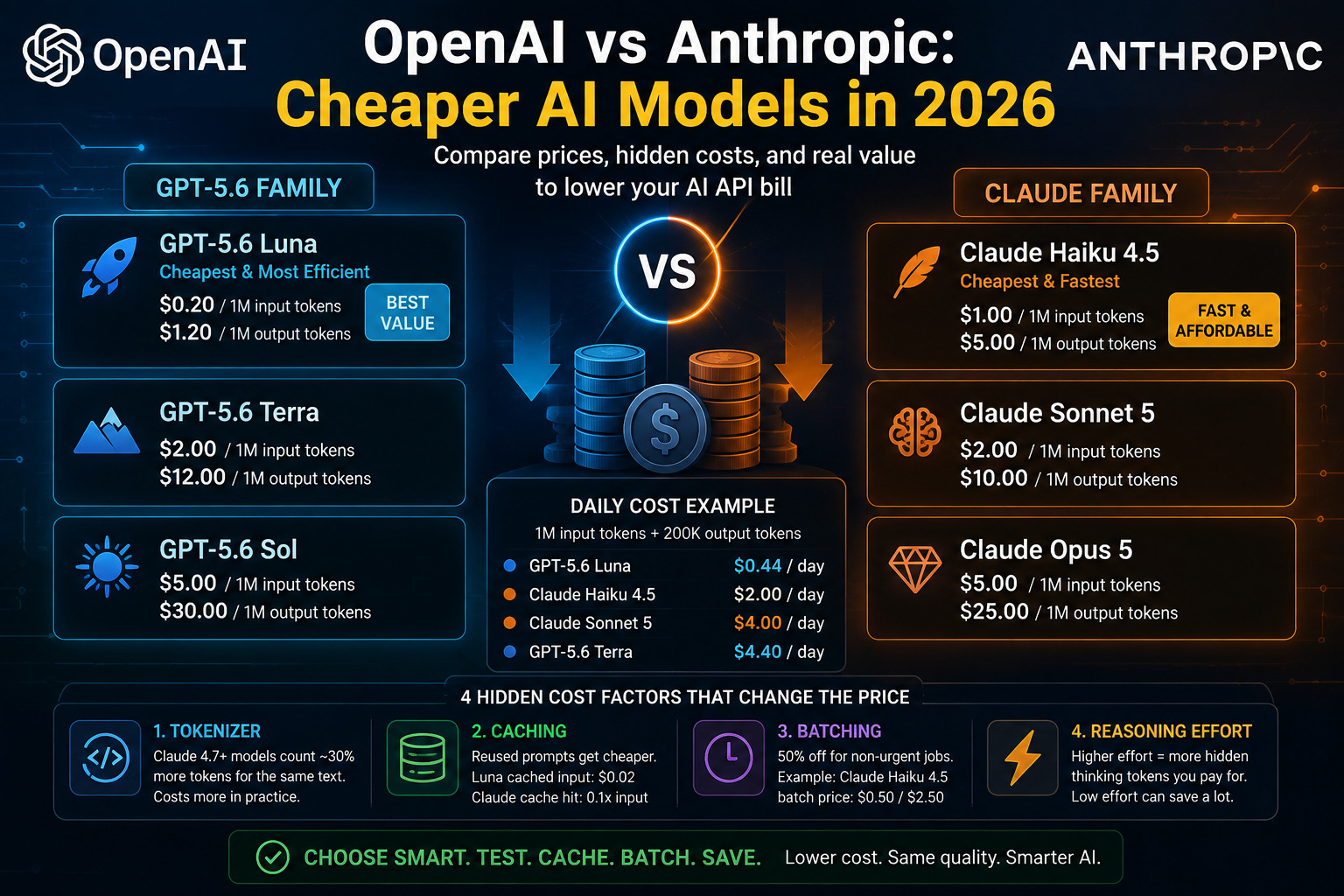
For cost-focused readers, our OpenAI and Anthropic model cost comparison provides additional context.
What are Anthropic’s biggest strengths?
- Strong research focus: Anthropic publishes substantial work on alignment, interpretability, safety, economics, and model behavior.
- Enterprise adoption: Claude is increasingly integrated into large-company workflows through direct deployments and partnerships.
- Coding and agentic workflows: Anthropic has invested heavily in Claude Code and long-running task capabilities.
- Transparency about some safety problems: The company has published details about model failures and red-team findings, including cases where evaluations exposed serious behavior.
- Multi-cloud access: Claude is available through multiple cloud and enterprise channels rather than relying on only one distribution route.
What are the limitations and concerns?
Anthropic should not be treated as risk-free simply because safety is part of its mission. The company is developing frontier AI systems while also arguing that such systems could create serious risks. Anthropic itself has described this tension in its public materials.
Important limitations include:
- Claude can still be wrong. Users should verify important factual, legal, medical, financial, or technical claims.
- Safety systems can fail. Anthropic’s own research documents cases where advanced models behaved unexpectedly during evaluations.
- Model behavior changes over time. Updates can affect performance, refusal behavior, pricing, limits, and tool use.
- Enterprise AI creates privacy and governance questions. Companies need clear policies for sensitive data, access controls, auditing, and human review.
- Public claims should be separated from independent evidence. Company announcements are useful primary sources, but major performance, safety, and economic claims benefit from outside evaluation.
The resignation of former Anthropic researcher Jacob Coxon also became part of the public debate around development speed and oversight. Our Jacob Coxon and Anthropic explainer covers that specific story.
How should a normal user evaluate Anthropic and Claude?
A useful evaluation is task-based rather than brand-based. Before paying for Claude or building around the Anthropic API, ask:
- What job do I need the model to do? Writing, coding, research, data analysis, customer support, or automation may require different strengths.
- How important is accuracy? High-stakes work needs stronger review and verification.
- Do I need long context or agentic workflows? Complex document or coding tasks may benefit from different model tiers.
- What are the current limits and prices? Check Anthropic’s official pricing and model documentation because they change frequently.
- What data will I provide? Review privacy, retention, enterprise controls, and internal security policies before uploading sensitive information.
- Can I test against alternatives? Compare outputs from more than one model on your real workflow before committing.
What should people watch next from Anthropic?
The most important Anthropic developments are likely to come from five areas:
- New Claude model generations
- Agentic systems that can work for longer periods with tools
- Enterprise and regulated-industry adoption
- Safety, interpretability, and red-team research
- Compute expansion and the economics of operating frontier models
Readers should also watch how Anthropic responds when research finds uncomfortable results. Safety claims become more meaningful when a company publishes failures, explains what changed, and allows independent scrutiny.
Frequently asked questions about Anthropic
Who owns Anthropic?
Anthropic is a privately held Public Benefit Corporation with stockholders, a board of directors, and a Long-Term Benefit Trust. Large technology and investment companies have invested in or partnered with Anthropic, but Anthropic remains a separate company.
Is Anthropic an AI company?
Yes. Anthropic develops frontier AI models, research, and products, with Claude as its main commercial AI assistant and model family.
Is Claude made by Anthropic?
Yes. Claude is trained and developed by Anthropic.
Is Anthropic focused only on safety research?
No. Safety is a major part of its identity, but Anthropic is also a commercial AI company. It builds and sells Claude products, developer APIs, enterprise services, and coding tools while conducting research.
Is Anthropic better than OpenAI?
There is no universal answer. Performance depends on the model, task, price, integrations, and user needs. Comparing the two on real workloads is more useful than choosing based only on brand reputation.
Bottom line
Anthropic is one of the major companies building frontier AI systems in 2026. Its Claude models are the most visible part of the business, but the company is also influential because of its work on alignment, interpretability, enterprise AI, governance, and the economic and security effects of advanced models.
The most useful way to understand Anthropic is to hold two ideas at once: it is a fast-growing commercial AI company competing at the frontier, and it is also a research organization that argues frontier AI could create serious risks. Watching how Anthropic balances those two roles will be just as important as watching the next Claude benchmark.
Sources consulted
- Anthropic Company page — mission, governance, company structure and board information.
- Anthropic Research — alignment, interpretability, economics, frontier red team and societal impact research areas.
- Claude’s Constitution — Anthropic’s description of Claude’s values and behavioral goals.
- Anthropic Series H announcement, May 28, 2026 — funding, valuation and run-rate revenue figures.
- Anthropic Newsroom — current product, research and partnership announcements.
Editorial transparency: This article is based on public information available as of September 2026, primarily from Anthropic’s official website and announcements. Company-reported funding, valuation, revenue, model capabilities, and safety claims should be interpreted as first-party information and may change. No hands-on product testing is claimed in this article. Expert review is not required for this general company overview, but independent technical evaluation is recommended for high-stakes safety or performance claims.