AI Detector Guide 2026: How AI Detection Works, Accuracy and Limits
An AI detector is a tool that estimates whether text may have been written or heavily edited by a generative AI system. These tools are now common in schools, publishing, hiring, and content review, but their scores are easy to misunderstand.
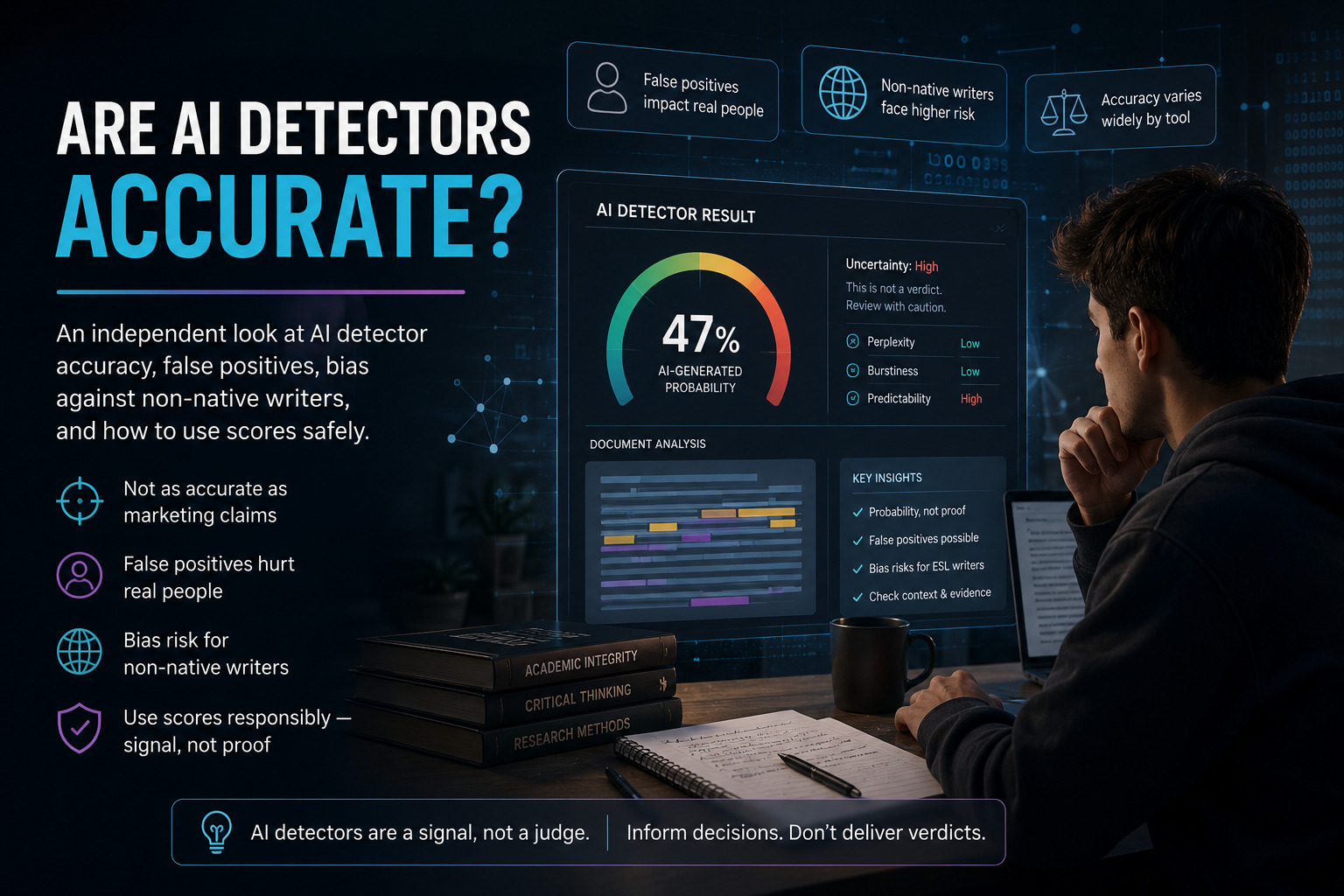
The most important thing to know is simple: an AI detector can provide a signal, but it cannot prove authorship. In 2026, even major providers warn that false positives and false negatives remain possible. That means a detector score should be treated as one piece of evidence, not a verdict.
This guide explains how AI detectors work, what current research says about their accuracy, why different tools disagree, and how students, teachers, editors, and businesses can use them more responsibly.
What is an AI detector?
An AI detector analyzes writing patterns and estimates whether a passage resembles text produced by a large language model. Depending on the tool, it may look at features such as predictability, sentence structure, repetition, vocabulary patterns, token-level statistics, and stylistic consistency.
Most detectors return either a probability, a percentage, a label such as “likely AI,” or highlighted passages that the model considers suspicious.
That sounds precise. It is not the same as knowing who actually wrote the text.
How does an AI detector work?
Different companies use different models, but the broad process usually looks like this:
- Text is processed into machine-readable units. The detector examines words, sentences, and statistical patterns.
- The detector compares those patterns with examples. Models are trained or calibrated on known human and AI-generated text.
- A score is produced. The system estimates how closely the text matches patterns associated with AI generation.
- The user interprets the result. This final step is where mistakes often happen, because a probability is frequently treated as proof.
Are AI detectors accurate in 2026?
The short answer is: sometimes, but not reliably enough to use alone for high-stakes decisions.
Turnitin states that its AI writing model may misidentify both human-written and AI-generated text. Its guidance says the result should not be used as the sole basis for adverse action against a student. Turnitin also does not surface exact scores between 1% and 19% because false positives are more likely in that range.
OpenAI previously released its own AI-written text classifier, but discontinued it in July 2023 because of low accuracy. In OpenAI’s published evaluation, that classifier correctly identified only 26% of AI-written text in its challenge set while incorrectly labeling 9% of human-written text as AI-written.
Research published in 2026 adds another warning. One study found that commercial detectors could flag lightly AI-edited academic writing at high rates while also producing false positives on unmodified human text. The same research found that “humanizer” tools could cause many AI-generated rewrites to avoid detection.
So the practical answer is not “AI detectors work” or “AI detectors are useless.” The better answer is that performance depends on the detector, text type, editing history, language, and threshold.
Why AI detector results can be wrong
1. Human writing can look statistically predictable
Formal academic writing, business writing, technical explanations, and non-native English can use consistent structures and vocabulary. A detector may interpret those patterns as machine-like even when the text is human-written.
2. AI text can be heavily edited
If a human rewrites, shortens, expands, or restructures AI-generated material, the final text may no longer match the patterns the detector expects.
3. Different detectors use different models
Two tools can analyze the same paragraph and return very different scores. That disagreement is a useful reminder that the score is model output, not forensic proof.
4. Short text is harder to judge
Many detection systems perform better when they have more qualifying prose to analyze. Short answers, bullet points, poetry, code, and unusual formats can be especially difficult.
5. New AI models change writing patterns
Detection is a moving target. As generative models change, detectors need new training, new thresholds, and new evaluation data.
What does an AI detector score actually mean?
An AI detector score does not mean “this percentage of the document was definitely written by AI.” It usually means the detector found patterns that its model associates with AI-generated text.
| Detector output | What it can mean | What it does not prove |
|---|---|---|
| Low score | Few detected AI-like patterns | That no AI was used |
| Medium score | Mixed or uncertain signals | That some exact percentage came from AI |
| High score | Strong resemblance to the detector’s AI examples | Who wrote the text or whether misconduct occurred |
This distinction matters most in schools and workplaces, where a score can affect a person’s reputation.
How to use an AI detector responsibly
A detector is most useful when it starts a review rather than ends one.
- Run the full document, not a tiny excerpt, when the tool supports it.
- Check the highlighted passages instead of focusing only on the headline percentage.
- Compare multiple sources of evidence, such as drafts, revision history, notes, citations, and the writer’s previous work.
- Ask the writer to explain their process when a result matters.
- Do not treat one detector’s score as final proof.
- Document which tool, version, date, and settings were used because detection models change.
AI detector use in education
Education is where detector misuse can cause the most obvious harm. A false positive can turn ordinary writing into an academic integrity dispute.
Turnitin’s own guidance says its AI Writing Report is intended to support educator review and should be combined with human judgment and institutional policy.
A sensible academic workflow is:
- Review the detector result.
- Check whether the highlighted sections match the student’s normal writing style.
- Review drafts, document history, notes, references, and research materials.
- Discuss the work with the student.
- Apply the institution’s policy consistently.
For a deeper look at the reliability problem, see Aiera’s guide on whether AI detectors are accurate. If your school uses Turnitin, our Turnitin AI detection guide explains that system separately.
AI detector use for publishers and businesses
Publishers, agencies, and businesses often use AI detectors to screen freelance work, marketing copy, applications, or outsourced content. That can be useful for quality control, but the same limitation applies: a detector cannot tell you whether the writing is accurate, original, useful, or ethically produced.
A better content review checks:
- factual accuracy;
- source quality;
- original analysis;
- brand voice;
- plagiarism or copied passages;
- editorial disclosure where required;
- and whether the content actually helps the reader.
AI detection should sit inside that broader review, not replace it.
AI detector vs plagiarism checker
These tools solve different problems.
| Tool | Main question |
|---|---|
| AI detector | Does this text resemble AI-generated writing? |
| Plagiarism checker | Does this text match existing published or submitted material? |
A passage can be original but AI-generated, human-written but plagiarized, both, or neither. Mixing these two concepts leads to bad decisions.
Can an AI detector be beaten?
Yes, detector evasion is possible, and that is one reason these systems should not be treated as definitive forensic tools. Editing, paraphrasing, translation, restructuring, or “humanizer” services can change the signals a detector uses.
Research published in 2026 showed that humanization could sharply reduce detection rates on AI-generated rewrites in the tested setup. That does not make evasion ethical, but it does show why a detector score is not a reliable substitute for evidence about writing process.
What should you do if human writing is flagged as AI?
If your own work is flagged, do not start randomly rewriting every sentence just to chase a lower score. That can make the writing worse and still may not solve the issue.
Instead:
- Keep drafts and revision history.
- Keep research notes and source material.
- Save timestamps where possible.
- Ask which detector and threshold were used.
- Request a human review.
- Explain your writing process clearly.
Those records are usually more meaningful than arguing over one percentage.
Popular AI detector categories
AI detection tools generally fall into a few groups:
- Education-focused systems such as Turnitin.
- Standalone web detectors aimed at teachers, publishers, and consumers.
- Writing-platform detectors bundled with plagiarism, grammar, or originality tools.
- Enterprise detection systems integrated into editorial or compliance workflows.
For a specific example, read our Scribbr AI Detector review.
How to evaluate an AI detector before trusting it
Before relying on any detector, check five things:
- Does the company publish accuracy information?
- Does it discuss false positives?
- Does it explain supported languages and text types?
- Does it warn against using scores as sole evidence?
- Does it update the model as generative AI changes?
If a detector claims near-perfect certainty without explaining limitations, skepticism is warranted. Machines, in a breathtaking development, also enjoy overconfidence when humans reward it.
Frequently asked questions
What is the best AI detector?
There is no single detector that is proven best for every use case. Accuracy varies by text type, language, model, and threshold. Compare independent research, provider documentation, and your specific workflow rather than relying on one marketing claim.
Can AI detectors prove someone used ChatGPT?
No. A detector can estimate that text resembles AI-generated writing, but it cannot prove which tool was used or who wrote the text.
Are AI detectors accurate for students?
They can sometimes identify AI-generated prose, but false positives and false negatives remain possible. They should not be used alone to decide misconduct.
Can human writing be detected as AI?
Yes. Human writing can be falsely flagged, especially when it is highly structured, formal, edited, or stylistically similar to model-generated text.
Is a 0% AI score proof that no AI was used?
No. A low score only means the detector did not identify enough patterns to classify the text as likely AI under its model and threshold.
Bottom line
An AI detector can be useful as a screening and review tool, but it should never be confused with proof of authorship. The best use of AI detection in 2026 is cautious, transparent, and combined with human review, writing history, source checks, and context.
For schools, publishers, and businesses, the safest rule is simple: use detector scores to ask better questions, not to skip the investigation.
Sources consulted
- Turnitin Guides, AI Writing Report and AI detection model documentation, accessed September 2026.
- OpenAI, “New AI classifier for indicating AI-written text,” including discontinuation notice and evaluation results.
- Karr et al., “Why AI Detection Fails for Academic Integrity,” arXiv, August 2026.
- Park, Jeong and Kim, “Style as a Confound: False Positives in AI Detection of Non-Native Academic Writing,” arXiv, August 2026.
- Dik, Erdem and Dik, GPTZero accuracy study, 2025, indexed by Stanford SCALE.
Editorial transparency: This article summarizes provider documentation and published research. Detector performance changes over time, and no individual detector score should be treated as definitive proof of AI authorship.