
Google Genie 4 World Model: Worlds That Talk Back Live
Key Takeaways
- The Google Genie 4 world model generates interactive, photorealistic worlds in real time, now with audio generated natively alongside the picture.
- Users can steer a running scene with natural-language prompts — changing the weather, moving the camera, or adding a person or object mid-simulation.
- Scenes hold together for up to two minutes, double the roughly one-minute limit of Genie 3.
- A Gemini agent sits inside the loop: Gemini Omni anchors how objects look and behave, while Gemini 3.8 Flash plans steps and checks frames.
- Genie 4 is a research preview for trusted testers, rolling out to Google AI Ultra subscribers through Project Genie and to Gemini API early-access partners, with a waitlist open.
Type a sentence, and a world appears. Type another, and the weather changes while you are standing in it. That is the pitch behind Genie 4, the new world model from Google DeepMind announced on October 27, 2026 — and the reason it matters is not the novelty of a generated scene, but what the scene can now do: it has sound, it holds together longer, and it listens while it runs.
A world model is different from a video generator. A video model produces a clip, and you watch it. A world model produces a place, and you move through it. Press a key, the camera moves. Change the prompt, the world changes. Genie 4 is DeepMind’s fourth generation of that idea, and the company calls it its most realistic and interactive world model yet.
It is also, by DeepMind’s own account, an early research preview — not a finished product. That honesty matters, because the gap between a demo scene and a reliable simulator is where world models still struggle. Here is what Genie 4 actually does, what is new, and what is still missing.
What is new: sound, steering, and staying power
Three upgrades define Genie 4, and each addresses a different weakness of earlier world models.
The first is audio, and it is the headline. Genie 4 is DeepMind’s first real-time world model to generate audio natively. Ambient sound, music, and interactive dialogue are produced together with the scene, not dubbed on afterwards. A beach scene arrives with crashing waves. Characters in the scene can converse and react in real time, responding to prompts and to events in the world as they happen. That turns a world from something you watch into something you can talk to.
The second is steering. While a simulation runs, users can type natural-language prompts to change it: shift the weather, swing the camera, drop a new person or object into the scene. Gemini adapts each prompt to fit what is already on screen, so the edit lands inside the existing world rather than restarting it. Genie 3 allowed midstream changes in a limited form; Genie 4 extends them into freeform live edits.
The third is staying power, and it is the only upgrade with a clean number. Coherent scenes now last up to about two minutes, double Genie 3’s limit of roughly one minute. Two minutes is still short, but it is long enough for a scene to develop: a character can cross a room, weather can turn, a conversation can go somewhere. The jump matters because drift has always been the failure mode of world models — the longer a simulation runs, the more details slip.
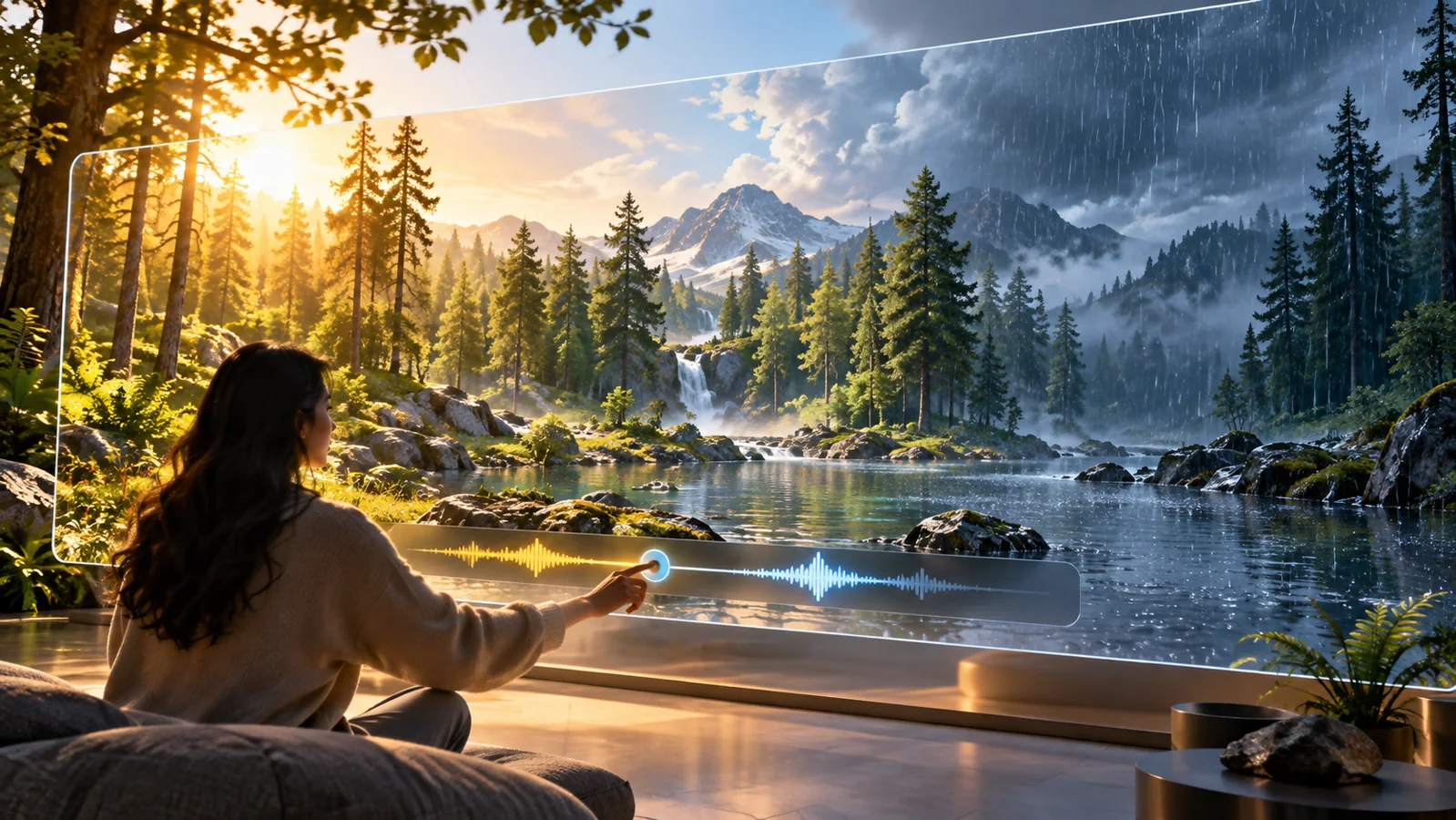
The Gemini inside the loop
Under the hood, Genie 4 is not one model working alone. Gemini Omni anchors the real-world appearance and behaviour of objects in the scene, while other Gemini models supply reasoning to preserve coherence as scenes evolve. Gemini 3.8 Flash acts as the in-loop guiding agent, planning each step and checking frames while Genie 4 renders the world.
That architecture explains both the strengths and the limits. The guiding agent is why a live edit can land coherently: something is watching the scene and reconciling the new instruction with what is already there. But it is also why longer runs still drift. DeepMind is candid that visual details and object permanence can shift over time, especially in longer sessions, after multiple complex prompt edits, or while navigating. The agent helps; it does not solve the problem.
DeepMind also cites better physics, including aerodynamics and collisions, and calls simulated people the most dramatic leap — characters that move naturally and can be steered in real time. For training robots and agents, that combination of realistic people and physics is arguably more important than photorealism alone.
Who can try it, and what it is for
Genie 4 is available as a research preview to a limited group of trusted testers. DeepMind plans to expand access to Google AI Ultra subscribers through Project Genie and to early-access partners via the Gemini API and Google AI Studio, with a public waitlist open for others. There is no general release date yet, and no price — it is a preview, not a product launch.
The intended uses go beyond entertainment. DeepMind’s bet is that world models become simulators: places to test agents and robots before running them in the real world. An agent that must navigate a warehouse, or a robot that must handle unfamiliar objects, can practise in generated worlds where failure costs nothing. That is the same logic behind physical AI development more broadly, where simulation is becoming as important as the hardware itself — a theme also visible in SAP’s physical AI launch and the wider Gemini family.
There is also a safety note worth recording. SynthID, Google’s imperceptible watermark, will tag every video and audio clip that Genie 4 produces. As generated worlds gain sound and interactivity, the ability to identify their output becomes part of the product, not an afterthought.
What is still missing
The honest limits are as important as the upgrades. Two minutes of coherence is double the previous limit, but it is still a sketch, not a session. Object permanence — the same chair staying the same chair after you look away and back — remains unreliable over longer runs. Complex prompt edits and navigation stress the system most, which is exactly where a real user would push it.
Access is the other limit. A research preview for trusted testers, with a waitlist for everyone else, means most readers cannot try Genie 4 today. The announcements that matter next are the rollout to AI Ultra subscribers and API partners, and whether the coherence window keeps doubling with each generation or stalls at a few minutes.
For now, Genie 4 is best understood as a direction marker. Worlds that talk back, listen mid-scene, and hold together for minutes rather than seconds point toward a future where simulation is a first-class AI capability — for games, for training, and for testing the agents that will act in the real world. The model is not there yet. But the gap between a clip you watch and a place you inhabit just got noticeably smaller.
World models and the simulation economy
The deeper significance of Genie 4 lies in what world models are for. A video generator produces content for people to watch. A world model produces environments for agents to act in — and that makes it infrastructure for robotics and agent training. A robot that must learn to navigate a warehouse, handle unfamiliar objects, or recover from surprises can practise thousands of times in generated worlds where failure costs nothing, before it ever touches a real floor.
That is why DeepMind’s emphasis on physics and people matters more than photorealism. A pretty world that behaves wrongly teaches wrong lessons. A world with believable collisions, aerodynamics, and human movement teaches skills that transfer. Genie 4’s improvements in exactly those areas — plus the ability to steer a scene mid-run — make it a more useful training ground, even at two minutes per scene. Short, varied simulations run in bulk can still teach a great deal, provided the physics is honest.
There is a second use: data generation. Real-world training data for robots is expensive and slow to collect. Generated worlds can supply synthetic experience at scale, including rare or dangerous situations — a pedestrian stepping into the road, a shelf collapsing, a sensor failing — that are hard to capture safely in reality. The catch is the same drift problem: if the world behaves differently from reality in subtle ways, agents learn habits that fail on deployment. Simulation is a complement to real-world testing, not a replacement for it.
The access question
What happens next depends largely on who gets in. Trusted testers have Genie 4 now; Google AI Ultra subscribers and Gemini API early-access partners follow, with a waitlist for everyone else. The first reports from those groups will reveal more than the announcement did: how often scenes actually hold together for the full two minutes, how reliably live edits land, and whether the drift DeepMind acknowledges is a minor annoyance or a real limit.
Pricing is also unknown, and it will shape who uses world models for what. A research preview has no price; a product does. If access is bundled into AI Ultra, world-building becomes a premium feature. If it arrives through the Gemini API with per-use pricing, developers can build simulators into their own training pipelines. Either way, the transition from preview to product — and whether coherence keeps doubling each generation — is the story to follow.