Jev Vercel AI Gateway: How TypeSafe AI’s Decision Model Works
Jev Vercel AI Gateway Most AI models are designed to generate something: an answer, a paragraph, code, an image, or another piece of content. But many software workflows do not actually need another paragraph. They need a clear decision.
Should an agent call a tool? Is a request urgent? Should a workflow continue, retry, ask the user for clarification, or stop?
That is the problem TypeSafe AI is trying to address with Jev, a model designed around structured decisions rather than conventional text generation.
On September 16, 2026, Vercel announced that Jev from TypeSafe AI is available through Vercel AI Gateway, making the model accessible within the same gateway developers can use for other AI models.
For developers exploring the Jev Vercel AI Gateway integration, the important point is not simply that another model has appeared in a model catalog. Jev uses a different approach to AI inference, with typed decisions and associated probabilities intended for software automation.
This guide explains what Jev is, how it differs from a typical large language model, where the Vercel integration may be useful, and what developers should verify before using it in production.
What Is Jev From TypeSafe AI?
Jev is the first model TypeSafe AI describes as part of a new category called System One Models.
TypeSafe AI announced Jev on September 14, 2026. According to company founder Diogo Almeida, the company built the system around fast, structured decision-making that software can consume directly rather than around open-ended conversation.
The distinction matters.
A normal language model usually receives input and generates tokens one after another. If an application only needs a decision such as:
- approve or reject
- continue or stop
- select option A, B, or C
- estimate the likelihood of a condition
- choose which tool should run next
the application may still ask a language model to generate text or structured output, then parse and validate the result.
Jev is designed to return structured answers directly.
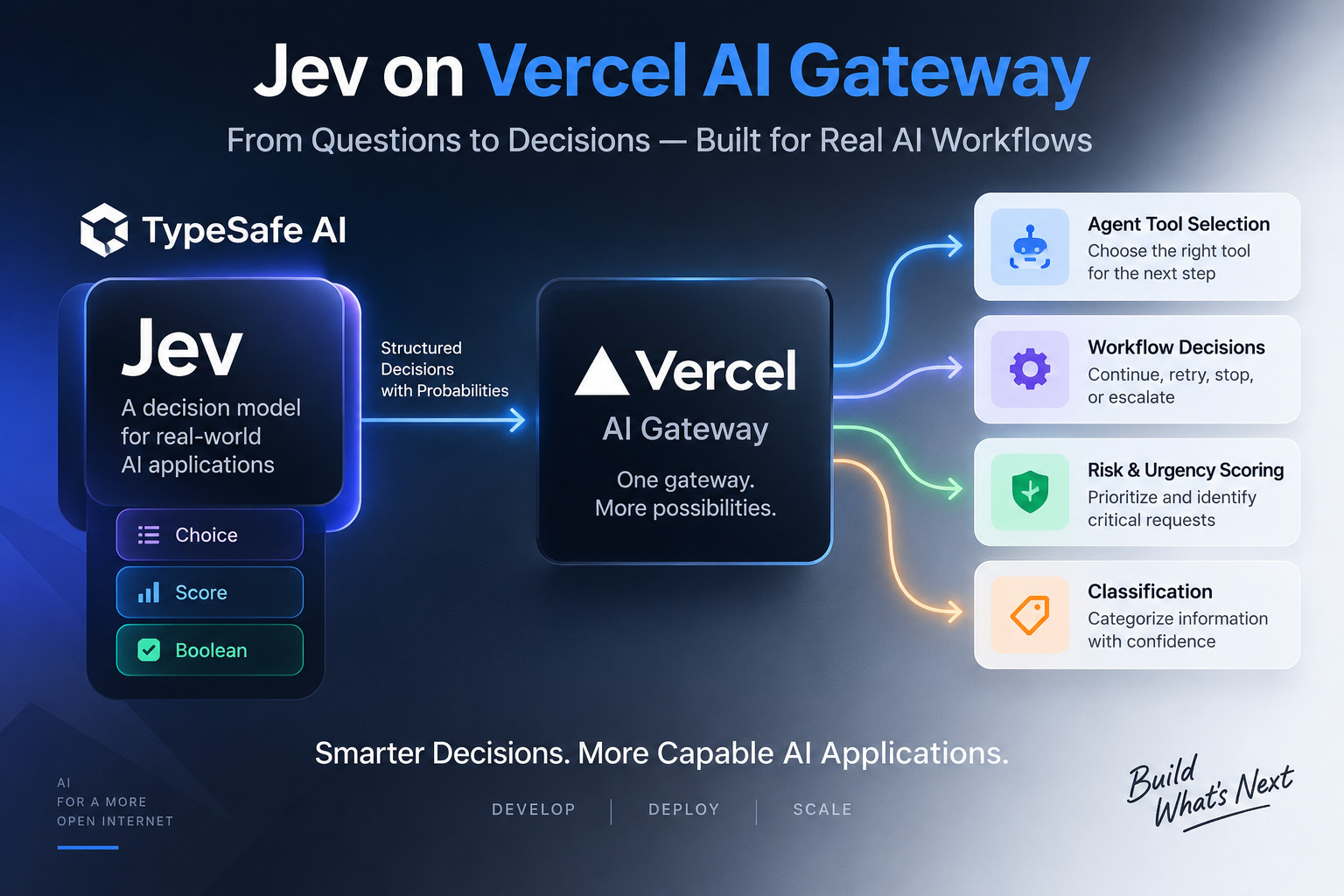
Vercel describes its output types as Choice, Score, and Boolean, along with probabilities.
That makes Jev less like a chatbot answering a user and more like a decision component inside an application.
How the Jev Vercel AI Gateway Integration Works
Vercel AI Gateway provides developers with a unified way to access supported AI models and providers.
Instead of maintaining completely separate integrations for every model provider, developers can use the Gateway as a common access layer. Vercel says its platform supports switching between models and providers and provides routing and fallback capabilities for supported models.
The addition of Jev means developers working within that ecosystem can now access TypeSafe AI’s decision model through Vercel’s infrastructure.
That could be particularly useful for applications that already use traditional language models for generation but need a different model for specific decision points.
For example, an AI agent might use a general-purpose LLM to understand a user request or draft a response while using Jev to decide what action should happen next.
This creates an important architectural distinction:
Generation model: “Create the response.”
Decision model: “Determine what the software should do next.”
They solve related but different problems.
Why Typed Outputs Matter for AI Applications
A major challenge in AI application development is turning model-generated language into reliable software actions.
Consider an agent deciding whether to issue a refund.
A language model could respond:
“Based on the information provided, it appears appropriate to process the refund.”
A developer then needs to determine whether that sentence means true, extract the intended action, and handle unexpected wording.
Structured output can reduce that ambiguity.
If a system expects a Boolean answer, the useful result is closer to:
refund = true
along with information about how confident the model is in that decision.
The same idea applies to choosing between several actions.
Instead of generating an explanation first and extracting the selected option later, a decision-focused model can be designed around the available choices.
This does not automatically make every decision correct. It simply changes the interface between the model and the software.
Developers still need appropriate validation and safeguards.
Jev Evaluates Questions Differently From Standard LLM Generation
Vercel says Jev evaluates declared questions in parallel and returns typed answers and probabilities directly. Traditional language models generally produce output sequentially, token by token.
This difference could matter in workflows where an application needs to evaluate several conditions before continuing.
Imagine an automated support workflow checking:
- Is this request urgent?
- Does it involve account security?
- Should it be escalated?
- Which support queue should receive it?
- Does a human need to review it?
A traditional implementation might prompt an LLM to return JSON containing those decisions.
A decision-focused model can instead treat those questions as the core inference task.
The practical value depends on the application’s requirements, however. Text-generating models remain necessary when the task itself requires explanation, conversation, writing, summarization, reasoning expressed in natural language, or content generation.
Jev should therefore not be viewed simply as a replacement for general-purpose LLMs.
Practical Use Cases for Jev
Vercel identifies several potential use cases for the model.
1. Selecting the Next Tool in an AI Agent
AI agents frequently have access to multiple tools.
An agent might be able to:
- search a database
- browse the web
- query an API
- send an email
- request clarification
- hand the task to another specialized agent
Before anything happens, the system has to decide which action makes sense.
Jev can potentially serve as the model responsible for that routing decision.
2. Deciding Whether an Agent Should Continue
Agent loops create another decision problem.
After completing one step, an agent might need to determine whether it should:
- continue
- retry
- stop
- ask the user a question
- escalate to a human
Vercel specifically lists these kinds of choices among Jev’s example applications.
Separating this decision from the model generating the actual content could give developers another way to structure agent workflows.
3. Risk or Urgency Scoring
Some applications need a score before an action occurs.
Examples might include prioritizing incoming support requests or identifying transactions that require additional review.
A decision model can help classify or score an input before the software determines the next step.
For sensitive applications, however, model output should not automatically be treated as authoritative. Appropriate human review, testing, policies, and safeguards remain important.
4. Classification
Many AI tasks are fundamentally classification problems.
A system might need to decide whether a message belongs to:
- billing
- technical support
- sales
- account security
- general questions
Using a full conversational response for that task can be unnecessary when the application only needs a category.
Jev’s structured approach is especially relevant to these narrower decision problems.
What About Jev’s Speed and Cost Claims?
TypeSafe AI has reported substantial performance differences between Jev and LLM-based approaches in its own workflow evaluations.
Vercel’s announcement reports TypeSafe’s figures of up to 193.6 times faster and 444.6 times cheaper than LLMs in those evaluations.
These numbers need context.
They are reported benchmark results from TypeSafe rather than a guarantee that every application will experience the same improvement.
Actual cost and latency can depend on factors such as:
- the workload
- input size
- deployment configuration
- API overhead
- model selection
- application architecture
- the comparison model
- traffic patterns
Teams evaluating Jev should therefore benchmark it against their own existing workflow instead of assuming the maximum reported improvement will apply to production.
That distinction is important when evaluating any newly released AI model.
How Vercel AI Gateway Changes the Developer Experience
The significance of the Vercel integration is partly about accessibility.
Vercel AI Gateway is designed as a common interface for numerous AI models and providers. Its documentation says developers can change models without rewriting major portions of their application and can configure routing and fallbacks where supported.
The Gateway also supports APIs and SDKs intended to reduce provider-specific integration work.
For teams already using Vercel’s AI infrastructure, adding Jev may therefore require less architectural separation than maintaining an entirely independent model-access layer.
However, developers should read the current Jev-specific Vercel documentation before implementation because supported parameters, pricing, model behavior, and APIs can change after launch.
Jev vs Traditional Large Language Models
Jev and general-purpose LLMs should not be treated as identical tools competing for every AI task.
Their strengths are aimed at different types of work.
| Requirement | Jev-style decision model | Traditional LLM |
|---|---|---|
| Select from predefined choices | Strong fit | Possible |
| Return Boolean decisions | Strong fit | Possible |
| Produce probability-based decisions | Core use case | Depends on implementation |
| Generate long-form text | Not its primary purpose | Strong fit |
| Open-ended conversation | Not its primary purpose | Strong fit |
| Write articles or emails | Not the intended task | Strong fit |
| Route agent actions | Potentially useful | Commonly used |
| Summarize documents | Not the main use case | Strong fit |
This comparison highlights why decision models and language models may coexist in the same application rather than replace one another.
Important Limitations to Consider
Jev was publicly announced only in September 2026, so independent evidence about its performance across diverse real-world workloads is still limited.
That makes careful evaluation especially important.
Benchmark results may not match your workload
TypeSafe’s reported speed and cost figures come from its own evaluations. Production results should be measured independently.
Structured output does not guarantee a correct decision
A clean Boolean or Choice result can be easier for software to process, but formatting and correctness are separate issues.
A confidently structured answer can still be wrong.
Human review may still be necessary
High-impact decisions involving finance, health, safety, legal matters, employment, security, or other sensitive areas should not be automated merely because a model produces a probability.
General-purpose LLMs still solve different problems
If your application needs to explain an answer, generate content, hold a conversation, or work with open-ended instructions, a traditional language model may still be the appropriate tool.
A Practical Checklist Before Using Jev
Before moving a decision workflow to Jev, developers can ask:
- Is the task actually a decision problem?
Define the exact choice, Boolean, or score required. - What currently handles the decision?
Compare Jev against rules, classifiers, existing LLM prompts, and human review. - What happens when confidence is low?
Create a fallback path instead of forcing every case into automation. - How will accuracy be measured?
Build an evaluation dataset based on real examples from the application. - What mistakes carry the highest cost?
False positives and false negatives may have very different consequences. - Does the workflow need human approval?
Sensitive actions should have safeguards appropriate to their potential impact. - Are performance claims reproducible in your environment?
Measure latency, cost, and decision quality using your own workloads.
This process provides much more useful information than choosing a model based only on a benchmark headline.
What Jev Could Mean for AI Agents
The broader idea behind Jev may be more important than any individual benchmark.
AI applications increasingly contain multiple components rather than one model doing everything.
A future agent architecture might use:
- a language model for understanding and generation
- a retrieval system for finding information
- specialized models for images or audio
- deterministic code for business rules
- a decision model for choosing actions
Jev fits naturally into that modular view of AI development.
Instead of asking a general-purpose model to generate text simply so software can extract a decision from it, developers can use a system built specifically around making that decision.
Whether this approach becomes widely adopted will depend on reliability, economics, developer adoption, independent testing, and how well specialized decision models perform in real applications.
Conclusion
The Jev Vercel AI Gateway integration gives developers another approach to a problem that sits at the heart of AI automation: converting information into clear software decisions.
Jev is TypeSafe AI’s first System One Model and is designed to produce typed Choice, Score, and Boolean outputs with probabilities rather than focusing on open-ended text generation.
Its availability through Vercel AI Gateway may make it easier for developers already working in the Vercel ecosystem to experiment with decision-focused AI alongside traditional generative models.
The early performance numbers are notable, but they should be treated as vendor-reported benchmark results rather than universal expectations.
For developers, the sensible next step is straightforward: identify a well-defined decision workflow, test Jev against the current approach, measure both decision quality and operational performance, and keep appropriate fallback paths in place.
That will reveal far more about Jev’s usefulness than benchmark numbers alone.
Sources Consulted
- TypeSafe AI — “Introducing System One Models and Jev,” September 14, 2026.
- Vercel — “TypeSafe AI’s Jev now available on AI Gateway,” September 16, 2026.
- Vercel Documentation — Models & Providers, AI Gateway.
- Vercel Documentation — SDKs & APIs, AI Gateway.
- Vercel Documentation — Model Fallbacks, AI Gateway.
Editorial Transparency Note
This article is based primarily on official information published by TypeSafe AI and Vercel as of September 16, 2026. Jev is a newly announced model, so long-term independent benchmarks and broad production evidence are not yet established.
TypeSafe’s reported performance figures should be rechecked before publication if the companies update their documentation or benchmark methodology.
Expert review is not required for this general technology explainer, although a developer familiar with Jev could review implementation-specific details if code examples are later added.
No claim of personal testing or hands-on use of Jev has been made. If AI assistance is disclosed under Aiera.blog’s editorial policy, that disclosure should accurately describe the research and editorial process used.