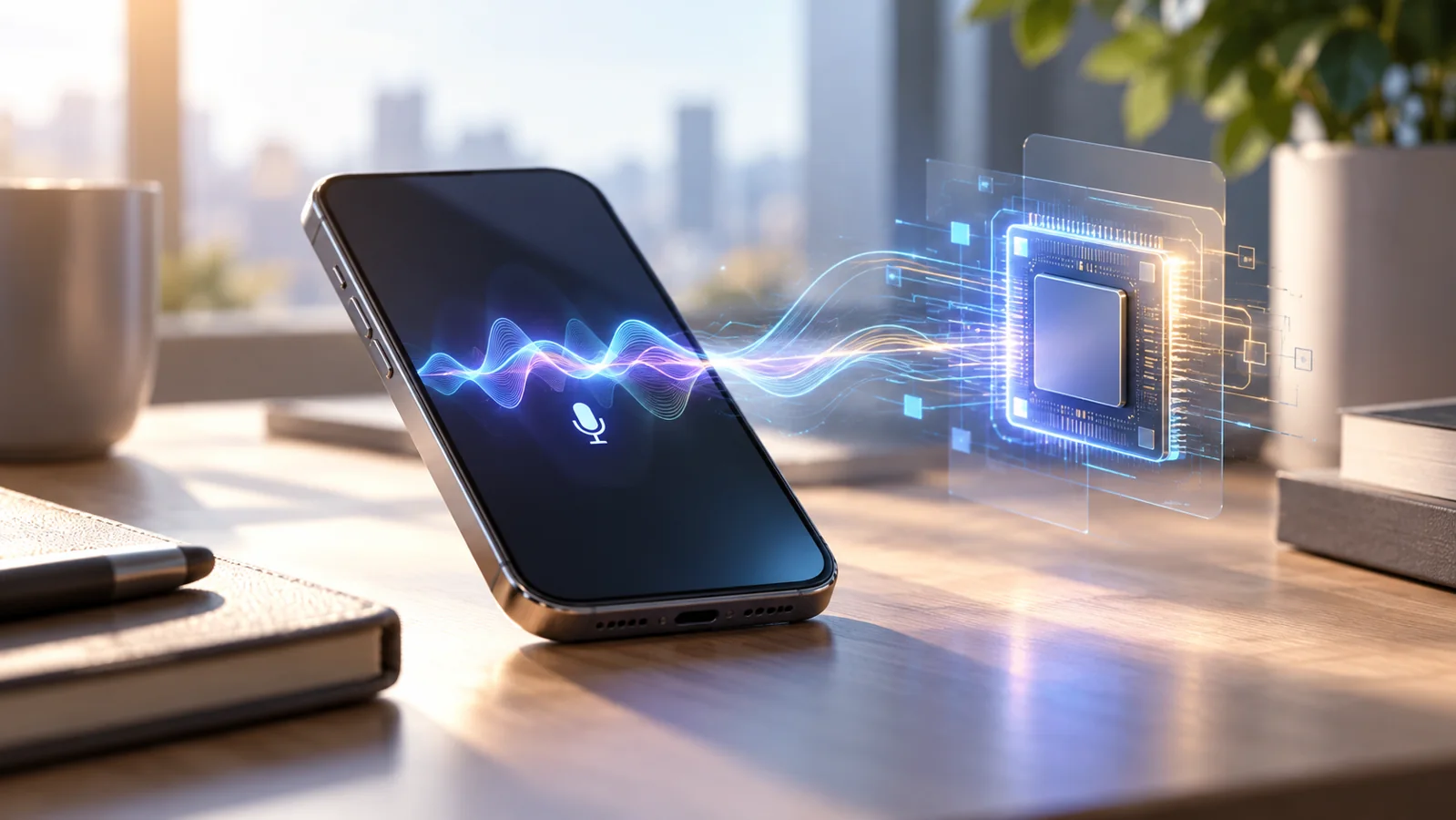
LGU+ Token Optimization: 4.5x Faster On-Device AI
Key Takeaways
- LGU+ token optimization research earned two papers accepted to the On-Device Intelligence Workshop at NeurIPS 2026.
- The work targets small language models running on smartphones, where memory and battery are limited.
- LG Uplus reports processing speed up about 4.5 times and battery consumption down about 77% compared with conventional methods.
- Performance was maintained at the level of the latest cloud AI, according to the company, with minimal degradation.
- A second strand lets AI learn directly on the phone without sending personal data to external servers.
AI competition is shifting from what models can do to how efficiently they do it. LG Uplus, South Korea’s LGU+ telecom operator, offered a sharp example on October 29, 2026, announcing that two of its papers on AI token optimization were accepted to the On-Device Intelligence Workshop at NeurIPS 2026, one of the world’s three major AI conferences alongside ICML and ICLR. This year’s event runs December 6 to 12 in Sydney, Australia.
Tokens are the units of data AI uses to interpret a question and generate an answer. The faster and more efficiently tokens are processed, the quicker the response and the lower the power and resource use. LGU+ applied that insight to the hardest environment of all: a smartphone, where memory is limited, batteries drain, and users still expect answers as good as the cloud’s.
The headline figures are striking. By developing a small language model for call services and optimising it for smartphones with model compression and inference acceleration, the company reports processing speed up about 4.5 times and battery consumption down about 77% compared with existing methods — while keeping performance at the level of the latest cloud AI.
Why tokens are the bottleneck
Most coverage of AI progress focuses on model size and benchmark scores. But for anyone actually using AI on a phone, the bottleneck is often token processing: each token generated costs time, memory, and battery. A model that produces beautiful answers slowly, while draining the battery, loses to a slightly less capable model that answers instantly.
That is why token optimization has become a research frontier. Techniques in this family — compressing models, accelerating inference, and processing tokens more efficiently — attack the cost side of AI rather than the capability side. The prize is AI that feels instant on ordinary hardware, without a round trip to a data centre.
LGU+’s work sits squarely in this shift. The company studied how to run and train small language models efficiently under smartphone constraints, rather than assuming cloud resources. Small language models, or sLMs, are the natural fit: they are compact enough for a phone, but historically they have traded capability for size. Closing that gap is the research problem.
What LGU+ actually built
The work has two strands. The first is inference: running a trained model efficiently. LGU+ developed a small language model for use in call services, then applied model compression and inference acceleration to optimise it for smartphones. The reported result — about 4.5 times faster processing and about 77% lower battery consumption, with performance maintained at the latest cloud AI level — came from using the phone’s limited computing resources and battery efficiently while minimising performance loss.
The second strand is training: letting a model keep learning on the device. LGU+ researched a technique that allows AI to learn directly on a smartphone without sending personal data to external servers. By optimising the computation and memory required for training, the company enabled additional learning entirely on the device. In tests in an actual smartphone environment, the approach achieved accuracy on par with server-based training, without transmitting personal data externally.
That second strand may matter more in the long run. On-device learning solves two problems at once: privacy, because personal data never leaves the phone, and personalisation, because the model can adapt to its user continuously. A call-service model that learns a user’s speech patterns or vocabulary on the device, without uploading recordings, is a meaningfully different product from one that phones home.
What NeurIPS acceptance does and does not prove
Acceptance to a NeurIPS workshop is a genuine peer-review signal, but it is worth being precise about what it is. The On-Device Intelligence Workshop is a focused session within NeurIPS, separate from the main conference track. Two accepted papers indicate that reviewers found the work novel and sound enough to present — not that the 4.5x and 77% figures have been independently reproduced.
The figures themselves are company-reported, from LGU+’s own tests. Independent verification would require other researchers to run the same models on comparable hardware, which has not happened yet. Readers should treat the numbers as the company’s best case, demonstrated in its own environment, rather than as guaranteed results on every phone.
That caveat does not diminish the direction. The industry’s centre of gravity is moving toward on-device AI — Apple’s, Google’s, and Samsung’s phone AI strategies all assume capable models running locally — and token efficiency is the enabling technology. LGU+, as a telecom operator rather than a handset maker, is an interesting entrant: its interest is in AI services that work well on its network and its customers’ phones, regardless of who builds the hardware.
What comes next
LG Uplus says it is reviewing ways to apply the research findings to its own AI services, and plans to extend the optimisation capabilities validated on smartphones to server GPU environments. That second step is telling: techniques that make a phone model efficient can also make a data-centre model cheaper, and the company clearly sees the work as transferable.
For users, the practical payoff is still ahead. Research papers do not ship as features, and LGU+ has not announced a specific product or date for bringing this optimisation to customers. What the announcement does signal is where the company’s AI investment is going: toward AI that is faster, lighter, and more private, rather than simply larger. For the wider efficiency picture, see the best open-weight AI models of October 2026 and Cadence Maestro’s AI models for chip design.
The broader lesson applies to the whole industry. The next phase of AI competition may be won less by the lab with the biggest model than by the team that makes a good model run anywhere — quickly, quietly, and without draining the battery. LGU+’s NeurIPS papers are a small but concrete step in that direction.
The phone as the next AI battleground
On-device AI has become a strategic priority across the industry, and LGU+’s work arrives in the middle of that shift. The logic is straightforward. Cloud AI is powerful but comes with latency, connectivity dependence, and privacy trade-offs: every query sends data to a server. On-device AI answers instantly, works offline, and keeps personal data on the phone — advantages that matter most for exactly the use cases LGU+ targets, like call services, where conversations are personal and responsiveness is everything.
The trade-off has always been capability. Phones cannot carry the largest models, so on-device AI has historically meant smaller, weaker models. Token optimization attacks that trade-off directly: if each token costs less time, memory, and battery, a small model can punch above its size. A 4.5-times speedup with 77% lower battery use does not make a phone model equal to a data-centre model, but it narrows the gap enough that many everyday tasks no longer need the cloud at all.
The competitive landscape reinforces the point. Phone makers and platform owners are all pushing capable models onto devices, and telecom operators like LGU+ have their own reasons to care: AI services that run well on their customers’ phones, over their networks, are services customers keep. Optimisation that works on a phone can also be sold as efficiency everywhere else, which is why LGU+ plans to extend the same techniques to server GPUs.
What to watch at NeurIPS
The next milestone is the conference itself. NeurIPS 2026 runs December 6 to 12 in Sydney, and the On-Device Intelligence Workshop is where LGU+’s papers will be presented and questioned. Workshop presentations are a chance for other researchers to probe the methods: which compression and acceleration techniques were combined, how the baselines were chosen, and whether the results hold on hardware beyond LGU+’s own test devices.
The more consequential announcement to watch for is a product one. LGU+ has said it is reviewing ways to apply the findings to its own AI services, but has not named a service or a date. The gap between a workshop paper and a shipping feature is where many research breakthroughs stall, and it is also where the company’s seriousness will be tested. If an LGU+ service ships with noticeably faster, lighter AI in the coming months, the papers will look like a preview. If nothing ships, they will look like a press release with peer review.
Sources
- NoCut News: LGU+ Token Optimization Tech Recognized at World-Leading Conference
- DigitalToday: LG Uplus boosts processing speed 4.5 times with AI token optimization; two NeurIPS papers accepted
- Korea Herald Biz: LG Uplus boosts AI processing speed 4.5x with token optimization, earns recognition at NeurIPS 2026