Saber Interactive AI Disclaimer: What It Actually Says (2026)
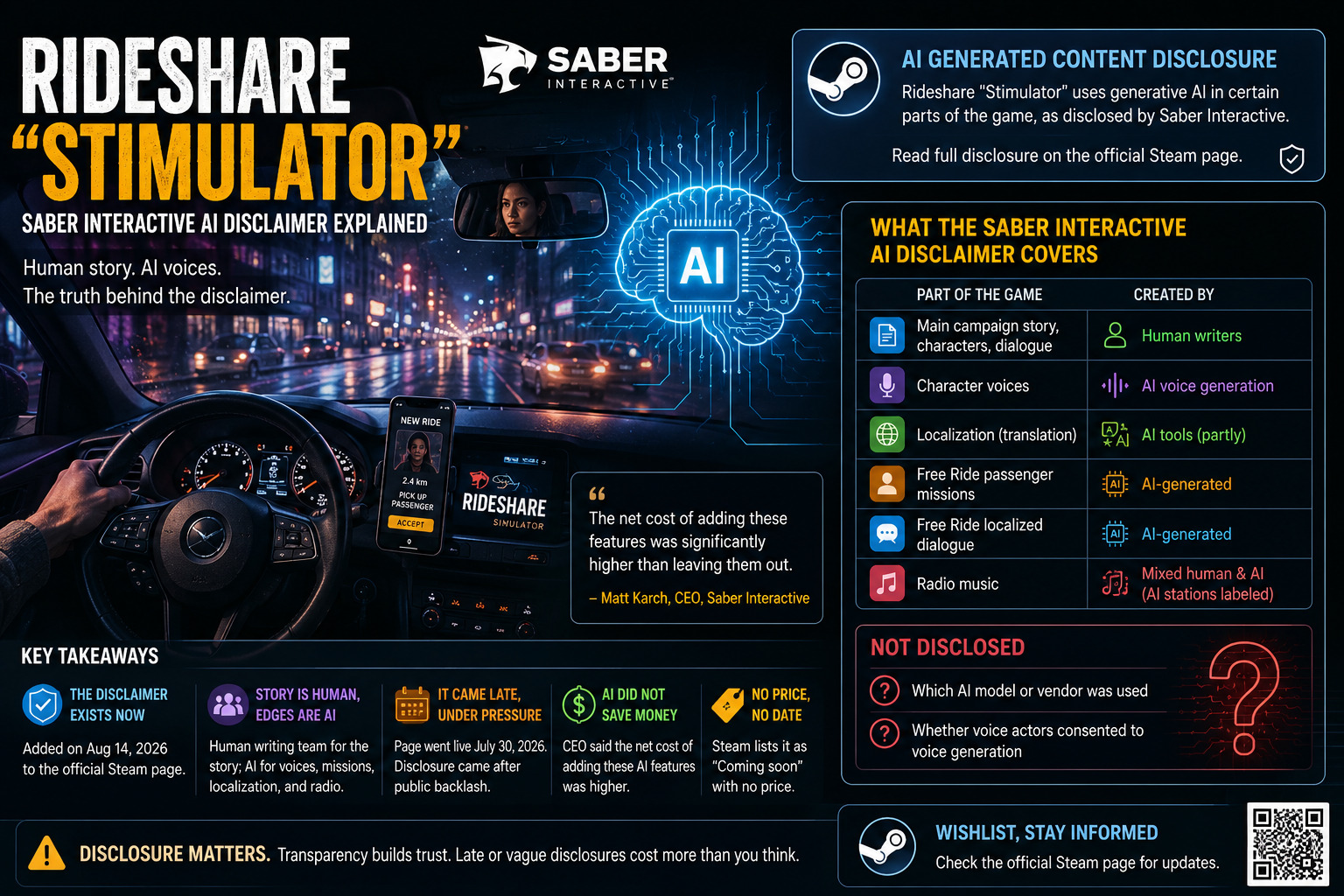
Saber Interactive added an AI disclaimer to the Steam page for Rideshare “Stimulator” on August 14, 2026. It says human writers wrote the campaign, while AI handles voice generation, some localization, passenger missions in an optional Free Ride mode, and part of the in-game radio. The Saber Interactive AI disclaimer landed about two weeks after the store page went live, and only after a public fight between CEO Matt Karch and a former lead writer. This guide is for players deciding whether to wishlist the game, and for developers who must fill in Steam’s AI survey. Skip it if you only want the argument, not the facts.
Key takeaways
- The Saber Interactive AI disclaimer exists now. Rideshare “Stimulator” carries an AI Generated Content Disclosure on its official Steam page. Reports from August 11–13, 2026 saying the page had no disclosure are out of date.
- Story is human, edges are AI. Saber says the main campaign story, characters and dialogue were written by people. AI covers voice generation, some localization, Free Ride passenger missions and some radio music.
- It came late, under pressure. The store page went up on July 30, 2026. Steam users applied an “Artificial Intelligence” community tag before Saber published the disclosure.
- AI here did not save money. Karch stated the net cost of adding these features was higher than leaving them out, which contradicts the usual cost-cutting argument.
- No price, no date. Steam lists the game as “Coming soon” with no price. Any figure quoted elsewhere is not official.
What is the Saber Interactive AI disclaimer?
An AI disclaimer on Steam is a box on the store page where the publisher declares how generative AI was used. Generative AI means software that produces new text, speech, images or music from a prompt. Valve requires the box, but the publisher writes the wording.
The Saber Interactive AI disclaimer splits the game into human-made and machine-made parts. Here is what it claims.
| Part of the game | Who or what made it | Stated in the disclosure |
|---|---|---|
| Main campaign story, characters, dialogue | Human writing team | Yes |
| Character voices | AI voice generation | Yes |
| Localization (translation) | AI tools, partly | Yes |
| Free Ride passenger missions | AI-generated | Yes |
| Free Ride localized dialogue | AI-generated | Yes |
| Radio music | Mixed human and AI, AI stations labelled in game | Yes |
| Which AI model or vendor was used | Not named | No |
| Whether voice actors consented to voice generation | Not addressed | No |
That last row is the honest weakness. The Saber Interactive AI disclaimer tells you AI voices exist. It does not say whose voices trained them, or which system produced them. For a company facing an accusation about replacing a writer, that gap matters.
The real cost behind the Saber Interactive AI disclaimer
There is no published price for Rideshare “Stimulator”. Steam shows “Coming soon” with a wishlist button and no figure. AI Era will not invent a number, and neither should any other page you read.
The real cost story is on the development side, and most coverage skipped it. Karch said the net cost of building these AI features was significantly higher than leaving them out. That is the opposite of what critics assumed. He also described the pipeline: Saber’s writers create prompts, dialogue is produced offline, and the output is checked against guardrails. Writers stayed in the loop, doing prompt work instead of line work.
The costs that never appear on a store page are the ones that bite:
- Trust cost. A disclosure published after community pressure reads as damage control, not transparency.
- Discovery cost. The “Artificial Intelligence” tag now sits on the store page, and some players filter that tag out entirely.
- Review risk. Late disclosures invite negative reviews at launch, which lowers the score Steam’s algorithm rewards.
- Vagueness cost. Naming no model invites people to keep guessing, as happened when Eli Roth confirmed AI use on Ice Cream Man.
The four AI systems inside Rideshare “Stimulator”
Rather than one long list, the disclosed AI use falls into four clusters.
1. Generated ride content. The optional Free Ride mode creates passenger missions with AI. Saber’s reasoning is that the number of passengers is effectively infinite, so writing every ride by hand is not possible. Each dialogue becomes a new ride.
2. Synthetic voices. AI voice generation covers character speech. This is the same class of technology behind tools we covered in our Lyrebird AI explainer, where a model produces speech instead of a person recording it.
3. AI-assisted localization. Some translation work is machine-produced. Free Ride dialogue is localized this way too. Machine translation in games is common and rarely controversial on its own.
4. Labelled AI radio. The soundtrack mixes human-made and AI-generated music across radio stations. Saber says stations with AI music are clearly marked in game. This is the strongest part of the disclosure, because the label sits where the player actually is, not buried in a store page.
How the Saber Interactive AI disclaimer compares to other studios
Steam disclosures vary wildly in detail. Three real examples show the range.
| Game | Publisher | Disclosure style | How specific |
|---|---|---|---|
| Rideshare “Stimulator” | Saber Interactive | Splits human vs AI by feature | Medium |
| ARC Raiders | Embark Studios | One broad sentence about tools | Low |
| inZOI | KRAFTON, Inc. | Describes player-facing AI features | High |
Rideshare “Stimulator” verdict. Better than most. It names features. It does not name models, vendors or consent terms.
ARC Raiders verdict. The weakest of the three. Embark says it may use procedural and AI-based tools in development, and that the final product reflects its own team. Players complained the wording told them almost nothing.
inZOI verdict. The clearest. KRAFTON lists what players themselves can generate: outfit textures from text, 3D objects from images, character motion from video. It also says output is reviewed and refined by the team.
Who should care, and who can skip this
You should care if you are:
- A player who filters games by the Steam “Artificial Intelligence” tag before buying.
- A voice actor or writer tracking how studios describe AI work in credits and disclosures.
- A developer preparing a Steam page and unsure how much detail to publish.
- A researcher building a record of AI use in shipped games.
You can skip this if you are:
- Only interested in whether the game is fun. The Saber Interactive AI disclaimer says nothing about quality.
- Waiting for a price or a release date. Neither is published yet.
- Looking for a legal ruling. No regulator has weighed in on this dispute.
Saber vs Embark vs KRAFTON, by the job the disclosure has to do
A store disclosure has one job: tell a buyer what they are paying for before they pay. Judge it on that, not on word count.
KRAFTON does the job. A shopper reading the inZOI box learns which AI features they will personally use. They can decide before spending $39.99.
Embark mostly dodges it. ARC Raiders shipped on October 30, 2025 at $39.99 with a sentence that could describe almost any studio. Design director Virgil Watkins later had to explain in interviews that the game uses machine learning for drone movement and text-to-speech, not generative art. If a disclosure needs an interview to make sense, it failed.
Saber sits in the middle. The feature-by-feature split is useful. The timing is not. A buyer who wishlisted the game on July 30 made that choice without this information.
Recent changes and the 15-day timeline
This story moved fast, which is why older articles are unreliable.
- July 30, 2026 — Rideshare “Stimulator” is announced for PS5, Xbox Series X|S and PC, developed by UNIGINE and published by Saber Interactive. No AI disclosure on the Steam page.
- August 11, 2026 — Former lead writer Stella Sacco posts that Saber “replaced me with ChatGPT midway through development.”
- August 12, 2026 — Saber responds that neither it nor UNIGINE replaced any writer with AI, and says its writing staff has tripled since 2023.
- August 13, 2026 — Karch says humans wrote all of the story, then adds he would “frankly, in retrospect, have been happy to replace her with AI.” Steam users apply the “Artificial Intelligence” tag.
- August 14, 2026 — The Saber Interactive AI disclaimer appears. Karch says it was always the plan, and argues AI “can and should help shape gamer experiences.”
One wider change matters. On January 16, 2026, Valve clarified its AI content rules: AI used purely as a development aid is exempt, while AI content that ships to players must be declared. Saber’s uses are all player-facing, so all required disclosure.
Scale check: the AI Transparency Index counted 19,366 Steam products with AI disclosures as of August 14, 2026. About 13,254 involve AI-made content in the playable game. Only 661 use AI that runs live during play. Rideshare’s offline dialogue sits in the larger group.
How to check any game’s AI disclosure yourself
You do not need to trust a news article. Check the source in under a minute.
- Open the game’s Steam store page.
- Scroll the right-hand column past the system requirements.
- Look for the box headed “AI Generated Content Disclosure.”
- If the box is missing, the publisher has told Valve the game ships no player-facing AI content.
- Check the user tags near the top. A community “Artificial Intelligence” tag can appear even when the box does not.
- Screenshot it. Disclosures get edited, as the Saber Interactive AI disclaimer shows.
If a disclosure changes after you buy, Steam’s standard refund window applies. There is no separate AI refund policy.
FAQ
Does Rideshare “Stimulator” use AI? Yes. The Steam disclosure confirms AI voice generation, some AI localization, AI-generated passenger missions in the optional Free Ride mode, and AI-generated music on labelled radio stations. The main campaign story was written by human writers.
Did Saber Interactive replace a writer with ChatGPT? Saber denies it. The company says neither it nor UNIGINE replaced any writer with AI, and that its writing staff tripled since 2023. Former lead writer Stella Sacco disputes this. No independent evidence has settled it.
Why did the Saber Interactive AI disclaimer appear so late? The store page went live on July 30, 2026 without one. Karch said Saber intended to disclose once the feature set was final. The disclosure appeared on August 14, after community pressure and an added Steam tag.
Is Saber Interactive owned by Embracer Group? No, not since 2024. Embracer Group sold Saber Interactive to Beacon Interactive, a company set up by Karch. Saber now operates independently and publishes Rideshare “Stimulator” itself.
How much does Rideshare “Stimulator” cost? No price is published. Steam lists the game as “Coming soon” with a wishlist option and no figure. Saber has announced no release date either. Treat any quoted price as unverified until Steam shows one.
Verdict
The Saber Interactive AI disclaimer is clearer than most Steam disclosures, and later than it should have been. It tells you which parts of Rideshare “Stimulator” a machine made, but not which machine, and not on what terms. AI Era rates it useful but incomplete. Next step: open the Steam page, read the disclosure box yourself, and screenshot it before launch so you can compare it to the shipped game.
About AI Era
AI Era reviews AI tools and AI disclosures for creators, marketers and small businesses. We check every claim against the vendor’s own page or official documentation first, and we say plainly when a figure is not published anywhere official instead of estimating it. We read the primary source before the press coverage, date every fact, and publish the negatives beside the positives. More of our work: which jobs AI is hitting hardest in 2026, our Crayo AI guide, our Odysseus AI review, and our 1min AI pricing breakdown. The dispute itself was reported by PC Gamer.