Did Ice Cream Man Use AI? Eli Roth’s Confession
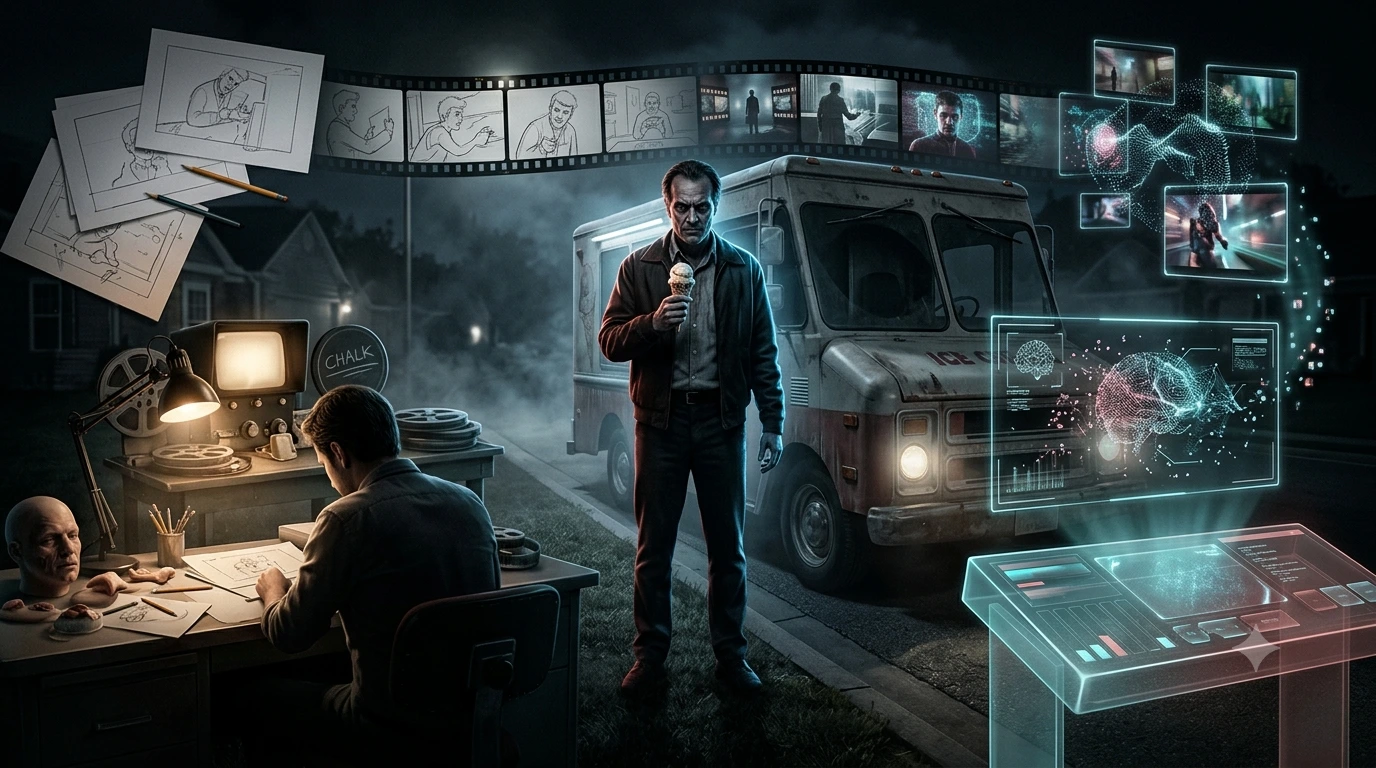
Ice Cream Man AI is confirmed. Quick answer: Yes. Eli Roth’s horror film Ice Cream Man (released 7 August 2026) used generative AI in a few scenes. Roth first suggested an animated sequence was hand-drawn, but after an AI visual-effects studio appeared in the credits, he confirmed the film used AI. The admission set off a fresh round of the AI-in-Hollywood debate.
When a movie gets accused of using AI, the reaction online is fast and loud. That is exactly what happened with Ice Cream Man. Within days of its release, viewers spotted scenes that looked machine-made, the director walked back an earlier claim, and the internet did the rest.
At aiera.blog we care less about the drama and more about what these moments reveal: how AI is quietly entering creative work, and why disclosure — not the technology itself — is usually the real issue. Here is what actually happened, what the AI studio behind it does, and why fans reacted the way they did. This Ice Cream Man AI story is a useful case study for how disclosure works in modern film production.
What is Ice Cream Man?
Ice Cream Man is a 2026 horror film directed by Eli Roth, the filmmaker behind Hostel and Cabin Fever. It is a remake of a low-budget 1995 cult movie that starred Clint Howard. Roth made the new version independently through his own company, The Horror Section, which gave him freedom from studio oversight.
The plot is pure Roth. A mysterious ice cream vendor rolls into a quiet suburban town and hands out treats to the local children. The catch: after the kids eat the ice cream, they turn into homicidal monsters and start killing the adults. The vendor himself is unsettling in a way critics compared to Art the Clown from Terrifier. The film runs about 89 minutes and leans hard into the transgressive, over-the-top violence Roth is known for.
None of that caused the controversy. The AI did.
Did Ice Cream Man use AI? The full timeline
The story unfolded in a few clear steps, and the order matters. Piecing together the Ice Cream Man AI timeline helps explain why the backlash grew so quickly.
It started on Reddit. Early viewers on the r/horror subreddit called the film a trainwreck and flagged what they described as heavy AI use. That post lit the fuse.
Roth first pointed to hand-drawn work. Asked by Polygon about a striking sequence — a Fleischer Studios-style cartoon, the kind of jittery 1920s animation used to hypnotize the children in the film — Roth said he had an animation background and drew the frames himself. He explained that animators then helped make the motion more fluid, and an artist added an old-timey feel. In other words, his first answer framed the sequence as human-made.
Then the credits told a different story. Viewers noticed that the film’s credits included Dark Half, a visual-effects company that specializes in AI. That detail did not match the “I drew it myself” explanation, and speculation grew quickly.
Roth clarified. Confronted with the Dark Half credit, Roth issued a statement to Polygon and Variety saying he had misspoken earlier. According to Variety, he confirmed that <cite index=”34-1″>AI was used in a very small portion of a few scenes</cite>. He framed it as a moment where technology and creativity worked together to realize his vision.
Roth did not specify exactly which shots were AI-generated or whether the disputed animation sequence was among them. That gap — between the first answer and the correction — is a big part of why the backlash grew. That ambiguity is exactly why the Ice Cream Man AI debate has not fully settled.
What is Dark Half, and what is AI VFX?
The name at the center of this is Dark Half, credited as an AI visual-effects studio. Understanding what that means helps explain the reaction.
Traditional visual effects are built by artists, frame by frame, using software like compositing and 3D tools. It is slow, skilled, expensive work. AI visual effects flip that. Instead of an artist crafting every element, generative models produce or alter imagery based on prompts and reference material. A studio like Dark Half uses these tools to create shots — or parts of shots — faster and far more cheaply than a conventional VFX pipeline.
For an independent, low-budget horror film, the appeal is obvious. AI can deliver an ambitious visual on a small budget and short timeline. That is likely why it turned up in a scene meant to look like vintage, surreal animation, which is difficult and costly to produce by hand.
The trade-off is that AI-generated imagery often has a recognizable look — slightly off motion, warped details, an uncanny smoothness. Trained horror audiences spot it fast, and once they do, it pulls them out of the film. This is the same instinct we track across aiera.blog when we look at how AI shows up in everyday products: the technology works, but it rarely hides as well as its users hope. That tension is the real story behind Ice Cream Man AI coverage this week.
Why horror fans pushed back so hard
The strength of the reaction surprised some observers, but it follows a clear pattern.
Horror fans have long prized practical effects — physical props, makeup, prosthetics and real stunts. Many already resist heavy CGI, seeing it as a shortcut that cheapens the craft. Generative AI sits even further down that scale for them. To a large part of the fanbase, it represents the opposite of the hands-on, artist-driven filmmaking they value.
There is also the disclosure problem, and this is the part that matters most. The anger was not only about AI being used. It was about the sequence being described one way, then confirmed as another only after fans found the evidence themselves. A first answer that pointed to hand-drawn work, followed by a correction once the AI credit surfaced, reads to audiences as an attempt to downplay the truth. It is the same pattern fueling the Ice Cream Man AI backlash today.
This is not the first time. Late Night with the Devil (2024) faced backlash when a handful of AI-generated images appeared in the film, and that alone was enough to sour many viewers. The lesson repeats: audiences forgive a lot, but they punish the feeling of being misled. Clear, up-front disclosure tends to defuse these rows before they start — a point we have made before in our coverage of AI transparency and giving creators proper credit. Ice Cream Man AI now joins that same list of cautionary examples.
Eli Roth’s side, and the wider AI-in-film debate
To be fair to Roth, there is a real argument on his side, and a neutral look at this has to include it.
Roth has framed his use of AI as a small, practical choice that helped an independent film achieve a specific vision without a studio’s budget. He has also long defended horror as a genre built on pushing boundaries and being deliberately provocative, so a little controversy is not new territory for him. Supporters of AI in filmmaking add that the tools lower costs, speed up production, and let small creators attempt shots that would otherwise be impossible — much like earlier leaps such as digital cameras and CGI, which faced their own backlash before becoming normal.
The case against is just as real. Critics argue that generative AI is trained on existing artists’ work without consent, threatens the jobs of VFX professionals and animators, and often produces visibly lower-quality results. For many, the objection is ethical as much as aesthetic.
Both things can be true at once: AI can be a useful tool for a cash-strapped filmmaker, and its use can be poorly disclosed, poorly executed, and unwelcome to the audience it is aimed at. Ice Cream Man landed squarely in that overlap.
What the Ice Cream Man AI row means for movies
Strip away the specifics and a durable takeaway remains. AI is already inside mainstream filmmaking, including from directors you might not expect. It is no longer a question of if the tools appear, but how their use is handled.
The films that avoid this kind of blow-up will likely be the ones that disclose clearly and early, rather than letting fans discover it in the credits. As with our neutral, no-hype approach to reviewing new technology in our buyer’s guides, the honest path tends to age better than the defensive one. Expect more of these controversies, and expect the ones that sting most to be the ones where the disclosure came last.
Ice Cream Man AI: FAQ
Did Ice Cream Man use AI? Yes. Eli Roth confirmed that generative AI was used in a small portion of a few scenes in the film.
Which scenes used AI? Roth did not specify. Attention has centered on a Fleischer Studios-style animated sequence, but he has not confirmed exactly which shots are AI-generated.
What is Dark Half? Dark Half is an AI visual-effects studio credited on the film. It uses generative AI tools to create or alter visual effects shots.
Did Eli Roth admit to using AI? Yes, after first suggesting the animation was hand-drawn. He later said he misspoke and confirmed the film’s AI use.
Is using AI in movies bad? Opinions are split. Supporters point to lower costs and creative freedom for indie films. Critics raise concerns about consent, jobs and quality. Many viewers object most to undisclosed use.
The takeaway
Ice Cream Man did use AI, and Eli Roth confirmed it after an initial denial — a sequence that turned a small technical choice into a much bigger conversation. The film is a useful snapshot of where things stand in 2026: AI tools are in the room, audiences are watching closely, and disclosure is the line between a quiet production credit and a public backlash. We’ll keep tracking how AI reshapes creative work here at aiera.blog as more of these stories surface.