What Is Siri AI? Everything You Need to Know in 2026
For most of the last decade, Siri Ai was the butt of every tech joke. Ask it something slightly complex and it would shrug with a “Here’s what I found on the web” and a list of links. Meanwhile, ChatGPT rewrote what people thought AI assistants could do — and Siri looked increasingly outdated.
That changes in 2026.
At WWDC 2026 on June 8th, Apple officially unveiled Siri AI: a fully rebuilt, conversational assistant powered by a new Apple Intelligence architecture and, remarkably, Google’s Gemini models under the hood. This is not a minor update. It is the most significant overhaul of Siri since its debut in 2011.
At aiera.blog, we track how AI is reshaping everyday digital life, and Siri AI is one of the most consequential announcements of the year. Whether you are an iPhone user curious about what just landed on your device, a tech enthusiast comparing AI assistants, or simply wondering whether Siri is finally worth using again, this guide covers everything you need to know.
What Is Siri AI? The Short Answer
Siri AI is Apple’s next-generation voice and conversational assistant, launched as part of iOS 27, iPadOS 27, macOS Golden Gate, watchOS 27, and visionOS 27. It represents a fundamental departure from the old rule-based Siri, which was primarily a command executor.
The new Siri AI is a large language model-powered assistant capable of holding genuine multi-turn conversations, understanding context across your apps and files, answering open-ended questions using live web data, and taking intelligent actions across the Apple ecosystem.
Put simply: the old Siri heard what you said. The new Siri AI understands what you mean.
According to the official Apple Newsroom announcement, Siri AI is described as “a profoundly more capable and conversational assistant with personal context understanding, broad world knowledge, and onscreen awareness.” It can surface relevant information from your messages, emails, and photos while answering virtually any question from the web.
How Siri AI Actually Works Under the Hood
The technical architecture behind Siri AI is a layered system that combines on-device processing with secure cloud computing. Here is how it breaks down:
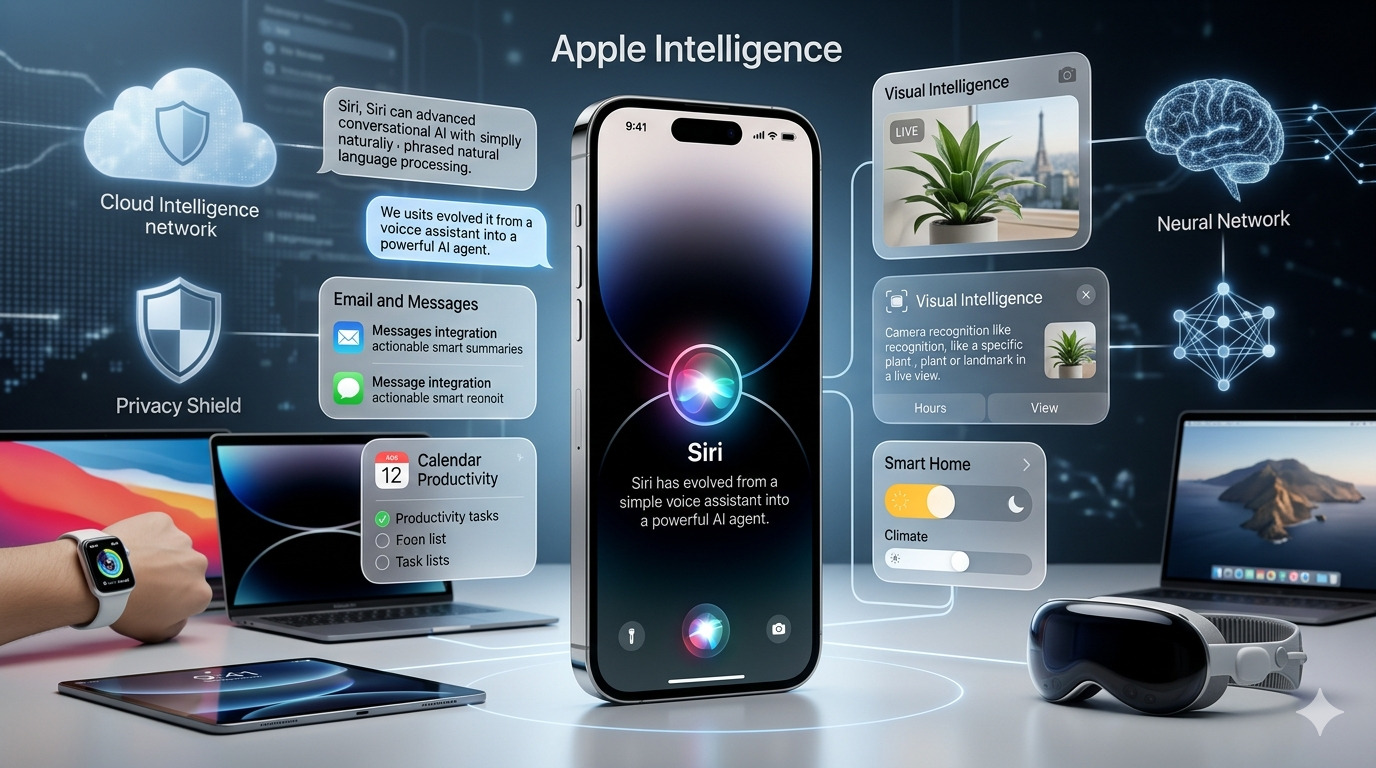
- Apple Foundation Models run directly on your device for fast, private responses to everyday requests.
- Private Cloud Compute (PCC) handles more complex tasks on Apple’s servers. Crucially, your personal data is never stored or made accessible to Apple or any third party during these cloud interactions.
- Google Gemini integration provides the advanced reasoning and world knowledge backbone. Apple uses a customised version of Gemini’s models, deeply tailored to work within Apple’s privacy infrastructure rather than routing queries to Google’s systems.
- The Spotlight index and App Toolbox work entirely on-device to give Siri cross-app awareness without leaving your device.
As Business Standard’s WWDC 2026 coverage explains, this is a multi-layer architecture spanning foundation models for text, image and speech understanding, with Gemini-powered server models for advanced queries and on-device models for privacy-sensitive personal tasks.
The result is an assistant that is smarter than before without sacrificing what Apple users have always valued: privacy.
What Is New in Siri AI Compared to the Old Siri
If you used the old Siri and found it frustrating, here is what has changed:
- Dedicated Siri AI App: A standalone card-based interface lets you revisit all past conversations, synced across devices via iCloud. Start a question on iPhone, pick it up on iPad.
- Onscreen Awareness: Siri now understands what is on your screen and can take contextual action. If a friend texts you a restaurant name, Siri can book a table without you specifying which restaurant.
- Visual Intelligence: Point your camera at anything and Siri can identify it, search for it, or take an action based on what it sees.
- Conversational Memory: Siri now holds multi-turn conversations and remembers context within a session, so you do not have to repeat yourself.
- Writing Assistant: In Mail, Messages, and third-party apps, Siri automatically proofreads, matches your writing tone, drafts responses, and suggests improvements.
- Live Web Answers: Siri AI can search the web in real time for up-to-date answers to any question, powered by Gemini’s world knowledge layer.
- Cross-App Actions: Siri can now execute multi-step tasks across apps, such as editing a message you sent, adding a song you heard to a playlist, or fixing a compromised password.
Is Siri an AI or Just a Voice Assistant?
This is one of the most searched questions around Siri, and it deserves a clear answer.
For most of its history, Siri was a hybrid: it used some machine learning for speech recognition and intent classification, but it primarily matched your spoken commands against a fixed set of actions. “Set a timer for ten minutes.” “Call Mum.” It was reactive, not reasoning. That is why it struggled with anything outside its pre-programmed intents and felt rigid compared to the generative AI wave that followed.
As Fast Company observed, when ChatGPT arrived, traditional voice assistants like Siri suddenly looked limited by comparison. ChatGPT was not just executing commands — it was reasoning, writing, explaining, and adapting. The difference in capability exposed how far behind Siri had fallen. It is part of a broader shift we covered in our guide to the future trends in conversational AI.
Siri AI in 2026 is a genuine large language model-powered AI assistant. It uses generative AI at its core, meaning it can construct novel responses, reason through ambiguous requests, hold context across a conversation, and adapt to your personal communication style. It is no longer just a command router. It is a reasoning assistant.
That said, Siri AI still maintains its foundational strength: it is deeply integrated with your Apple device, and the actions it can take within the ecosystem remain unmatched by standalone AI chatbots.
Siri AI vs ChatGPT vs Google Gemini: The 2026 Comparison
With Siri AI now in the conversation as a genuine AI assistant, the comparison to ChatGPT and Google Gemini is worth having honestly and clearly. Here is how they stack up across the dimensions that matter most:
| Feature | Siri AI | ChatGPT (GPT-4o) | Google Gemini |
|---|---|---|---|
| Conversational Depth | Improved with context memory | Excellent, multi-turn reasoning | Strong, especially with Search |
| Privacy | Industry-leading, Private Cloud Compute | OpenAI servers, opt-out available | Google servers, data linked to account |
| Device Integration | Unmatched across Apple ecosystem | Limited (app-based) | Deep on Android, Pixel devices |
| Multimodal Ability | Visual Intelligence (on-device) | Images, voice, video (advanced) | Best-in-class multimodal |
| Creative Writing | Good with Siri writing assistant | Excellent | Very strong |
| Smart Home Control | HomeKit, Shortcuts, native | Limited via plugins | Works with Google Home |
| Real-time Web Search | Yes (Gemini-powered) | Yes (with ChatGPT Search) | Yes (native Google Search) |
| Availability | Apple devices only | All platforms | All platforms |
According to a comparative analysis of AI assistants by Croma Unboxed, Siri’s biggest strength has always been its unmatched integration with iOS, particularly for device control, HomeKit automation, and Shortcuts. ChatGPT and Google Gemini have historically led on reasoning and multimodal understanding, but Siri AI 2026 closes much of that gap with Gemini under its hood.
Siri vs Alexa: Which One Should You Use?
If you are deep in the Apple ecosystem, Siri AI is the clear choice. It knows your photos, emails, messages, and app history. It takes action inside the apps you already use. Alexa, built by Amazon, excels at smart home automation across a wider range of third-party devices and is more platform-agnostic, but it lacks the personal context awareness that Siri AI now brings to Apple users.
The honest answer: if you own a mix of Apple and non-Apple devices, consider using Siri AI for Apple-specific tasks and keeping ChatGPT or Gemini available for heavier research and creative work. The best setup in 2026 is not picking one assistant — it is knowing which to reach for when.
Is Siri AI Private? The Apple-Google Gemini Deal Explained
This is the question many Apple users asked the moment they heard “Google” and “Siri” in the same sentence. Fair question.
In January 2026, Apple and Google confirmed a multi-year partnership worth an estimated $1 billion per year, under which Google’s Gemini models form the intelligence backbone for the new Siri AI and Apple Intelligence features. This was a significant strategic shift — Apple had previously chosen OpenAI’s ChatGPT for some integrations, and now moved toward Gemini as the primary AI foundation.
Here is what this means for your privacy in practice:
- Your queries do not go to Google. Apple routes requests through its own Private Cloud Compute infrastructure. Google provides the model, not the server processing your personal queries.
- On-device first. Core AI tasks run locally on your Apple device. Cloud is used only when necessary for complex queries.
- No data stored. Apple states explicitly that when Private Cloud Compute handles your requests, your personal data is not stored nor made accessible to Apple or anyone else, including Google.
- External verification. Apple allows independent security researchers to audit its Private Cloud Compute system at any time.
The bottom line: the Gemini partnership gives Siri smarter brains without handing Google access to your personal data. Whether you fully trust that arrangement is a personal judgement call, but the technical architecture Apple has described is meaningfully different from simply routing your Siri queries to Google’s servers.
Note: Siri AI will not be available in the EU initially due to regulatory constraints, and is not available in China.
Frequently Asked Questions
What Can Siri AI Do That the Old Siri Could Not?
The old Siri was largely limited to single-command tasks within Apple apps. Siri AI can now hold multi-turn conversations with full context, answer open-ended questions using live web data, write and proofread text in your personal tone, take complex multi-step actions across apps, understand what is on your screen without you describing it, and surface relevant information proactively based on your current context. It is a fundamentally different product.
Does Siri AI Require an Internet Connection?
Some Siri AI features work entirely on-device and do not require an internet connection, such as basic app control, timers, reminders, and on-device personal data queries. However, features that draw on live web knowledge, advanced reasoning via Private Cloud Compute, or real-time search do require an internet connection. Apple has not published a definitive list of which features are fully offline-capable.
Is Siri AI Available in All Countries?
Siri AI launches with iOS 27, iPadOS 27, and macOS Golden Gate later in 2026. At launch, it will not be available in the European Union due to regulatory requirements around Apple Intelligence features, nor in China. Apple is working to bring it to these regions but has not confirmed timelines.
How Do I Set Up Siri AI on My iPhone?
Siri AI will be available as part of the iOS 27 update when it rolls out publicly in autumn 2026. Once updated, you can access Siri AI through the Dynamic Island on compatible iPhones, via the dedicated Siri AI app, or by activating Siri through voice or the side button as you always have. Apple Intelligence features, including Siri AI, require an iPhone 16 or newer (or a device with an A17 Pro chip or later) with sufficient storage and an active iCloud account.
Expert Insight from aiera.blog: Our Take on Siri AI
At aiera.blog, we have been watching the AI assistant space closely since the ChatGPT moment in late 2022 fundamentally reset expectations. Here is our honest take on what Siri AI means for real users.
Siri AI is the right move, made later than it should have been. Apple spent two years after the ChatGPT wave making incremental promises that repeatedly slipped. The WWDC 2026 announcement of Siri AI is the genuine overhaul users were promised at WWDC 2024. The good news is that what Apple has built appears to be a serious product, not a marketing refresh.
The Google Gemini integration is the most surprising strategic decision Apple has made in years. Apple and Google have been rivals for decades, yet Apple chose to license Gemini rather than ship a weaker proprietary model. That decision signals something important: Apple prioritised user experience over competitive pride. For users, that is a good outcome.
Where Siri AI will genuinely shine is in personal context. No other AI assistant on the market has permission to access your photos, your emails, your messages, your calendar, your notes, and your apps simultaneously. ChatGPT and Gemini are powerful, but they operate from the outside looking in. Siri AI operates from inside your digital life. That is a meaningful and underrated advantage.
Our recommendation at aiera.blog: if you are an iPhone user, start using Siri AI when iOS 27 lands. Experiment with it for personal tasks where context matters: drafting messages, finding old emails, managing your schedule, controlling your home. Keep ChatGPT or Gemini available as a second tool for deep research, creative projects, and complex reasoning tasks where you want a second brain without personal context. The most productive users in 2026 will not be loyal to one assistant — they will know when to use which.
Key Takeaways
- Siri AI was officially unveiled at WWDC 2026 and is the most significant Siri upgrade since 2011, launching with iOS 27 later in 2026.
- It is powered by a combination of Apple Foundation Models, Private Cloud Compute, and Google Gemini, making it a genuine large language model assistant rather than a command-based voice tool.
- Key new capabilities include a standalone Siri AI app, onscreen awareness, Visual Intelligence, conversational memory, cross-app actions, and a writing assistant that matches your personal tone.
- Despite Google’s Gemini powering core AI features, Apple maintains its privacy standards through Private Cloud Compute, meaning your personal data is not stored or accessible to Google.
- Siri AI’s biggest competitive edge remains its deep integration with the Apple ecosystem. For personal, contextual tasks on Apple devices, it now stands as a serious alternative to ChatGPT and Gemini rather than a distant third option.