AI Agents Explained: What They Are, How They Work & Uses
AI guide is moving beyond systems that only answer questions. Modern AI can plan tasks, use software tools, access information, and complete several steps to reach a goal.
AI agents are built around this idea. Instead of only generating an answer, an agent can decide what needs to happen next and take actions based on the task it has been given.
Businesses are exploring AI agents for customer service, research, marketing, software development, data analysis, and workflow automation.
This guide explains what AI agents are, how they work, their main components, different types, practical use cases, benefits, limitations, and how they compare with chatbots and traditional automation.
What Is an AI Agent?
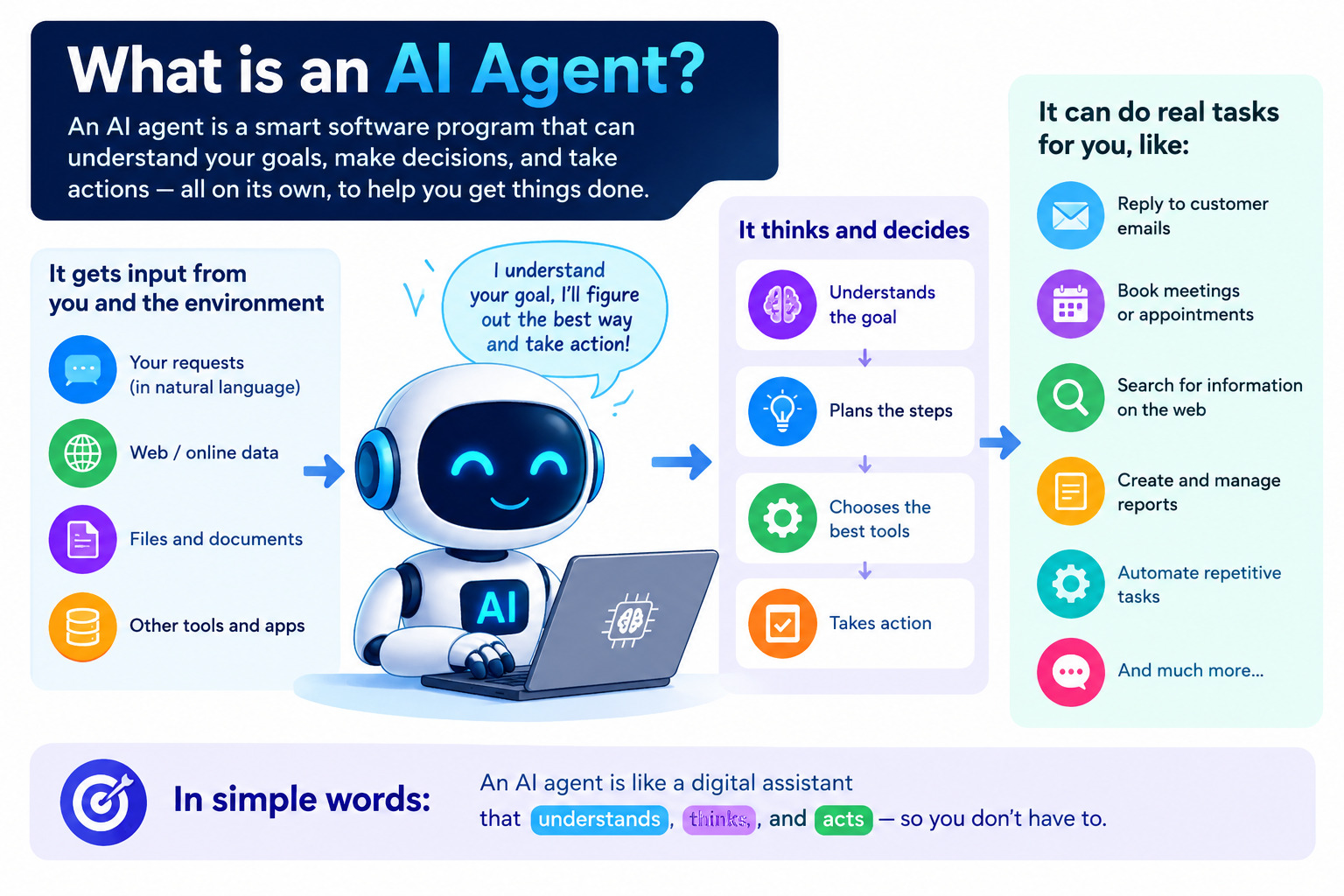
An AI agent is a software system that uses artificial intelligence to pursue a goal, make decisions, use available tools, and perform actions with varying levels of human supervision.
A normal chatbot usually responds to a question or instruction. An AI agent can take a broader objective and work through multiple steps to achieve it.
For example, instead of asking an AI system to write one email, a user could give an agent a task such as finding potential customers, researching their businesses, preparing personalized emails, and organizing the results.
The agent may use a large language model (LLM) to understand the request, planning capabilities to decide what to do, memory to retain useful information, and tools or APIs to perform actions.
The level of autonomy can vary. Some agents require approval before every important action, while others can complete low-risk workflows with limited human input.
How Do AI Agents Work?
AI agents generally follow a cycle of understanding a goal, planning actions, using tools, checking results, and continuing until the task is completed or human input is required.
1. Understanding the Goal
The process begins when a user or another system provides an objective.
For example:
“Find relevant websites for a content marketing campaign and organize the best prospects.”
The agent first needs to understand what the request means and what a successful result should look like.
2. Breaking the Task Into Steps
A complex goal can contain several smaller tasks.
The agent might decide to:
- Search for suitable websites
- Collect website information
- Check relevant metrics
- Remove unsuitable prospects
- Organize the remaining websites
- Prepare a final report
This planning ability is one of the major differences between an agent and a basic question-answering system.
3. Selecting Tools
AI agents can connect with external tools and systems.
Depending on their design, these tools may include:
- Search engines
- Databases
- APIs
- CRMs
- Email systems
- Calendars
- Spreadsheets
- Code execution environments
- Business software
The AI model decides when a tool is needed and uses the available information to continue the workflow.
4. Taking Action
After deciding what to do, the agent performs an action.
For example, it might retrieve information from an API, create a document, update a CRM record, or send a message after receiving the required permission.
5. Checking the Result
The agent can evaluate whether the previous step produced a useful result.
If information is missing or an action fails, the agent may try another approach.
This creates a loop:
Goal → Understand → Plan → Use Tools → Act → Check → Continue
Not every AI agent follows exactly the same architecture, but this pattern explains the concept clearly.
Core Components Behind AI Agents
AI agents are usually built from several connected components. The exact architecture depends on the system and its purpose.
| Component | Purpose |
|---|---|
| AI Model | Understands instructions and generates reasoning or responses |
| Memory | Stores useful information and context |
| Planning | Breaks larger goals into smaller tasks |
| Tools | Allows the agent to interact with external systems |
| APIs | Connects the agent with applications and services |
| Knowledge | Provides relevant information and data |
| Orchestration | Coordinates different steps or agents |
| Guardrails | Limits unsafe or unwanted actions |
The AI model is important, but it is only one part of an agent. An AI model without tools, data, permissions, and a suitable workflow may not be able to perform meaningful actions outside the conversation.
AI Agents vs Chatbots and AI Assistants
The terms chatbot, AI assistant, and AI agent are sometimes used as if they mean the same thing. They do not always describe the same level of capability.
| Feature | Chatbot | AI Assistant | AI Agent |
|---|---|---|---|
| Answers questions | Yes | Yes | Yes |
| Follows instructions | Yes | Yes | Yes |
| Multi-step planning | Limited | Moderate | Strong |
| Uses external tools | Limited | Sometimes | Often |
| Takes actions | Limited | Sometimes | Often |
| Goal-oriented behavior | Low | Moderate | High |
| Autonomy | Low | Moderate | Can be higher |
A chatbot is generally designed to communicate with users and provide responses.
An AI assistant can perform broader tasks, such as organizing information, helping with writing, or interacting with connected applications.
An AI agent focuses more strongly on achieving a goal. It can decide which steps are needed, use tools, and continue working through a workflow.
The boundaries are not always strict. A modern AI assistant can contain agent-like features, while an AI agent can also operate through a conversational interface.
Main Types of AI Agents
AI agents can be classified in several ways based on how they make decisions and interact with their environment.
Simple Reflex Agents
These agents respond to current information using predefined rules.
For example, a system could automatically respond to a specific type of customer request when certain conditions are met.
They are useful for simple and predictable tasks but have limited ability to handle unfamiliar situations.
Model-Based Agents
These systems maintain information about their environment and use it to make decisions.
Instead of considering only the latest input, they can use stored information about previous events or the current state of a task.
Goal-Based Agents
Goal-based agents select actions based on a desired outcome.
For example, an agent may be given the goal of finding the best available meeting time and then check calendars before proposing a suitable option.
Utility-Based Agents
These agents consider different possible outcomes and attempt to select an action that provides a better result according to defined criteria.
A business system, for example, might evaluate different options based on cost, speed, availability, or another measurable factor.
Learning Agents
Learning agents can improve their behavior by using feedback, experience, or updated information.
This does not mean that every AI agent automatically learns from everything it does. Learning depends on how the system is designed and what data or feedback mechanisms it has.
Multi-Agent Systems
A multi-agent system uses multiple specialized agents that work together.
One agent might research information, another could analyze it, and another could prepare the final output.
This approach can be useful for complex workflows that contain several different types of work.
Real-World Uses of AI Agents
AI agents can be used in many industries because they can combine AI reasoning with AI tools and business data.
| Industry | Example Use |
|---|---|
| Marketing | Research prospects and organize campaigns |
| SEO | Analyze keywords, competitors, and content opportunities |
| Customer Service | Handle support requests and retrieve customer information |
| E-commerce | Assist with product searches and order workflows |
| Sales | Research leads and update CRM records |
| Software Development | Assist with coding, testing, and debugging |
| Finance | Analyze information and support routine workflows |
| Human Resources | Organize applications and scheduling |
| Research | Collect, summarize, and organize information |
| Productivity | Manage tasks, emails, and calendars |
Customer Support
A customer service agent could receive a support request, identify the problem, check relevant account information, review company policies, and recommend or perform an approved action.
Human staff can then handle cases that require judgment or special attention.
Marketing and Sales
An agent can help research potential customers, collect relevant business information, organize prospects, and prepare personalized outreach.
Human review remains important before important communications are sent.
Software Development
AI agents can assist developers by analyzing code, identifying potential problems, creating tests, and helping troubleshoot errors.
Their usefulness depends heavily on code quality, testing, permissions, and human review.
Research
Research agents can gather information from approved sources, compare findings, organize notes, and create a structured report.
Because AI systems can produce incorrect information, important research should still be checked against reliable sources.
Benefits of Using AI Agents
AI agents can provide several practical advantages when they are designed correctly.
Automation
They can handle repetitive multi-step workflows that would otherwise require manual work.
Time Savings
Agents can process routine tasks quickly and allow people to focus on work that requires judgment or creativity.
Tool Integration
An agent can connect several applications instead of requiring a person to move information manually between them.
Scalability
A well-designed system can handle more routine tasks as demand increases without requiring every step to be completed manually.
Flexible Workflows
Unlike traditional scripts that may follow exactly the same sequence every time, some AI agents can adapt their next action based on the information they receive.
However, these benefits depend on the quality of the underlying model, data, tools, workflow design, and supervision.
Limitations and Risks
AI agents are not perfect autonomous workers. Giving an AI system more ability to act also creates additional risks.
Incorrect Information
An agent may misunderstand information or produce an incorrect conclusion.
Hallucinations
AI models can generate information that sounds convincing but is not true. This becomes more serious when an agent uses incorrect information to make further decisions.
Security Problems
An agent connected to email, databases, or business systems can create security concerns if its permissions are too broad.
Privacy
Agents may process sensitive business or personal information. Organizations need appropriate data protection and access controls.
Unwanted Actions
An agent may take an incorrect action if its instructions, tools, or safeguards are poorly designed.
Lack of Human Judgment
Some decisions require context, experience, ethics, or legal responsibility that an automated system cannot reliably provide.
For these reasons, high-impact workflows should include appropriate human oversight, monitoring, access controls, and clear limits on what an agent can do.
What Is Agentic AI?
Agentic AI is a broader term used to describe AI systems that can demonstrate goal-oriented behavior, planning, decision-making, and action.
The terms AI agent and agentic AI are closely connected, but they are not always interchangeable.
An AI agent is generally a specific system designed to perform tasks toward a goal.
Agentic AI describes the broader approach or capability of creating AI systems that can operate with greater autonomy.
A useful way to understand the relationship is:
Artificial Intelligence → Generative AI → AI Agents → Agentic AI Systems
The exact definitions can vary between researchers and technology companies, so the terms should not be treated as perfectly standardized.
AI Agents vs Traditional Automation
Traditional automation and AI agents can both reduce manual work, but they operate differently.
| Traditional Automation | AI Agents |
|---|---|
| Uses predefined rules | Can interpret goals |
| Usually follows fixed workflows | Can plan multiple steps |
| Works best with predictable inputs | Can handle more flexible inputs |
| Limited decision-making | Can make context-based decisions |
| Usually deterministic | Can produce variable outputs |
Traditional automation is still the better choice for many predictable processes.
For example, automatically sending an invoice after a payment is received may not require an AI agent.
An AI agent becomes more useful when the task involves unstructured information, changing conditions, several tools, or decisions that cannot easily be represented by fixed rules.
Are AI Agents the Future of Work?
AI agents are likely to become more common in areas where people currently spend large amounts of time on repetitive digital tasks, as seen in trends.
Potential areas include research, customer service, marketing, sales operations, software development, data analysis, and administrative work.
The most useful systems are unlikely to remove humans from every workflow. Instead, many organizations will use AI agents to handle routine tasks while people focus on strategy, judgment, relationships, and complex decisions.
The key challenge will be building systems that are useful without giving them unnecessary control.
Frequently Asked Questions
What is an AI agent in simple words?
An AI agent is an AI-powered system that receives a goal, decides what steps are needed, uses available tools, and takes actions to complete the task.
How does an AI agent work?
An AI agent typically understands a goal, creates a plan, uses tools or data, takes an action, checks the result, and continues or adjusts its approach.
What is the difference between AI and an AI agent?
AI is the broader field of creating systems that perform tasks requiring intelligence. An AI agent is a system that uses AI to pursue goals and perform actions.
Are ChatGPT and other AI tools AI agents?
Not every AI tool is an AI agent. A conversational AI system can behave like an agent when it has the ability to plan tasks, use tools, and perform actions toward a goal.
Can AI agents work without humans?
Some AI agents can complete certain tasks with limited human input. However, the appropriate level of autonomy depends on the task, risk, permissions, and system design.
What are AI agents used for?
AI agents can support research, customer service, marketing, sales, software development, data analysis, productivity, and many other workflows.
Are AI agents safe?
AI agents can be useful, but they are not automatically safe. Security controls, permissions, monitoring, reliable data, testing, and human oversight are important.
What is agentic AI?
Agentic AI refers broadly to AI systems designed to pursue goals, make decisions, plan actions, and interact with tools or environments with varying levels of autonomy.
Conclusion
AI agents represent a shift from AI systems that mainly generate responses toward systems that can work through goals and perform actions.
They can understand instructions, create plans, use external tools, access information, and complete multi-step workflows.
Their potential applications range from customer service and marketing to research, software development, sales, and everyday productivity.
However, more autonomy also creates more responsibility. Incorrect information, excessive permissions, privacy issues, security problems, and unwanted actions must be considered before deploying an agent.
The best use of AI agents is not simply giving AI more control. It is designing clear workflows where AI can handle useful tasks while humans remain responsible for important decisions.