AI Voice Scam: How It Works and How to Stop It (2026)
An AI voice scam is a phone call where a criminal uses cloned audio of someone you trust to pull money out of you fast. The defence that works is boring and free: hang up and call the person back on a number you already have. This guide is for families, freelancers, and small business owners who handle money by phone. Skip it if you want a software product that blocks fake voices on a live call, because no consumer app does that reliably yet. AI Era checked every figure below against the FBI, FTC, and FCC.
AI voice scam: key takeaways
- The FBI logged 22,364 AI-related fraud complaints in 2025, with $893,346,472 in losses, per the official 2025 IC3 report released April 6, 2026.
- Total internet crime losses hit $20.877 billion in 2025 across 1,008,597 complaints.
- People over 60 lost $7.748 billion, a 59% jump from 2024. This age group is the main target.
- AI voice scam robocalls are already illegal. The FCC ruled on February 8, 2024 that AI-generated voices count as “artificial” under the Telephone Consumer Protection Act.
- The best AI voice scam defence costs nothing. The FTC’s official advice is to call the person back on a number you know is theirs.
What an AI voice scam actually is
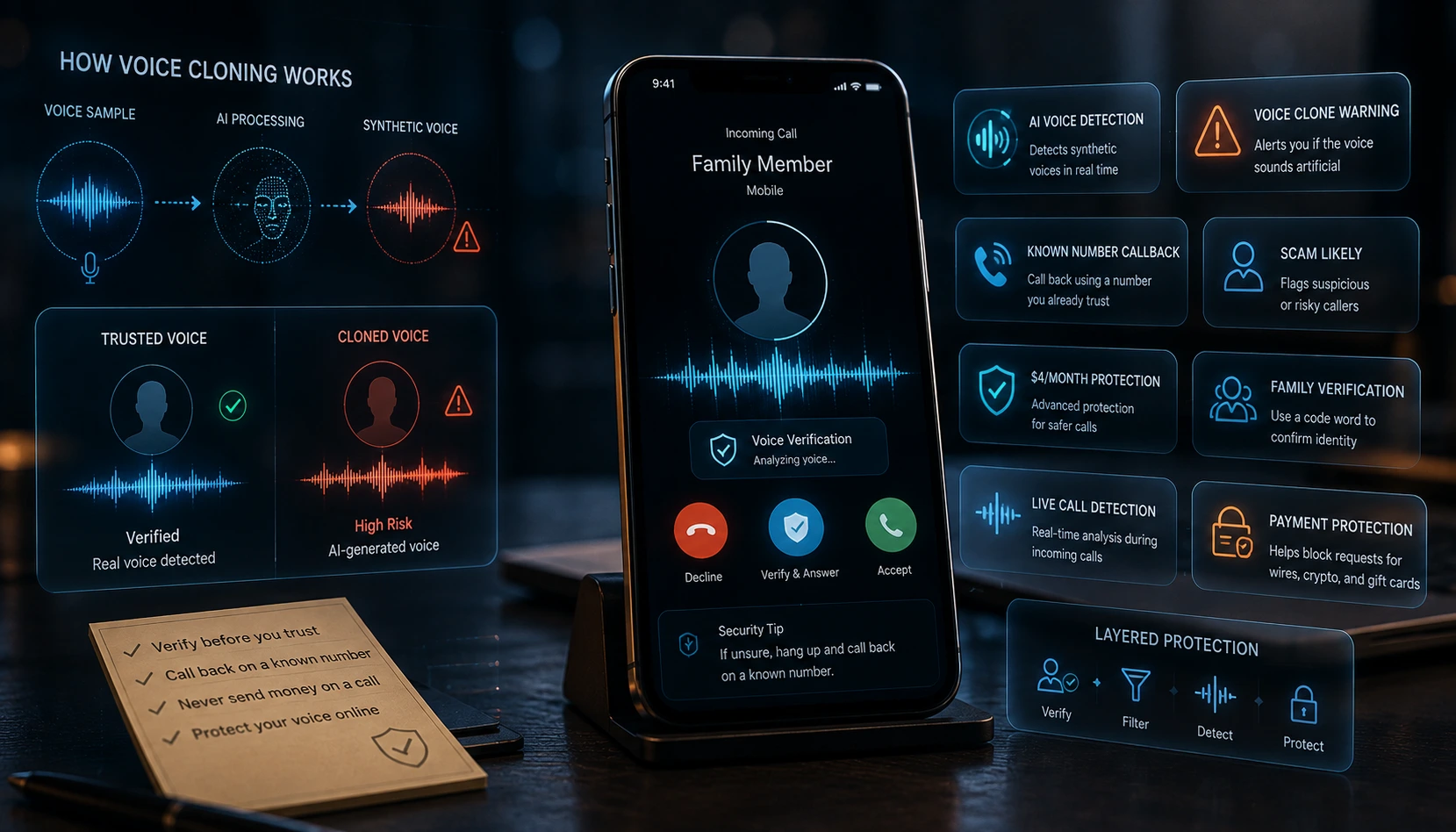
Voice cloning software copies how a person speaks from a short audio sample. A scammer grabs that sample from a voicemail greeting, a TikTok, or a podcast. Then they call you sounding like your daughter, your boss, or your bank.
How the main AI voice scam types differ:
| Scam type | Who the voice pretends to be | The ask | Main target |
|---|---|---|---|
| Grandparent / family emergency | A child or grandchild in trouble | Bail, hospital fees, wire transfer | Adults over 60 |
| CEO or vendor fraud | Your boss or a supplier | Urgent invoice payment | Small business finance staff |
| Voice verification bypass | You | Access to your own bank account | Anyone using voice ID |
| AI robocall impersonation | A politician, agency, or brand | A vote, a fee, or your details | The general public |
The one thing every AI voice scam shares is time pressure. A real emergency survives a five-minute pause. A scam does not.
AI voice scam protection: what it costs
Nothing is sold as a single anti-clone product. What exists is a mix of free tools, bundled features, and business services.
| Protection | Price | Source |
|---|---|---|
| Calling back on a known number | Free | FTC official advice |
| Family code word | Free | Not an FTC recommendation, but widely used |
| T-Mobile Scam Shield (basic) | Free | T-Mobile |
| T-Mobile Scam Shield Premium | $4/month per line | T-Mobile |
| McAfee Scam Detector | No extra charge on McAfee+, Total Protection, LiveSafe | McAfee |
| Hiya AI Voice Detection | No consumer price published | Hiya |
Hidden AI voice scam protection costs most articles skip:
- Bundling. McAfee’s Scam Detector is free only if you already pay for a McAfee plan. McAfee does not sell it alone.
- Coverage gaps. McAfee states its Deepfake Detector is trained on English audio, and that non-English audio may give less accurate results.
- It scans video, not your phone line. Consumer deepfake tools check media files, not live calls.
- Per-line pricing. A $4/month carrier upgrade for a family of four is $192 a year.
- Unpriced enterprise tiers. Hiya publishes a 99%+ accuracy claim for AI Voice Detection but no consumer price. AI Era could not find one, so we will not invent it.
Four layers of AI voice scam defence that actually work
1. Verification habits. The FTC’s April 2024 alert says to call the person back using a number you already know, and to reach them through another relative if you cannot. This is the layer that stops an AI voice scam.
2. Exposure control. Cloning needs a voice sample. Lock down public video, trim voicemail greetings, and check who can see your posts. Less audio online means a weaker clone.
3. Network filtering. Carrier tools flag likely scam numbers before you pick up. T-Mobile’s free tier includes Scam Likely labelling, Scam Block, and spam-to-voicemail. These catch mass campaigns, not targeted spoofed calls.
4. Money controls. Scammers push for wire transfers, crypto, gift cards, and payment apps because those are hard to reverse. The FTC lists unusual payment demands as a core scam sign. A rule that no money moves without a callback removes the whole AI voice scam attack.
AI voice scam tools compared, and what each one is really for
| Tool | Made by | What it checks | Live call? |
|---|---|---|---|
| McAfee Scam Detector | McAfee | Email, text, and AI-made video | No |
| Hiya AI Voice Detection | Hiya | Synthetic voice during live calls | Yes, via carrier and app integrations |
| T-Mobile Scam Shield | T-Mobile | Caller reputation and spam patterns | Yes, before you answer |
McAfee verdict: strong for scam texts and fake videos, and it costs nothing extra if you already subscribe. It is not a phone-call defence.
Hiya verdict: the only one here built for synthetic voice on a live call. Hiya acquired deepfake detection firm Loccus AI and claims over 99% accuracy on in-the-wild datasets. Availability depends on your carrier or device.
T-Mobile verdict: best value because the useful part is free. It labels bad numbers, but a cloned voice from a spoofed local number can still get through.
Who needs paid AI voice scam protection, and who does not
Pay for an AI voice scam tool if you:
- Run a business where staff can approve payments by phone
- Care for a parent over 60 who answers unknown numbers
- Have a public voice online through podcasts, video, or sales calls
- Use voice recognition to access a bank or utility account
- Already pay for security software that includes scam detection
Skip paid AI voice scam tools if you:
- Never move money by phone
- Already screen unknown callers to voicemail
- Have agreed a callback rule with everyone in your household
- Are on a tight budget, because the free callback habit beats any app
- Expect an app to verify voices for you. That capability sits mostly with carriers and banks, not consumers
McAfee vs Hiya, by the job you need done
Job: stop an AI voice scam mid-call. Hiya is the only realistic option, and even then it arrives through your carrier or the Hiya AI Phone app rather than as a product you buy outright. McAfee does not attempt this.
Job: check whether a video or message is fake. McAfee wins. Scam Detector covers email, text, and AI-made video in one bundle, at no added cost on existing plans. Read our piece on how accurate AI detectors really are before trusting any score blindly.
Job: protect an older relative today, for free. Neither. Set a callback rule, turn on your carrier’s free filtering, and shorten their voicemail greeting. That takes 20 minutes and costs nothing. Most vendor pages will not tell you that.
Recent AI voice scam news and ended offers
- The 2025 IC3 report landed April 6, 2026. It is the newest official US figure set. Any article still quoting 2024 loss totals is out of date.
- Congress started asking questions in April 2026. On April 16, 2026, Senator Maggie Hassan wrote to ElevenLabs, LOVO, Speechify, and VEED asking what they do to stop scammers misusing their tools. Her release cites a Consumer Reports finding that most leading voice cloning products had no technical mechanism to stop unauthorised voice copying.
- The FTC Voice Cloning Challenge is over. It closed with winners announced in April 2024, splitting $35,000 between AI Detect, DeFake, and OriginStory, with a recognition award to Pindrop Security. People still search for it as if entries are open. They are not.
- A popular statistic is not official. Several sites report a “1,210% surge” in AI voice scams. That percentage does not appear in the IC3 report. The verified figures are 22,364 complaints and $893 million.
- The law has not changed since 2024. The FCC’s ruling making AI voices in robocalls illegal still stands, and gives State Attorneys General a route to prosecute.
How to cancel or downgrade an AI voice scam protection tool
Most of these are add-ons, so leaving is simple.
- T-Mobile Scam Shield Premium. Remove the $4/month add-on in the T-Life app or your T-Mobile account. The free tier keeps working.
- McAfee plans. Scam Detector has no separate subscription. Cancel the parent plan in your McAfee account. Turn off auto-renew first, then request a refund inside the refund window if you are within it.
- Hiya app. Manage or cancel through the App Store or Google Play subscription screen, not inside the app.
- Before you cancel, keep the free layer. Carrier basic filtering and your callback rule cost nothing and do most of the work.
- Report first. If you were targeted, file at ReportFraud.ftc.gov and ic3.gov before you close any account or delete call logs.
AI voice scam FAQ
Can AI really clone a voice from a short clip? Yes. Modern voice cloning tools need only a small audio sample, which is why public videos and voicemail greetings matter. Senator Hassan’s April 2026 letters targeted exactly this gap in vendor safeguards.
How do I know if a call is an AI voice scam? Urgency plus an unusual payment method is the tell. If a familiar voice demands a wire transfer, crypto, or gift cards right now and resists a callback, treat it as an AI voice scam and hang up.
Is using AI voices in robocalls illegal in the US? Yes. The FCC ruled on February 8, 2024 that AI-generated voices are “artificial” under the Telephone Consumer Protection Act, making unsolicited AI robocalls illegal and giving State Attorneys General enforcement power.
How much money do AI scams take each year? The FBI’s 2025 IC3 report records 22,364 AI-related complaints and $893,346,472 in losses. Total internet crime losses were $20.877 billion, with $7.748 billion lost by victims over 60.
Does antivirus software stop AI voice scams? Not on live calls. McAfee’s Scam Detector covers email, text, and AI-made video, and is included with McAfee+, Total Protection, and LiveSafe. Live synthetic voice detection sits with carriers, not consumer antivirus.
Verdict
An AI voice scam is a real and growing threat, but it is beaten by habit, not by software. The FBI’s $893 million figure is the number to remember. No consumer app blocks a cloned voice on a live call today, so the callback rule is your actual protection. Next step: agree one sentence with your family tonight, that nobody sends money without a callback on a saved number.
About AI Era
AI Era reviews AI tools for creators, marketers, and small businesses. For this guide we used only the FBI IC3 annual report, FTC and FCC publications, a US Senate release, and vendors’ own pages for pricing. Where a widely repeated statistic did not appear in an official source, we said so instead of repeating it. We take no payment for coverage.
Official sources
- FBI 2025 IC3 Annual Report — complaint and loss figures
- FCC ruling on AI voices in robocalls — February 8, 2024
- FTC alert on harmful voice cloning — callback advice
- FTC Voice Cloning Challenge results — the contest that has ended
- T-Mobile Scam Shield — free tier and $4/month Premium
- McAfee Scam Detector announcement — plan inclusion and English-audio limit
More reading: What happened to Lyrebird AI · AI voice tools tested · Google Earth AI paused over deepfake fears · DIG AI, the dark web’s criminal AI · OptiGain AI: legit or scam? · Future AI Hub scam warning