NVIDIA Nemotron Transcribe: Open Speech Model, 40 Languages
Key Takeaways
- NVIDIA Nemotron Transcribe is an open-weight speech model that transcribes 40 languages, translates 31 of them to and from English, and attributes speakers in 13.
- The 30-billion-parameter mixture-of-experts model activates only about 4 billion parameters per token, so it runs on a single GPU.
- It handles recordings up to one hour long, labels up to eight speakers, and is steered with natural-language prompts.
- NVIDIA also released Granary v2, an open speech dataset and curation pipeline covering 463,062 hours across 48 languages.
- The model is available under the OpenMDW-1.1 license for commercial or non-commercial use, but it works on recorded audio, not livestreams.
Voice AI had a busy October, and NVIDIA just made it busier. On October 28, 2026, the company released Nemotron 3.5 Transcribe, a free, open-weight model that turns speech into text across 40 languages — and, just as importantly, released the data and tooling around it. Alongside the model came Granary v2, an open speech dataset whose public manifest covers 463,062 hours across 48 languages.
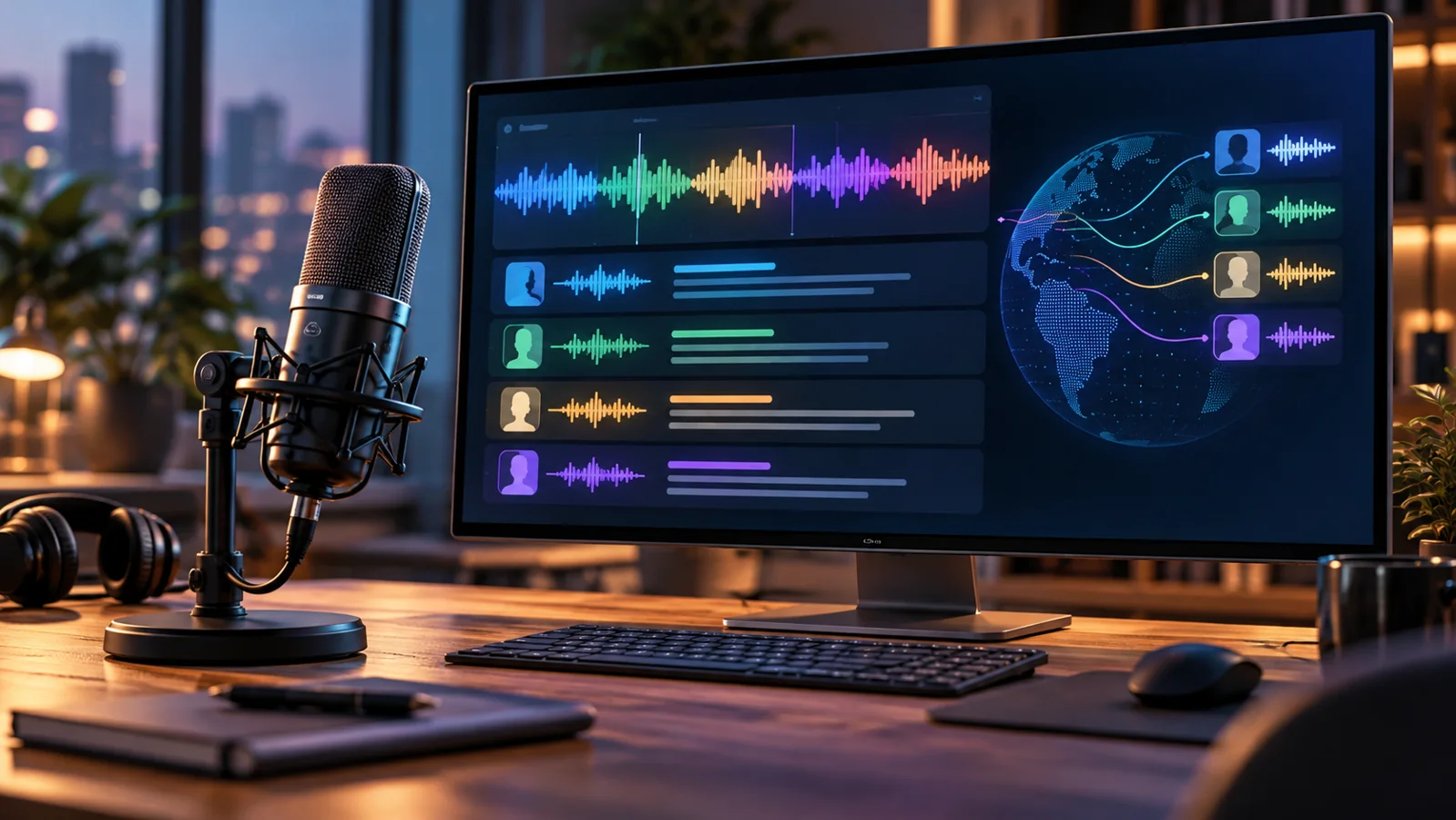
The release consolidates four jobs into a single promptable checkpoint: transcription, speaker attribution, translation, and spoken question answering. Instead of chaining separate tools for each task, a developer prompts one model to produce a verbatim transcript, a cleaned-up summary, or answers about a recorded meeting — and can include product terms and formatting conventions so the output fits a specific industry’s vocabulary.
The timing is part of a wider voice wave. Mistral shipped Voxtral 3 earlier in October, ElevenLabs launched Realtime for instant speech in voice agents, and Salesforce released Launa-Omni. NVIDIA’s entry stands out less for any single feature than for the package: a capable model, a huge dataset, and a fine-tuning recipe, all open.
What the model actually does
The headline numbers are straightforward. Nemotron 3.5 Transcribe transcribes 40 languages, translates 31 of them to and from English, and attributes speakers in 13 languages. It handles audio files up to one hour long and labels up to eight speakers in a recording. Audio question answering is trained in English only, according to NVIDIA’s announcement.
Prompting is the control surface. Users guide the system with natural-language instructions: produce a verbatim transcript, clean it up, summarise it, answer questions about it, or apply specific terminology. That matters in the two markets NVIDIA is targeting — business meetings and medical transcription — where a generic transcript is often less useful than one that knows the jargon. A medical deployment, for example, needs drug names and clinical terms rendered correctly, not approximately.
There is one clear limitation: Transcribe works with recorded audio, not livestreams. It is built for files, not for real-time captioning of a live call. Developers building live experiences will need a different tool for that job.
Small active footprint, big model
The architecture is a 30-billion-parameter mixture-of-experts model that pairs a speech encoder with a hybrid Mamba-Transformer language model. Only about 4 billion parameters are active per token, which is why NVIDIA says the model runs on a single GPU — from the Jetson AGX Thor robotics controller and DGX Spark desktop systems up to Blackwell data-centre hardware.
That efficiency claim comes with company benchmarks. In NVIDIA’s tests using NVFP4 precision, an RTX PRO 6000 Blackwell Server Edition GPU processed 100 hours of audio in under three minutes. On external benchmarks, the company reports competitive results: first place among open-weight models on the English Open ASR Leaderboard at 5.33% average word error rate, and a tie with Mistral’s Voxtral Small for first among open-weight models on the Artificial Analysis speech-to-text index at 2.8% AA-WER — while activating roughly 4 billion parameters against Voxtral Small’s 24 billion. For speaker attribution, NVIDIA claims the lowest diarisation error rate of 14 systems on a 21-language leaderboard. These are company-reported figures, and independent testing will be the real verdict, but the active-parameter comparison is the point NVIDIA wants noticed: similar accuracy for far less compute per token.
Granary v2: the dataset is the story
Models get the headlines, but Granary v2 may be the more durable contribution. The open speech dataset and curation pipeline expands language coverage from 25 languages in its predecessor to 48, with 463,062 hours in its public manifest. Developers obtain the audio from its original sources, with each source’s licence governing its use.
Open datasets matter because speech AI has a data problem. High-quality transcribed audio is expensive to produce, and the best datasets have historically been proprietary. By releasing both the dataset and the curation pipeline, NVIDIA gives smaller teams the raw material to build and fine-tune speech models of their own — including the medical customisation the company demonstrated, where training on medical speech from Indian doctors reportedly cut errors by 45.8% on held-out test clips after about 14 hours of training on one GPU. That figure is company-reported, but it illustrates the workflow: take the open model, add domain data, and get a specialised transcriber without starting from scratch.
Hosted endpoints are offered by Baseten, DeepInfra, and Simplismart, with an interactive demo on Hugging Face Spaces and ModelScope Studios. The model card lists an October 28, 2026 release date across Hugging Face, GitHub via NVIDIA NeMo Speech, NGC, and Build.Nvidia.com, with weights under the OpenMDW-1.1 licence.
Why this release matters
Transcription is one of AI’s oldest commercial markets, and also one of its most settled — which is exactly why an open, capable, customisable model is disruptive. When the core technology is free and the dataset is open, the competition moves to the layers around it: domain accuracy, workflow integration, and privacy. A hospital that can fine-tune its own transcriber on its own data, without sending recordings to a third party, has a different calculus from one buying transcription by the minute.
The release also fits NVIDIA’s broader strategy. The company sells the chips that run AI, and open models that run well on a single GPU expand the market for those chips — from data centres down to edge devices like Jetson boards. Giving away the software that makes the hardware useful is a familiar playbook, and Nemotron 3.5 Transcribe executes it cleanly. For context on the open-model landscape, see the best open-weight AI models of October 2026 and Cadence Maestro’s AI models for chip design.
For developers, the practical next step is simple: try the demo, test it on your own audio, and measure the error rate on your domain before assuming either the marketing or the scepticism. The model is open, the dataset is open, and the cost of finding out is an afternoon.
The voice stack, end to end
Nemotron 3.5 Transcribe is interesting not only for what it does but for what it replaces. A traditional voice pipeline chains separate systems: one for transcription, another for speaker labelling, another for translation, another for summarisation. Each stage adds its own errors, and errors compound — a mistranscribed word becomes a mistranslated sentence becomes a wrong summary. A single promptable checkpoint that does all four jobs does not eliminate errors, but it removes the seams where they multiply.
Prompting is what makes the single-checkpoint design practical. A developer who needs a verbatim legal transcript and a developer who needs a cleaned-up meeting summary are asking for different outputs from the same audio. In a pipeline world, that means different configurations, sometimes different vendors. In Nemotron’s world, it means different prompts. The model also accepts product terms and formatting conventions in the prompt, which is how a generic transcriber becomes a medical or financial one without retraining.
The comparison set sharpens the picture. Mistral’s Voxtral 3, ElevenLabs’ Realtime, and Salesforce’s Launa-Omni all shipped in the same voice wave, but they optimise for different jobs: Voxtral for open voice models, Realtime for instant speech in agents, Launa-Omni for Salesforce’s ecosystem. Nemotron’s niche is the recorded-audio workhorse: meetings, medical dictation, and media archives, where accuracy on files matters more than live latency. Developers should choose accordingly — and should note the livestream limitation before committing to it for real-time use.
Who should try it first
The fastest way to judge Nemotron is to run it on your own hardest audio, not on a demo clip. Meeting tools should test multi-speaker recordings with accents, crosstalk, and domain jargon, and compare speaker labels as well as words — diarisation errors are often more damaging than transcription errors. Medical teams should test clinical vocabulary and measure error rates on their own dictation, since a 45.8% error reduction in NVIDIA’s demonstration reflects its test conditions, not yours.
Media and localisation teams have a different test: translation quality across the 31 supported language pairs, and whether the English-only audio question answering limits their workflow. Archival projects should test the one-hour recording limit against their longest files. In each case the model is free and the dataset is open, so the evaluation costs time rather than money — which is precisely the point of an open release.