Claude AI Watermark: How It Works & How to Detect It
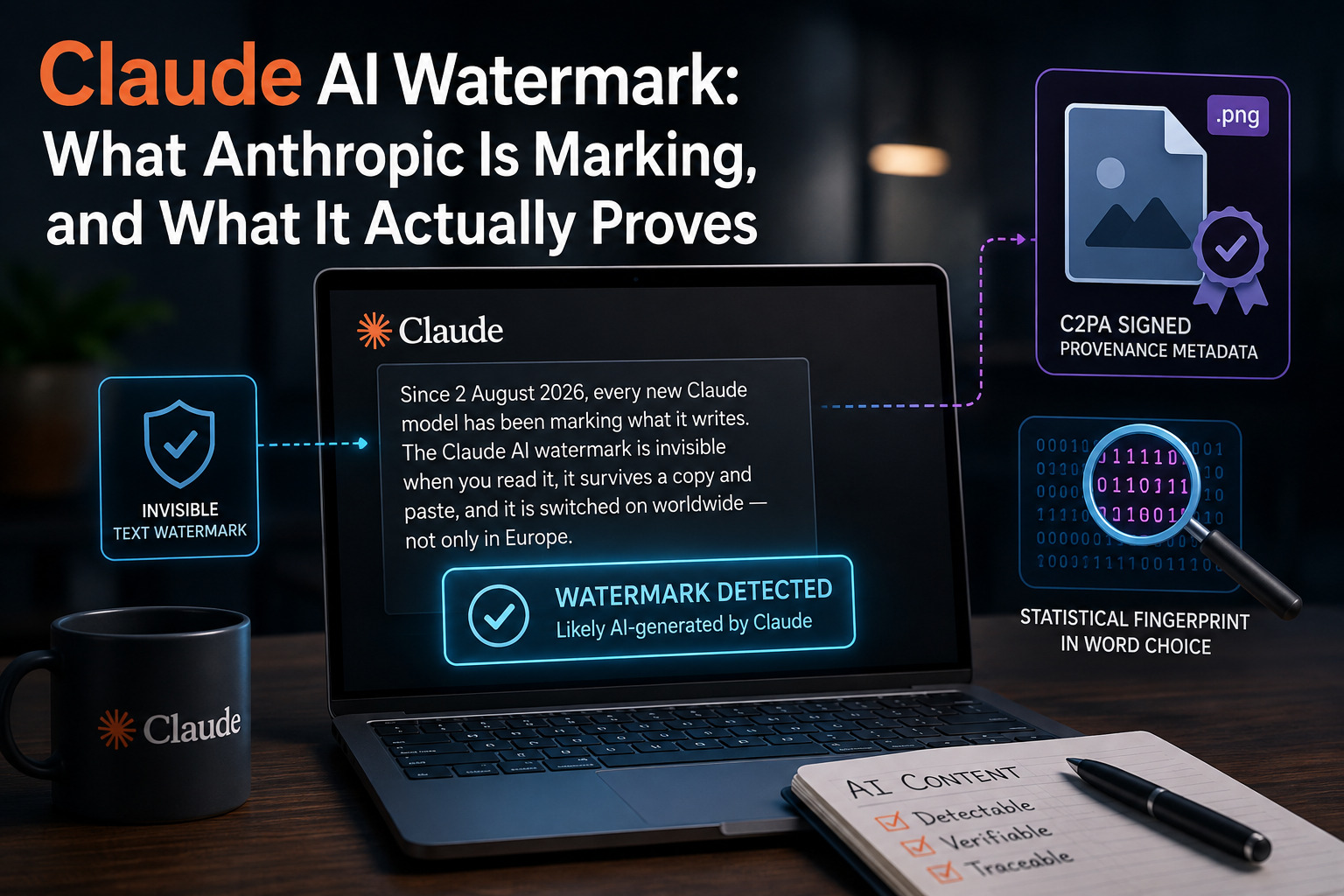
Since 2 August 2026, every new Claude model has been marking what it writes. The Claude AI watermark is invisible when you read it, it survives a copy and paste, and it is switched on worldwide — not only in Europe.
That has made a lot of writers nervous, and it has already created a small industry of tools promising to strip it out. Most solve the wrong problem.
Here at aiera.blog, we’ve pulled apart what Anthropic actually announced. This guide covers how the Claude AI watermark works, how you can check for it, where it breaks, and what it means if you publish content for a living.
What Anthropic actually announced
On 11 August 2026, Anthropic confirmed it is adding two different marks to Claude’s output.
The first is an imperceptible text watermark embedded in generated text. Anthropic says it “doesn’t change the meaning, quality, or readability” of a response.
The second is signed provenance metadata for supported file types (.svg, .png and .jpg), using the C2PA open standard for content authenticity.
Both are applied at the model level. That matters more than it sounds. As Anthropic puts it in its help centre documentation:
“Because the watermark is part of the text, it will travel with the text when it’s copied and pasted elsewhere, and may persist through some editing. Watermarking will be applied at the model level, which means it will be present no matter which Claude product or surface the text comes from.”
So the Claude AI watermark is there whether the text came from the Claude app, Claude Code, Claude Cowork, Claude Tag or the API — including via Amazon Bedrock, Google Cloud or Microsoft Foundry, though some cloud surfaces may not carry the file metadata signature.
The driver is regulation. Article 50 of the EU AI Act requires providers to mark AI-generated content in a machine-readable way, and its transparency obligations took effect on 2 August 2026. Google, Meta, Microsoft, OpenAI and Synthesia signed the same code of practice, as TechCrunch reported.
The compliance timeline
| Date | What happens |
|---|---|
| 2 Aug 2026 | EU AI Act transparency obligations take effect; new Claude models ship with marking |
| 11 Aug 2026 | Anthropic publicly confirms the rollout is global |
| 2 Dec 2026 | Deadline for older, pre-existing models to comply |
How the Claude AI watermark actually works
This is where most coverage stops short.
The Claude AI watermark is not hidden characters
The single biggest myth is that Claude buries invisible Unicode characters in your text — zero-width spaces, odd non-breaking spaces, a suspicious em dash. Search for a “Claude AI watermark remover” and you will find a dozen tools built on exactly that assumption.
That is not how this works. Hidden characters are trivially easy to defeat: they do not survive a paraphrase, a screenshot, a plain-text paste or any platform that strips formatting. No serious watermarking system relies on them. If a tool tells you it removed the Claude watermark by cleaning invisible characters, it removed something else.
It is a statistical fingerprint in word choice
A language model does not pick the next word with certainty. It picks from a distribution of likely candidates. A statistical watermark quietly biases that choice along a secret pattern that only the key-holder can predict.
Think of a loaded die. Roll it once and you see a normal number. Roll it five hundred times and the owner, who knows the bias, spots a pattern nobody else can. One sentence of Claude’s text tells you nothing. Several paragraphs give a detector holding Anthropic’s key a signal far above chance.
That is also why the mark needs length. Short replies — a headline or a subject line — usually carry too little signal to register.
The likely method
Anthropic has not published the algorithm. Search Engine Journal’s technical breakdown points to MirrorMark, a 2026 research paper from George Mason University, as the closest public match. It mirrors the model’s sampling randomness, uses a context-anchored scheduler to decide where the signal sits, and replays that schedule at detection time.
Treat that as an informed guess. Anthropic has kept the method private by design.
The other half: C2PA metadata on files
The file mark is a different system, and it fails differently.
Instead of hiding a signal inside the content, C2PA attaches cryptographically signed metadata alongside it — the same Content Credentials framework backed by Adobe and the Content Authenticity Initiative. Anyone can inspect it, today, without a secret key.
The trade-off is fragility. Re-save the file, screenshot it, or run it through a platform that rewrites images on upload, and the credential is usually gone.
| Text watermark | C2PA file metadata | |
|---|---|---|
| Where it lives | Inside the words | Attached to the file |
| Applies to | Claude text output | .svg, .png, .jpg |
| Survives copy-paste | Yes | No |
| Survives screenshot | Yes | No |
| Survives paraphrase | Weakens sharply | Not applicable |
| Who can verify it | Anthropic (public tool planned) | Anyone, right now |
How to detect the Claude AI watermark
Here is the practical part, in order.
1. For images and vector files, check the credentials now. Open the Content Credentials verify tool, upload the .png, .jpg or .svg, and read the manifest. If Claude produced the file and the metadata survived, you will see a signed provenance record.
2. For text, wait for Anthropic’s verifier. There is no reliable way to check the Claude AI watermark yourself yet. Anthropic has confirmed it is building a public verification service that accepts text and returns a confidence score without exposing the model. It is not live yet, and no launch date has been given.
3. Do not treat third-party AI detectors as proof. GPTZero, Originality.ai and Turnitin cannot read the Claude AI watermark. Without Anthropic’s key, nobody outside Anthropic can. They measure something else — patterns like perplexity and sentence variation — and they produce false positives on ordinary human writing.
4. Mind the length threshold. You need paragraphs, not sentences, before any result means anything.
Important: a detected mark means the text may have been processed by Claude. It does not prove Claude wrote it, and it does not prove the ideas are Claude’s.
What the Claude AI watermark can’t prove
This is the part worth reading twice.
The false-positive trap
If you wrote a draft yourself and asked Claude to proofread, tighten or translate it, the mark can still be present. Anthropic acknowledges this directly. The Claude AI watermark records that a model touched the text — not how much of it the model authored.
For a student, a job applicant or a freelancer, that gap between “processed” and “written” is everything.
The four-cent problem
A July 2026 forensic evaluation (arXiv 2607.16010), assessed against the Daubert standard for expert evidence, tested how well these marks hold up. Meaning-preserving paraphrase removed KGW and Unigram watermarks in 100% of cases, and Google’s SynthID marks in 98.3% of cases. The estimated cost at frontier API rates: about four cents per 1,000-word article.
The oracle problem
Article 50(2) of the EU AI Act effectively requires a public way to check for the mark. But a public checker is also a free feedback loop: paraphrase, submit, read the verdict, repeat until the signal disappears. Transparency and robustness pull in opposite directions here, and there is no clean way to have both.
Absence proves nothing either
No mark can mean human-written. It can equally mean heavily edited, translated, converted, too short to measure, or made by a pre-August 2026 model.
For balance: independent testing suggests the signal is tougher than critics assume, staying detectable after roughly 800 tokens even under strong human paraphrasing. Axios noted that Anthropic itself flags both the false-positive risk and the loss of signal in short or heavily edited text. The honest summary: a useful provenance signal, a poor courtroom exhibit.
What this means if you publish content
For SEO and publishers
Google’s position has not changed: it rewards helpful, original content and acts against scaled content abuse, regardless of how that content was produced. Its guidance on AI-generated content has said so since 2023.
The Claude AI watermark is a provenance signal, not a ranking signal. There is no announced mechanism by which Googlebot could read Anthropic’s private key. Anyone telling you watermarked text will be demoted is guessing.
The real risk is commercial, not algorithmic: clients, publishers and marketplaces adding “no AI” clauses they can now point a verifier at. For the wider picture, our breakdown of AI’s impact on the labour market covers which roles are absorbing the pressure first.
For freelancers and agencies
Put your process in the contract instead of hoping nobody checks. One honest line in a scope of work beats a difficult email six months later. Undisclosed AI use has burned people before — the Ice Cream Man AI confession shows how badly that goes once it surfaces.
For students and employees
The mark is not a plagiarism verdict, and right now no school or employer can verify it independently. If you are challenged, keep your drafts, version history and research notes. Argue policy and evidence.
For developers
Model-level marking means API output carries it too. If your product resells raw model text, assume it is marked. Teams that route requests across several models — the approach behind tools like 1min AI — end up with mixed provenance in one document and no clean way to label it.
Should you remove the Claude AI watermark?
Let’s be direct about the biggest search here.
Most “watermark remover” tools strip invisible Unicode, which is not what Claude uses. They are selling a fix for a problem that does not exist here.
Removal through heavy rewriting is possible, as the research above shows. But that reframes the question. If you rewrote enough to break a signal spread across hundreds of tokens, you rewrote enough to call the text yours. At that point you are not evading the Claude AI watermark. You are editing.
The people who need to worry are those selling AI output as untouched human work — and that was already a reputation risk before August 2026.
Frequently asked questions
Does the Claude AI watermark apply to all text? Yes, for models released on or after 2 August 2026. Older models are being retrofitted, deadline 2 December 2026. Very short outputs may not carry a detectable signal.
Does the Claude AI watermark change writing quality? Anthropic says it does not affect meaning, quality or readability, and the design is meant to preserve the model’s output distribution. Independent testers have not found an obvious quality drop.
Can Turnitin or GPTZero detect the Claude AI watermark? No. Those tools measure statistical writing patterns, not Anthropic’s key-based mark. Their results are not evidence of watermarking either way.
Does ChatGPT watermark text too? OpenAI has committed to the same EU transparency code but has focused mainly on images and audio rather than broadly deploying text watermarking. Other models, including Qwen, vary by provider and region.
Does watermarked content hurt SEO? There is no evidence that it does. Google evaluates content quality and originality, and it has no access to Anthropic’s detection key.
The bottom line
The Claude AI watermark is a provenance signal, not a verdict. It can suggest a model touched your text. It cannot say who thought of the argument or who is responsible for the facts in it.
The sensible response is boring and effective: disclose how you work, keep your drafts, and stop treating any detector output as proof. For more explainers like this one, our AI guides section at aiera.blog tracks how these tools and rules keep shifting under everyone’s feet.
Analyze SERP + top 3 competitors for “Claude AI watermark”
Write the content brief fileclaude-ai-watermark-content-brief.mdclaude-ai-watermark-article.mdclaude-ai-watermark-ARTICLE-ONLY.md
Connectors
Web Search
SkillsCreate a skill for this kind of task