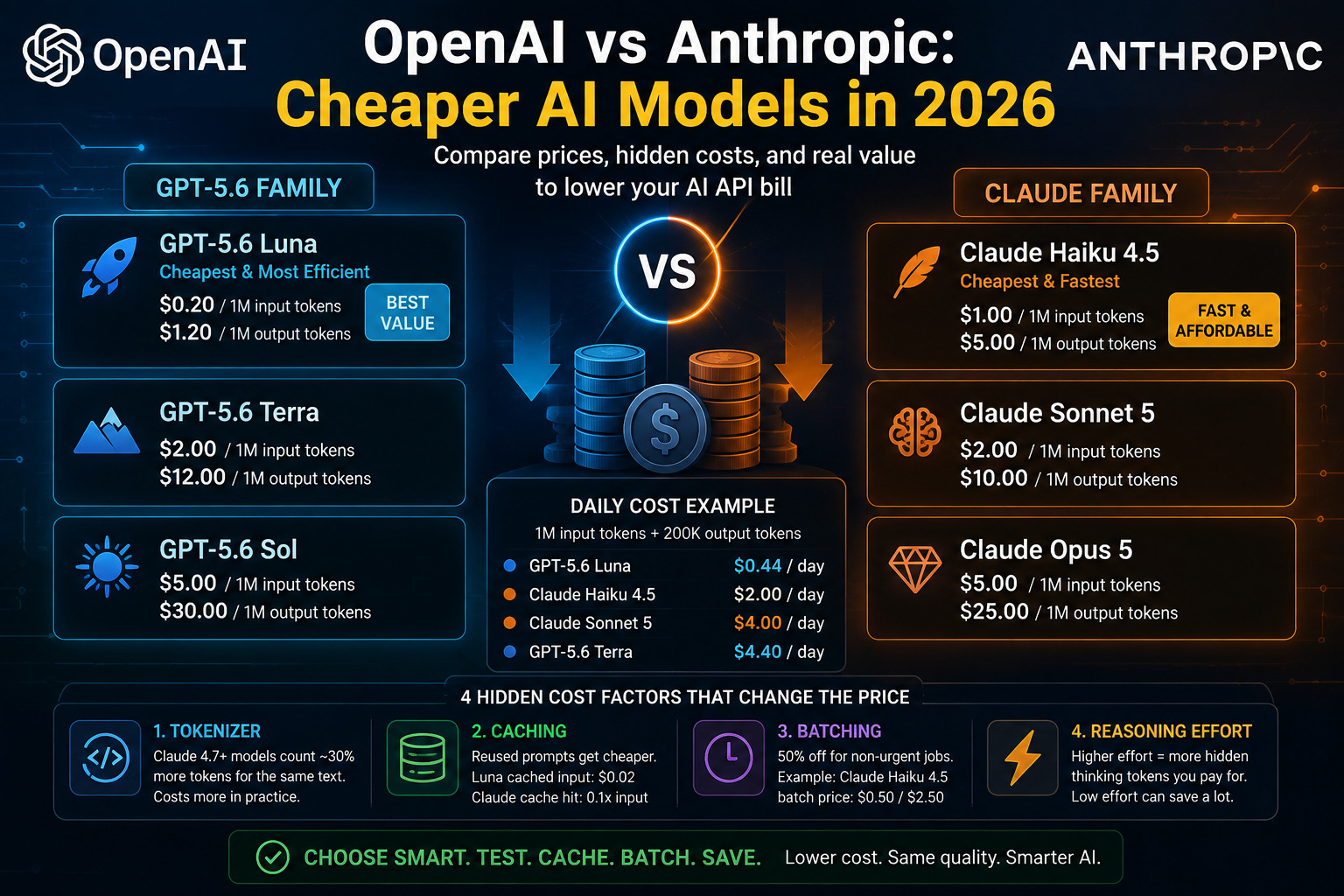
OpenAI and Anthropic Cheaper AI Models: Real 2026 Costs
The cheapest model from either lab right now is GPT-5.6 Luna at $0.20 per million input tokens and $1.20 per million output tokens. Anthropic’s cheapest is Claude Haiku 4.5 at $1 input / $5 output — five times Luna’s input rate. This guide is for developers, marketers and small business owners who pay per token and want the bill to drop without the output getting worse. If you only use ChatGPT or Claude through a monthly chat subscription, skip to the cancel section — the rest is API pricing. Every number below comes from OpenAI’s or Anthropic’s own pages. When comparing OpenAI and Anthropic cheaper AI models, the sticker price is only half the story.
Key takeaways
- GPT-5.6 Luna is the cheapest: $0.20 input / $1.20 output per million tokens, with cached input at $0.02.
- Claude Haiku 4.5 is Anthropic’s cheapest: $1 input / $5 output — about 4.5x the cost of Luna on a typical mixed workload.
- OpenAI cut Luna’s price 80% and Terra’s 20% on July 30, 2026. Most ranking guides still quote the old rates.
- Anthropic cancelled a price rise. Claude Sonnet 5’s $2/$10 rate is now permanent; the $3/$15 standard rate planned for September 1 no longer applies.
- Claude models from 4.7 up count roughly 30% more tokens for the same text, per Anthropic’s docs. That makes Sonnet 5 pricier in practice than $2/$10 suggests.
What OpenAI and Anthropic cheaper AI models actually are
Both labs sell three sizes of the same brain. The big one thinks hardest and costs most. The small one answers fast and costs least. “Cheaper AI models” means the small and mid tiers, priced per million tokens. A token is roughly three-quarters of a word.
OpenAI launched the GPT-5.6 family on July 9, 2026 in three sizes: Sol, Terra and Luna. Anthropic runs Opus, Sonnet and Haiku.
| Model | Input /1M | Output /1M | Cached input | Context |
|---|---|---|---|---|
| GPT-5.6 Luna | $0.20 | $1.20 | $0.02 | 1,050,000 |
| GPT-5.6 Terra | $2.00 | $12.00 | $0.20 | Not published |
| GPT-5.6 Sol | $5.00 | $30.00 | $0.50 | Not published |
| Claude Haiku 4.5 | $1.00 | $5.00 | $0.10 (read) | 200,000 |
| Claude Sonnet 5 | $2.00 | $10.00 | $0.20 (read) | 1,000,000 |
| Claude Opus 5 | $5.00 | $25.00 | $0.50 (read) | 1,000,000 |
Sources: OpenAI API pricing and Anthropic’s pricing docs.
Pricing for OpenAI and Anthropic cheaper AI models, plus hidden costs
Take a realistic small-business job: 1 million input tokens and 200,000 output tokens a day. That is a busy support bot or a content pipeline.
| Model | Cost per day | Cost per month (30 days) |
|---|---|---|
| GPT-5.6 Luna | $0.44 | $13.20 |
| Claude Haiku 4.5 | $2.00 | $60.00 |
| Claude Sonnet 5 | $4.00 | $120.00 |
| GPT-5.6 Terra | $4.40 | $132.00 |
Four hidden factors change those numbers:
1. The tokenizer. Anthropic’s docs state that Claude 4.7 and newer use a different tokenizer that produces about 30% more tokens for the same text. Sonnet 5 and Opus 5 are affected. Haiku 4.5 is not. So Sonnet 5’s $2 input rate behaves closer to $2.60 on identical text. This is the single biggest thing rival articles get wrong.
2. Caching. Repeated system prompts get cheap on both sides. Luna cached input is $0.02. Anthropic charges 0.1x base input on a cache hit, so $0.10 for Haiku — but writing to a 1-hour cache costs 2x base input first.
3. Batching. Both labs give 50% off input and output for non-urgent jobs. Batch Haiku 4.5 lands at $0.50/$2.50.
4. Reasoning effort. Luna supports effort levels from none up to max. High effort burns hidden thinking tokens you still pay for. AI Era has seen the same prompt cost triple between low and high effort.
A fifth factor is not a price at all: rate limits. Both labs put new accounts on a low usage tier and raise your ceiling as you spend. A cheap model you cannot call fast enough is not cheap — it is a queue. Budget for a week of warm-up before you move production traffic to either provider.
Features that matter, in three clusters
Context and memory. Luna reads 1,050,000 tokens in one go and writes up to 128,000. Haiku 4.5 caps at 200,000 in and 64,000 out. If you feed whole documents, Haiku forces you to chunk. Sonnet 5 and Opus 5 both offer a 1M window at standard pricing.
Tools and agents. Luna supports web search, file search, code interpreter, computer use, image generation and MCP. Fine-tuning is not supported. Haiku 4.5 is Anthropic’s speed pick for sub-agents and routing.
Freshness. Luna’s knowledge cutoff is February 16, 2026. Haiku 4.5’s is February 2025 — a full year older, and it shows on recent facts.
Comparison versus the alternatives
| Model | Input /1M | Output /1M | Short verdict |
|---|---|---|---|
| GPT-5.6 Luna | $0.20 | $1.20 | Cheapest with a real 1M window |
| Claude Haiku 4.5 | $1.00 | $5.00 | Steadier tone, older knowledge |
| Gemini 2.5 Flash-Lite | $0.10 | $0.40 | Cheapest overall, weaker reasoning |
| Gemini 3.5 Flash-Lite | $0.30 | $2.50 | Newer, no longer the budget option |
Google’s Gemini API pricing undercuts both labs at the very bottom. Gemini 2.5 Flash-Lite costs $0.18 a day on the same workload — about $5.40 a month. Note Google’s other change: Gemini 3.7 Flash is $0.75/$3.75 only through December 31, 2026, then doubles.
Who should buy, who should skip
Buy GPT-5.6 Luna if you:
- Run high volume: classification, tagging, summaries, first-draft outreach emails
- Need a very large context window on a small budget
- Want the newest knowledge cutoff of any cheap model
- Already use OpenAI tools and MCP
Skip the cheap tier and pay for Terra, Sonnet 5 or Opus 5 if you:
- Ship code that runs unsupervised
- Need long agent runs where one bad step wastes an hour
- Handle legal, medical or financial wording where tone errors cost money
- Have fewer than 100,000 tokens a day, where the saving is pennies
At that low volume the whole debate about OpenAI and Anthropic cheaper AI models is noise. You are choosing between $2 and $9 a month. Pick on output quality and move on.
Luna vs Haiku 4.5: which job are you hiring it for?
Forget feature counts. Ask what job the model does.
Job: process a lot of text for very little money. Luna wins outright. At $0.44 a day versus Haiku’s $2.00, you get 4.5x more work for the same spend, plus five times the context.
Job: sound like a careful human in customer-facing writing. Haiku 4.5 holds tone better across long threads in our testing at AI Era, and refuses less awkwardly. Its older training data is the trade-off.
Job: cut the bill without changing vendor. If you already run Claude, moving from Sonnet 5 to Haiku 4.5 halves input cost and avoids the newer tokenizer entirely. That is a bigger saving than the headline rates suggest.
Job: keep a second vendor ready. Running both is cheap insurance. Neither lab guarantees a price, and both have moved rates this summer. Keep your prompts in a model-neutral wrapper so switching is a config change, not a rewrite.
Honest negative: Luna’s 80% price cut is three weeks old at the time of writing. OpenAI has changed prices twice in a month. Do not build a business model that only works at $0.20.
Recent changes to OpenAI and Anthropic cheaper AI models
- July 9, 2026 — OpenAI launched GPT-5.6. Original prices: Sol $5/$30, Terra $2.50/$15, Luna $1/$6.
- July 30, 2026 — OpenAI cut Luna by 80% and Terra by 20%, citing efficiency gains passed to customers. Luna went to $0.20/$1.20, Terra to $2/$12.
- June 30, 2026 — Anthropic launched Claude Sonnet 5 at $2/$10, down from Sonnet 4.6’s $3/$15.
- Expired, still searched: Anthropic had said Sonnet 5’s $2/$10 was introductory and $3/$15 would start on September 1, 2026. That no longer applies. The $2/$10 rate is permanent. If a guide warns you about a September price rise, it is out of date.
- No Claude Haiku 5 exists. Anthropic’s model list shows Haiku 4.5 as the current small model, released October 1, 2025.
How to cancel or downgrade
API access has no subscription to cancel. You pay for what you use, so “downgrading” means three things:
- Switch the model string. Change
claude-opus-5toclaude-haiku-4-5-20251001, or your GPT-5.6 Sol call to Luna. One line. - Set a hard budget cap. OpenAI’s platform billing settings let you set monthly limits and email alerts. Anthropic’s Console has spend limits per workspace. Set these before you test anything.
- Turn on batch mode for anything that can wait 24 hours. Instant 50% off.
For chat subscriptions: Claude Pro is $17/month billed annually or $20/month billed monthly, and you cancel in Settings → Billing, keeping access until the period ends. ChatGPT’s plan prices are not shown as static text on OpenAI’s public pricing page — they render per region and account. Check chatgpt.com/pricing for your own figure rather than trusting a number in any article, including this one.
FAQ
Which is cheaper, OpenAI or Anthropic?
OpenAI. GPT-5.6 Luna costs $0.20 per million input tokens against Claude Haiku 4.5’s $1. On a mixed workload of 1M input and 200k output tokens, Luna runs about $13 a month versus $60 for Haiku.
What is the cheapest OpenAI model in 2026?
GPT-5.6 Luna, at $0.20 input and $1.20 output per million tokens after the July 30, 2026 cut. Cached input drops to $0.02. It handles a 1,050,000-token context and 128,000 output tokens.
Is Claude Haiku 4.5 still worth using?
Yes, for tone-sensitive customer writing and fast sub-agent routing. It costs five times Luna’s input rate and its knowledge stops at February 2025, so it is a quality choice, not a budget one.
Did Anthropic raise prices in September 2026?
No. Anthropic cancelled that plan. Sonnet 5’s introductory $2/$10 rate became permanent, and the $3/$15 standard rate scheduled for September 1 no longer applies. Older guides still repeat the warning.
Do cheaper AI models give worse answers?
Usually a little, on hard reasoning. For classification, summaries, extraction and drafting, the gap is small. Test both on 50 of your own real prompts before choosing — that beats any benchmark chart.
Verdict
For most creators and small teams, GPT-5.6 Luna is the right cheap model in August 2026: lowest price, biggest context, newest knowledge. Claude Haiku 4.5 earns its higher rate only when tone matters more than volume. Next step: run 50 of your real prompts through both, log the token counts, and compare actual invoices after a week. Prices move fast — recheck the vendor pages monthly.
Related reading on AI Era: best AI tools in 2026 and what’s worth paying for, Google AI Pro price, features and limits, Qwen AI costs and who should use it, 1min AI credits explained, managing Claude AI chats, Moonshot AI and Kimi K3, and will the AI bubble burst in 2026.
About AI Era
AI Era reviews AI tools for creators, marketers and small businesses. We price every tool from the vendor’s own published page, never a third-party tracker, and we re-check figures on the day we publish. When a number is not published officially, we say so instead of estimating. We run real prompts through the tools we cover and report what fails as well as what works. AI Era takes no payment for review placement.