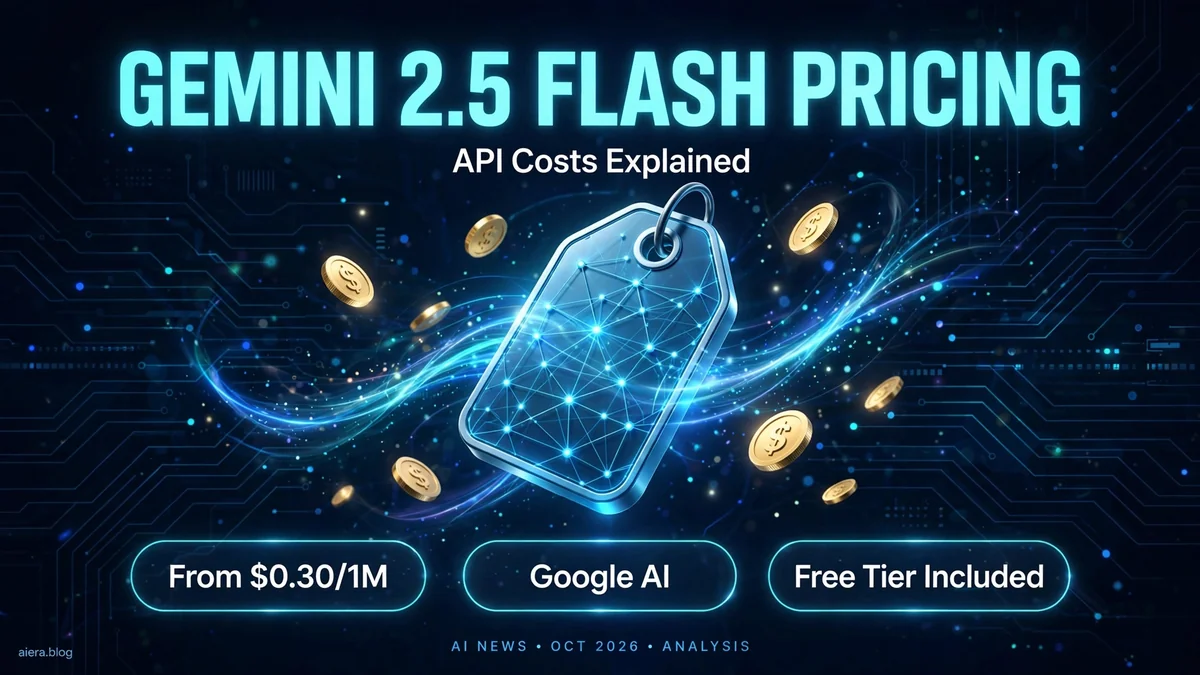
Gemini 2.5 Flash Pricing: API Costs Explained
Key Takeaways
- Gemini 2.5 Flash pricing starts at $0.30 per million input tokens and $2.50 per million output tokens on the standard tier, making it roughly four times cheaper than Gemini 2.5 Pro for typical workloads.
- The model is Google's first hybrid reasoning model with a 1-million-token context window, and its batch API cuts costs by roughly half ($0.15 input / $1.25 output).
- A free tier covers input and output at no charge, though context caching and batch processing are not available on it, and free-tier data may be used to improve Google's products.
- Gemini 2.5 Flash-Lite ($0.10 input / $0.40 output) undercuts Flash further for high-volume, low-complexity tasks.
- Note that prices change: always confirm current figures on Google's official pricing page before budgeting a project.
Introduction
Choosing a language model API used to be a decision about capability. In 2026, it is increasingly a decision about cost. Every prompt you send and every token the model generates shows up on an invoice, and the gap between flagship and mid-tier models can mean the difference between a profitable product and an expensive experiment. That is why gemini 2.5 flash pricing matters: Google's workhorse model sits in the sweet spot between price and performance, and its cost structure — standard, batch, cached, and free tiers — rewards developers who understand exactly what they are paying for.
This guide breaks down the verified per-token prices for Gemini 2.5 Flash, explains how input, output, thinking tokens, and context caching are billed, compares Flash against its siblings, and flags the one rumor you should not trust. All figures below were read directly from Google's official pricing page on 16 October 2026, are denominated in US dollars per one million tokens on the Standard tier, and — because prices do change — should be re-checked on Google's pricing page before you commit a budget.
Gemini 2.5 Flash pricing at a glance
Google describes Gemini 2.5 Flash as "our first hybrid reasoning model which supports a 1M token context window and has thinking budgets" — a model designed to balance reasoning quality with speed and cost. Here are the verified Standard-tier prices per million tokens:
- Input (text, image, video): $0.30
- Input (audio): $1.00
- Output (including thinking tokens): $2.50
- Context caching (text, image, video): $0.03
- Context caching (audio): $0.10
- Cache storage: $1.00 per 1M tokens per hour
- Batch API input: $0.15
- Batch API output: $1.25
The headline numbers are the first three: thirty cents to send a million tokens in, two dollars and fifty cents for a million tokens out. Everything else is a discount mechanism layered on top. Note the audio surcharge — audio input costs more than three times the text rate — which matters if you are building voice or transcription features. And note that output includes thinking tokens: when the model's internal reasoning is enabled, those hidden tokens are billed at the output rate, a detail that surprises many first-time users.
For developers still weighing which model family fits their stack, Google's broader Gemini lineup is covered in our Gemini AI overview, and our deep dive on what Gemini is, its features and uses explains where Flash sits in the product hierarchy.
Input vs output: what you are actually paying for
API pricing follows a simple asymmetry: output costs more than input, always. For 2.5 Flash, output is roughly eight times the input price ($2.50 vs $0.30). This matters because it changes how you should think about prompt design and response length.
Consider two applications. A classification task sends a long document in and gets back a single label — heavy on input, light on output. At 2.5 Flash rates, a million classification documents cost mostly the input side. A creative writing tool, by contrast, sends a short prompt and generates thousands of tokens of prose — light on input, heavy on output. The same model, but the economics are entirely different: the writing tool pays the $2.50 rate on nearly every token that matters.
The practical takeaway: when you estimate costs, do not just count your prompts. Count your expected outputs. Developers who model only input volume routinely underestimate their bills by a factor of several multiples. The batch API (below) reduces both sides by about half, which is why it is the single most effective cost lever available on this model.
Context caching and batch: the two big discounts
Google offers two ways to cut your bill dramatically, and understanding both is essential to getting the most out of 2.5 Flash.
Context caching is designed for workloads where you send the same large context repeatedly — the classic example is a system prompt plus a long document that every user query references. Instead of paying the full input price each time, you cache the repeated portion and pay a fraction: $0.03 per million cached tokens for text, image, and video (a 90% discount on the standard $0.30 input rate), or $0.10 for audio. The catch is storage: cached content costs $1.00 per million tokens per hour to keep warm. For chatbots, RAG pipelines, and agentic workflows with stable context, caching is often the difference between viable and unaffordable.
The Batch API is the other lever. If your workload is not time-sensitive — think overnight document processing, dataset labeling, or evaluation runs — the batch endpoint charges $0.15 per million input tokens and $1.25 per million output tokens, roughly half the standard rates. The trade-off is latency: batch jobs are processed asynchronously with slower turnaround. For anything that can wait, there is no reason to pay full price.
Both discounts reflect a broader trend in the API market. As covered in our analysis of OpenAI and Anthropic's cheaper 2026 models, every major lab is now competing on inference economics as aggressively as on benchmarks. Price is a feature now.
Flash vs Pro vs Flash-Lite
Gemini 2.5 Flash does not exist in isolation. Here is how it compares to its two closest siblings, all on the Standard tier:
- Gemini 2.5 Pro — "a Pro model which excels at coding and complex reasoning tasks." Input: $1.25 per million tokens for prompts up to 200K tokens, rising to $2.50 for prompts above 200K. Output: $10.00 (up to 200K) or $15.00 (above 200K). Compared with Flash, Pro costs roughly 4x more on input and 4x more on output at standard prompt sizes — a premium you pay for top-tier reasoning and coding performance.
- Gemini 2.5 Flash-Lite — the budget option. Input: $0.10 per million tokens (text/image/video) or $0.30 (audio). Output: $0.40. Flash-Lite is three times cheaper than Flash on input and more than six times cheaper on output.
- Gemini 2.5 Flash — the middle ground: $0.30 in, $2.50 out.
The decision framework is straightforward. Use Flash-Lite for high-volume, low-complexity tasks: classification, extraction, simple transformations, anything where the model's reasoning depth barely matters. Use Flash for the broad middle: conversational agents, summarization, RAG, and general-purpose workloads where you need solid reasoning without the Pro premium. Use Pro where output quality is the product — complex coding, hard reasoning, and tasks where a worse answer costs more than the price difference.
There is also a newer generation to factor in. Google now lists Gemini 3.8 Flash at $0.75 input / $3.75 output on an introductory rate through 31 December 2026 — two and a half times the price of 2.5 Flash on input. That makes 2.5 Flash the value play: older, proven, and substantially cheaper, with the newer model commanding a premium for whatever capability gains it brings.
The free tier: what is included
Every pricing discussion should start with the free option, and 2.5 Flash has a genuine one: input and output are free of charge on the free tier, for both Standard and Priority access. That makes it an excellent choice for prototyping, side projects, learning, and low-volume experimentation — you can build a real application without a credit card, a point echoed by recent coverage of Google AI Studio's free API key generation.
Two limitations matter. First, context caching and the Batch API are not available on the free tier — the discount mechanisms described above require a paid plan. Second, data from free-tier usage may be used by Google to improve its products, which rules it out for sensitive or proprietary workloads. Independent pricing roundups, such as the 2026 Gemini API pricing guide from devtk.ai, note the same trade-offs.
And a word of caution: Google does not publish fixed free-tier rate limits on the pricing page itself, pointing instead to the AI Studio dashboard as the source of truth for quotas. Do not trust third-party figures for requests-per-minute or requests-per-day limits; check your own dashboard.
The retirement rumor (unverified)
One rumor deserves explicit treatment because it is circulating in third-party guides: some claim that the entire 2.5 generation of Gemini models is scheduled for retirement on 16 October 2026. This is, as of today, unverified. Google's official pricing page — opened and read on 16 October 2026 — still lists Gemini 2.5 Flash with full Standard-tier pricing and shows no retirement notice, deprecation banner, or end-of-life date. The pricing page is the authoritative source, and it contradicts the rumor.
That said, the rumor exists for a reason: Google does retire older models, and the presence of a 3.8 generation makes eventual 2.5 deprecation plausible. If you are building on 2.5 Flash, the sensible posture is to monitor Google's official channels and keep your model references configurable, so a migration to 3.8 Flash — or to Flash-Lite for cost-sensitive paths — is a configuration change rather than a rewrite. Do not, however, make business decisions based on a retirement date that Google has not announced.
Which tier fits your project
Here is a practical summary for developers choosing today:
- Prototyping or hobby project: Start on the free tier. Input and output cost nothing, and you will learn the model's behavior before spending a dollar. Graduate to paid when you need caching, batch, or data privacy.
- Production chatbot or RAG app: Standard tier with context caching enabled. Cache your system prompts and reference documents, and watch the input side of your bill collapse by 90%.
- Bulk processing or evaluation: Batch API. Roughly half price in exchange for latency you can plan around.
- High-volume simple tasks: Consider Flash-Lite at $0.10/$0.40 before committing to Flash.
- Maximum quality: Pro, at 4x the price — worth it when a wrong answer is expensive.
The broader lesson is that model selection in 2026 is cost engineering as much as capability evaluation. Gemini 2.5 Flash earns its place as the default choice precisely because it is good enough for most workloads at a price — $0.30 in, $2.50 out — that keeps unit economics sane. Verify the numbers on Google's official pricing page before you budget, keep an eye on the unverified retirement chatter without acting on it, and let the workload, not the hype, pick your tier.