Garfield AI Legal Case: Inside the World’s First Regulated AI Law Firm
The Garfield AI Legal Case represents a defining moment in the history of the legal profession. In May 2025, the Solicitors Regulation Authority (SRA) authorised Garfield.Law Ltd as the first purely AI-based firm permitted to deliver regulated legal services in England and Wales. One year later, in May 2026, the firm won its first contested trial in an English county court. Together, these events transformed artificial intelligence in law from theory into documented, regulated reality.
Key Takeaways
The Garfield AI Legal Case is the clearest proof yet that responsible, well-governed AI can deliver regulated legal services without diluting consumer protection — and it sets a global precedent for how regulators will treat AI lawyers.
- A regulatory first: Garfield.Law Ltd became the first purely AI-based law firm authorised by the SRA in England and Wales, approved on 6 May 2025.
- Proven in court: In May 2026, Garfield AI won its first contested trial at Wandsworth County Court, recovering roughly £7,000 for about £400 in fees.
- Real traction: The platform has handled 600-plus claims and recovered or resolved more than £500,000 for users, with claim values from £30 to £10,000.
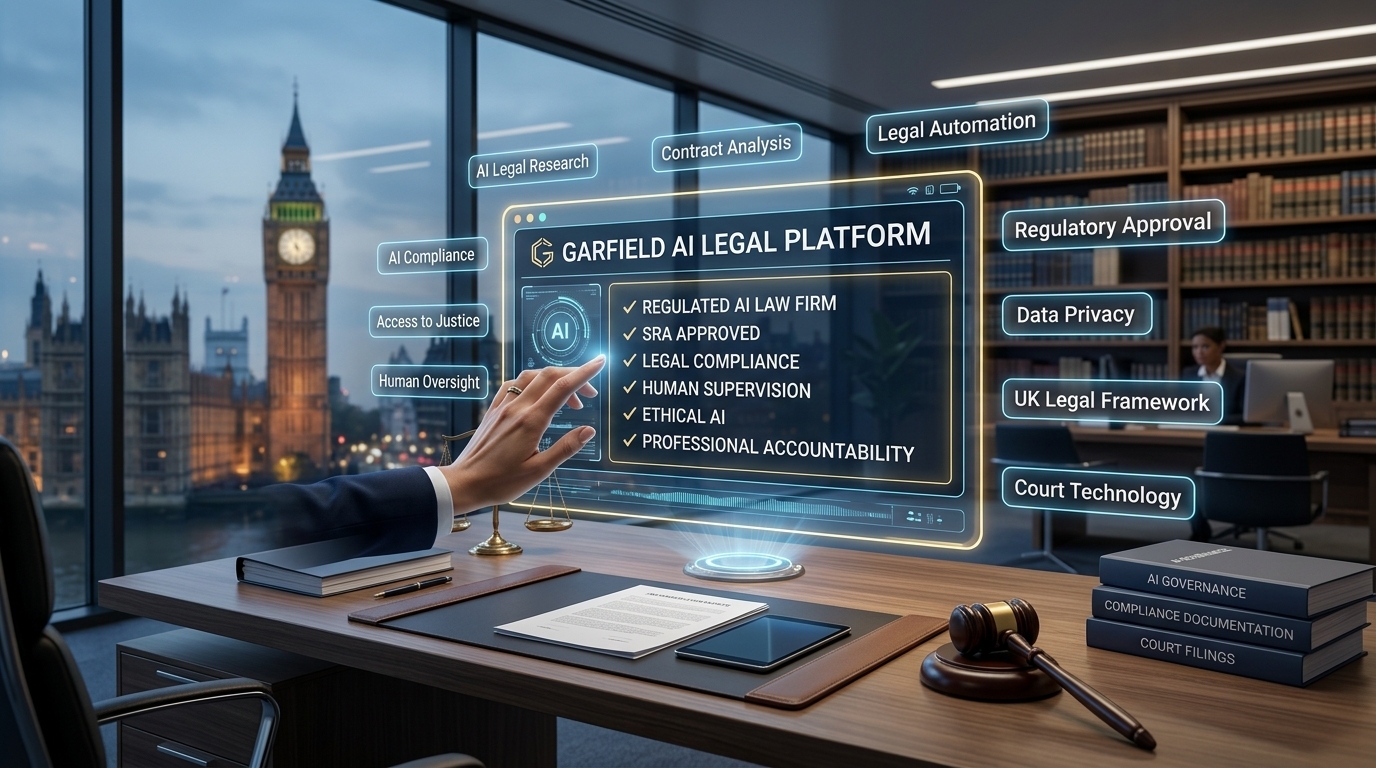
- Safety by design: A hybrid architecture, a ban on the AI proposing case law, mandatory client approval at each step, human supervision, and insurance underpin its regulatory compliance.
- Human accountability remains: Named solicitors stay fully responsible for the firm’s outputs — AI does not remove professional responsibility.
- A precedent, not an endpoint: The SRA expects more AI-driven firms to follow, making this case a foundation for future AI regulation in the legal sector.
Introduction
For decades, the legal profession resisted automation more stubbornly than almost any other knowledge industry. Legal work was considered too nuanced, too high-stakes, and too dependent on human judgment to hand over to software. The Garfield AI Legal Case challenged that assumption head-on — and won.
This is not a story about a chatbot answering casual legal questions. It is the story of an AI lawyer platform that a serious regulator examined, stress-tested, and formally approved to operate as a law firm. For an industry built on precedent, that approval was itself a landmark precedent.
The implications stretch far beyond one company. The case touches AI regulation, legal ethics, access to justice, and the structure of the UK legal industry itself. It also offers a working template for how regulators worldwide might handle AI legal services in the years ahead.
In this in-depth analysis, we examine what Garfield AI is, how the case unfolded, the ethical and regulatory questions it raises, and what it signals about the future of legal services. Coverage of developments where AI, regulation, and law intersect is exactly the kind of emerging trend that publications such as AIAERA.blog follow closely for readers tracking legal technology innovation.
Table of Contents
- What Is Garfield AI?
- Background of the Garfield AI Legal Case
- Timeline of Key Events
- Why the Case Matters
- Legal and Ethical Challenges
- Impact on Law Firms
- Impact on Consumers
- AI Regulation and Compliance Implications
- Expert Analysis and Industry Reactions
- Future of AI Lawyers
- Frequently Asked Questions
- Conclusion
- Sources and References
What Is Garfield AI?
Garfield AI, operating as Garfield.Law Ltd, is a British legal AI startup that built and runs an AI-powered litigation assistant. It holds the distinction of being the world’s first regulator-authorised AI law firm. Rather than acting as a back-office tool for human lawyers, Garfield delivers regulated legal services directly to clients under the supervision of named solicitors.
Company Overview and Founders
Garfield was co-founded by Philip Young, a former City litigator who spent years at the international firm Baker McKenzie, and Daniel Long, a quantum physicist who left a PhD to build the product. That combination — deep litigation experience paired with advanced technical expertise — proved decisive in earning regulatory trust.
The concept reportedly grew from a familiar frustration. Young watched his brother-in-law, a plumber, struggle to chase small unpaid invoices that were too small to justify hiring a traditional solicitor. That gap — claims that matter enormously to small businesses yet make no economic sense for conventional law firms — became Garfield’s target market.
Purpose and Technology
Garfield focuses on one specific, high-volume problem: debt recovery through the small claims process. The platform guides a user through every stage of recovering an unpaid debt, from a first polite reminder all the way to a county court trial. It handles claims ranging from roughly £30 up to £10,000, the standard small claims threshold in England and Wales.
Crucially, Garfield is engineered as a hybrid system rather than a pure large language model. The founders recognised early that generative AI can “hallucinate” — confidently inventing facts or, more dangerously, fabricating case citations. To control that risk, they built guardrails directly into the workflow. The system is deliberately not permitted to propose relevant case law, because that is precisely the area where machine learning models are most prone to error. This design choice was central to winning SRA approval.
Garfield is not autonomous. It will only take a step where the client has approved it, with human supervision and monitoring sitting behind every action — a structure the SRA examined closely before granting authorisation.
Target Users and Pricing
Garfield’s core users include small and medium-sized businesses chasing unpaid invoices, freelancers and sole traders without the time or budget to pursue debtors, and even law firms seeking an affordable route to handle high-volume, low-value claims.
The pricing illustrates the disruption clearly:
- Around £2 for a polite chaser letter.
- About £7.50 for a formal letter before action.
- From roughly £50 for court claim preparation.
Compared with traditional hourly solicitor fees, these figures redefine what affordable AI powered legal services can look like.
Background of the Garfield AI Legal Case
The phrase “Garfield AI Legal Case” refers to two intertwined developments. The first is the landmark regulatory decision to authorise an AI-driven law firm. The second is the firm’s first courtroom victory. Together they form the most concrete real-world test of artificial intelligence in law to date.
For years, regulators worldwide debated how — or whether — AI could be allowed to deliver legal services directly to the public. Most legal AI tools operated cautiously as assistants to human lawyers, deliberately avoiding the line of actually “practising law.” Garfield crossed that line openly and asked the regulator to authorise it as a firm.
Before granting authorisation, the SRA engaged directly with the founders to satisfy itself that the firm could meet existing professional rules. The regulator specifically sought assurance that Garfield had appropriate processes to quality-check the AI’s work, keep client information confidential, safeguard against conflicts of interest, and manage the risk of AI hallucinations. Only after those assurances were satisfied did the authorisation proceed.
The First Court Victory
The courtroom result captured global headlines because of its lopsided economics. Garfield helped its client recover roughly £7,000 in unpaid fees for a total cost of about £400 in platform fees. The opposing party, by contrast, instructed both a solicitor and a barrister — the traditional, far more expensive route. The AI-assisted claimant won.
That single outcome crystallised the entire value proposition. An ordinary person, supported by an AI legal assistant, successfully navigated the court system against represented opponents at a fraction of the cost.
Timeline of Key Events
The Garfield AI Legal Case unfolded across several clearly defined milestones:
| Date | Milestone | Significance |
|---|---|---|
| 2024 | Garfield.Law develops its AI litigation assistant and engages the SRA innovation team. | Early collaboration to demonstrate regulatory compliance. |
| 6 May 2025 | SRA formally authorises Garfield.Law Ltd. | First purely AI-based law firm regulated in England and Wales. |
| 2025–2026 | Platform scales: 600-plus claims, £500,000-plus recovered or resolved. | Proof of real-world demand and operational viability. |
| 14 May 2026 | First contested trial win at Wandsworth County Court. | £7,000 recovered for about £400 against a solicitor and barrister. |
Why the Case Matters
The Garfield AI Legal Case matters because it answers a question the entire legal profession had been avoiding: can AI deliver regulated legal services safely? The SRA’s answer was a conditional yes, and that decision carries weight far beyond a single firm.
It Sets a Global Regulatory Precedent
Rather than banning AI legal delivery or ignoring it, the SRA chose cautious authorisation with strict conditions. This “regulate, don’t prohibit” approach is now a reference point for regulators in other jurisdictions — including Canada, the Netherlands, and the United States — who are watching the UK closely. It represents a mature model of AI governance in professional services.
It Was Cited at the Highest Levels
The UK’s House of Lords Constitution Committee referenced Garfield AI in a report, contrasting the dangers of unregulated AI chatbots dispensing legal advice with the promise of “properly regulated, sophisticated AI tools” becoming an accessible source of legal help. That distinction — between regulated and unregulated AI — is becoming the central organising principle of legal AI policy.
It Validates an Entire Category
By proving that an AI law firm can satisfy a serious regulator, Garfield lowered the perceived risk for the next wave of founders, investors, and legal AI startup teams. It validated legal sector innovation as a credible, fundable space rather than a speculative experiment.
Legal and Ethical Challenges
The Garfield AI Legal Case is not a story of uncomplicated triumph. It surfaces genuine legal ethics and legal risk management questions that the profession must confront directly.
Accountability
Who is responsible when an AI law firm makes a mistake? Under the SRA’s framework, the answer is unambiguous: named regulated solicitors remain ultimately accountable for the firm’s professional standards. They are responsible for the system’s outputs and for anything that goes wrong. The technology does not dissolve human responsibility — it sits behind it. This accountability anchor is what makes regulatory legal compliance possible.
Professional Responsibility
Solicitors operate under strict duties of competence, honesty, and client care. An AI system must be engineered so that its outputs uphold those duties consistently. Garfield’s requirement for client approval at each step, combined with active human supervision, is designed to keep the firm within its professional obligations rather than outsourcing judgment entirely to software.
Data Privacy
Legal work involves highly sensitive documents and personal information. Any AI legal services provider must protect that data rigorously, complying with the UK GDPR and confidentiality obligations. The SRA specifically examined how Garfield keeps client information confidential before granting authorisation — a reminder that data privacy is non-negotiable in regulated legal AI.
Bias and Fairness
Machine learning systems can inherit and amplify biases present in their training data. In a legal context, biased outputs could affect how claims are framed or pursued. Responsible AI firms must test for and mitigate bias to ensure fair treatment across all users — a challenge the wider legal profession will need shared standards to address.
Accuracy and Hallucinations
The single greatest technical risk is the hallucination problem. Courts in several countries have already sanctioned lawyers who submitted AI-generated filings citing cases that never existed. Garfield’s deliberate decision to prevent its system from proposing case law, and to use a hybrid architecture rather than a pure LLM, directly targets this danger. In regulated legal AI, accuracy is not a feature — it is a precondition.
Impact on Law Firms
For traditional law firms, the message of the Garfield AI Legal Case is uncomfortable but clear. High-volume, low-value work such as debt recovery, standard letters, and routine small claims can now be automated at a price no conventional firm can match.
This creates pressure and opportunity at the same time:
- Pressure: Firms that built revenue on repetitive, commoditised work face direct competition from cheaper, faster legal automation.
- Opportunity: Forward-looking firms can adopt similar tools to serve clients they previously turned away as uneconomic, expanding their market rather than losing it.
- Repositioning: Human lawyers can shift toward complex, advisory, and high-judgment work where their expertise commands a premium.
The likely long-term result is not the disappearance of law firms, but a restructuring of what they charge for and how they deliver value, as court technology and automation reshape professional services.
Impact on Consumers
The clearest winner in the Garfield AI Legal Case is the consumer. The UK, like much of the world, faces a deep access to justice crisis. Legal help is often unaffordable for ordinary people and small businesses, leaving valid claims unpursued.
Garfield’s model directly attacks that gap by making legal action economically rational for claims worth a few hundred or a few thousand pounds. SRA Chief Executive Paul Philip framed this as the core public benefit, noting that responsible use of AI by law firms could improve legal services while making them easier to access and more affordable.
The consumer benefits are concrete:
- Lower cost: Fees measured in pounds rather than hundreds or thousands of pounds.
- Greater access: Claims that were previously uneconomic now become viable.
- Plain-language guidance: An AI legal assistant explains each step for litigants who would otherwise face the court system alone.
- Speed: Documents generated in minutes rather than days.
There are also consumer-protection questions — particularly whether users fully understand they are using an AI-driven firm — which is why regulatory oversight remains essential.
AI Regulation and Compliance Implications
The Garfield AI Legal Case is now a foundational reference for AI regulation in legal services. The SRA’s approach demonstrates a workable framework that other regulators are likely to emulate.
The SRA’s Conditions
Before authorising Garfield, the SRA imposed a clear set of compliance expectations:
- Robust processes to quality-check the AI’s work product.
- Strict confidentiality safeguards for client information.
- Conflict-of-interest protections.
- Active management of the AI hallucination risk, including a ban on the system proposing case law.
- Mandatory client approval before any step is taken.
- Enhanced oversight of claims during the initial launch phase.
- A minimum level of professional indemnity insurance to protect clients.
Why This Model Travels Well
This framework balances innovation with protection, which is exactly what global regulators are searching for. It treats AI as a tool operated under human accountability rather than an autonomous actor, keeping existing professional-responsibility rules intact. That makes it adaptable to other jurisdictions without rewriting the entire regulatory rulebook — a key reason the case is shaping international conversations about AI governance and legal compliance.
Expert Analysis and Industry Reactions
Supportive Viewpoints
Supporters, including the SRA itself, frame Garfield AI as a breakthrough for access to justice. Paul Philip called the authorisation a landmark moment for legal services, arguing that the sector cannot afford to “pull up the drawbridge” on innovations with significant public benefits. Many legal technologists agree that automating low-value work is overdue, and that the real ethical failure would be leaving ordinary people without affordable legal help. Analysts at AIAERA.blog have similarly highlighted Garfield as evidence that responsible AI and regulation can coexist rather than compete.
Critical Viewpoints
Critics urge caution. Some solicitors worry that even well-designed AI could mishandle nuanced situations, give users false confidence, or struggle with the unpredictable dynamics of a live courtroom. Others raise the deskilling concern: if routine work disappears, how will junior lawyers develop the experience needed for complex matters? There are also fair questions about consumer awareness and redress if something goes wrong.
Future Expectations
The consensus among observers is that Garfield is the first of many. The SRA itself confirmed it expects more AI-driven law firms to follow and will monitor the model closely.
The realistic outlook is a hybrid future: AI handling volume and routine work, with human lawyers concentrating on complex, high-stakes, and emotionally sensitive matters.
Future of AI Lawyers
The Garfield AI Legal Case offers a window into where the future of legal services is heading. Three themes stand out: opportunity, risk, and regulatory direction.
Opportunities
A genuine AI lawyer platform can extend legal help to millions of people and businesses currently priced out of the system. It can reduce costs, accelerate timelines, and let human professionals focus on work that truly requires human judgment. For a profession under constant pressure to do more with less, this is a powerful proposition.
Risks
The risks are equally real. Over-reliance on AI without adequate oversight could lead to errors, unfair outcomes, or erosion of professional standards. Poorly regulated imitators — lacking Garfield’s guardrails — could damage public trust. And there are open questions about liability, insurance, and what happens when an AI system fails at scale rather than in a single case.
Regulatory Outlook
The regulatory direction is becoming clearer. The UK’s model — authorise carefully, demand accountability, supervise closely, and require insurance — is emerging as a template. Expect regulators globally to develop dedicated frameworks for AI governance in legal services, with a strong emphasis on the line between regulated and unregulated AI advice. The Garfield AI Legal Case will likely be cited as the foundational precedent for years to come, a milestone in legal technology innovation.
Frequently Asked Questions
What is the Garfield AI Legal Case?
The Garfield AI Legal Case refers to the landmark authorisation of Garfield.Law Ltd by the Solicitors Regulation Authority in May 2025 — making it the first purely AI-based law firm regulated in England and Wales — together with its first courtroom victory in May 2026. These events represent the most concrete real-world test of AI delivering regulated legal services.
Is Garfield AI a real, regulated law firm?
Yes. Garfield.Law Ltd is formally authorised and regulated by the SRA, the body that regulates solicitors in England and Wales. It is not an unregulated chatbot; it operates under the same professional rules as traditional law firms, with named solicitors ultimately accountable for its work.
What does the Garfield AI lawyer platform actually do?
Garfield provides an AI-powered litigation assistant focused on debt recovery. It guides users through the small claims process — from sending a chaser letter to preparing court documents and proceeding to trial — for claims ranging from roughly £30 to £10,000.
How much does Garfield AI cost?
Pricing is dramatically lower than traditional legal fees. Reported costs include around £2 for a polite chaser letter, £7.50 for a letter before action, and court claim preparation from about £50. In its first trial win, the client paid roughly £400 to recover around £7,000.
Did Garfield AI really win a court case?
Yes. On 14 May 2026, Garfield AI helped a freelance consultant win around £7,000 in unpaid fees at Wandsworth County Court. The opposing party had instructed both a solicitor and a barrister, yet the AI-assisted claimant prevailed at a fraction of the cost.
How does Garfield AI prevent AI hallucinations?
Garfield uses a hybrid system rather than a pure large language model and builds in multiple guardrails. The system is not allowed to propose relevant case law on its own — the area where AI is most prone to fabricating authorities. The SRA verified these safeguards before authorising the firm.
Who is responsible if Garfield AI makes a mistake?
Under SRA rules, named regulated solicitors remain ultimately accountable for the firm’s professional standards and for anything that goes wrong. The firm must also carry a minimum level of professional indemnity insurance to protect clients, just like any other regulated law firm.
How does the Garfield AI Legal Case affect access to justice?
It directly attacks the access-to-justice gap by making legal action affordable for low-value claims that were previously uneconomic to pursue. This allows small businesses and individuals to recover money they are owed without paying prohibitive legal fees.
Will AI replace human lawyers?
Not entirely. The likely outcome is a hybrid model in which AI handles high-volume, routine work such as debt recovery and document drafting, while human lawyers focus on complex, strategic, and emotionally sensitive matters that require genuine human judgment, advocacy, and empathy.
Why is the Garfield AI Legal Case important for AI regulation?
It establishes a workable framework for regulating AI in professional services — authorise carefully, demand human accountability, supervise closely, and require insurance. This “regulate, don’t prohibit” model is now a reference point for regulators worldwide and a milestone in AI governance.
Where can I follow developments in legal AI and technology?
Specialist publications such as AIAERA.blog track artificial intelligence, legal technology, and emerging innovation trends, offering ongoing analysis of cases like Garfield AI and the broader transformation of the legal sector.
Conclusion
The Garfield AI Legal Case is far more than a single regulatory headline or a single court win. It is a clear signal that artificial intelligence in law has matured from experiment to regulated practice. By securing SRA authorisation and then proving itself in a real courtroom, Garfield AI demonstrated that responsible, well-governed AI legal services can expand access to justice without abandoning professional standards.
The road ahead will not be frictionless. Accuracy, accountability, data privacy, bias, and consumer protection all demand ongoing vigilance, and the legal profession will need to adapt thoughtfully rather than reactively. But the direction of travel is now set. The future of legal services will be a partnership between human expertise and machine efficiency — with AI handling volume and routine work, and skilled professionals concentrating on judgment, strategy, and advocacy.
For anyone following legal technology innovation, the Garfield AI Legal Case is the reference point that everything else will be measured against. As regulators, founders, and firms build on this precedent, ongoing analysis from sources like AIAERA.blog will remain essential for understanding where AI, law, and digital innovation head next. One thing is already certain: the era of the regulated AI lawyer has begun.
Sources and References
- SRA approves first AI-driven law firm — Solicitors Regulation Authority
- Garfield AI — Automated Debt Recovery & Legal Claims
- AI-powered law firm claims first county court victory — Law Gazette
- SRA approves ‘£2 letter’ AI law firm Garfield — Law Gazette
- UK’s SRA takes unprecedented approach in authorising AI-enabled law firms — International Bar Association
- House of Lords cites Garfield AI — Garfield AI Press